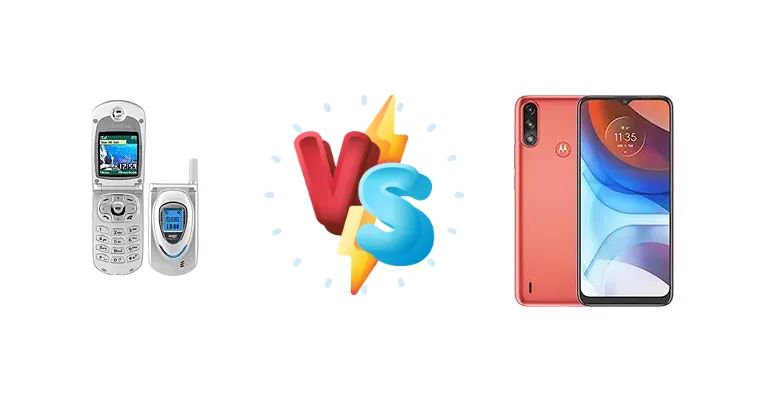
The ultra-budget smartphone segment is fiercely competitive. We pit the Innostream INNO 110 against the Motorola Moto E7i Power, two devices aimed at first-time smartphone buyers or those needing a reliable secondary device. The key difference lies in the E7i Power’s known chipset, while the INNO 110 remains largely a mystery in terms of detailed specifications, forcing us to analyze it based on market positioning.
🏆 Quick Verdict
For the average user, the Motorola Moto E7i Power is the better choice. Its Unisoc SC9863A chipset provides a demonstrable performance advantage over what we can reasonably expect from the INNO 110, even if the latter is cheaper. However, if the INNO 110 is significantly less expensive, it could be a viable option for extremely basic tasks.
| Network |
|---|
| 2G bands | GSM 900 / 1800 | GSM 850 / 900 / 1800 / 1900 |
| 3G bands | - | HSDPA 850 / 900 / 1700(AWS) / 1900 / 2100 |
| 4G bands | - | LTE |
| EDGE | No | - |
| GPRS | No | - |
| Speed | - | HSPA, LTE |
| Technology | GSM | GSM / HSPA / LTE |
| Launch |
|---|
| Announced | 2003, Q4 | 2021, February 23 |
| Status | Discontinued | Available. Released 2021, March 15 |
| Body |
|---|
| Build | - | Glass front, plastic back, plastic frame |
| Dimensions | 80 x 43 x 20 mm (3.15 x 1.69 x 0.79 in) | 165.1 x 75.9 x 9.2 mm (6.5 x 2.99 x 0.36 in) |
| SIM | Mini-SIM | Nano-SIM + Nano-SIM |
| Weight | 80 g (2.82 oz) | 200 g (7.05 oz) |
| | - | Water-repellent design |
| Display |
|---|
| Resolution | 128 x 144 pixels, 10 lines | 720 x 1600 pixels, 20:9 ratio (~270 ppi density) |
| Size | - | 6.51 inches, 102.3 cm2 (~81.7% screen-to-body ratio) |
| Type | LCD, 65K colors | IPS LCD, 380 nits (typ) |
| | Second external display (64 x 80 pixels)
Screensavers and wallpapers | - |
| Platform |
|---|
| CPU | - | Octa-core (4x1.6 GHz Cortex-A55 & 4x1.2 GHz Cortex-A55) |
| Chipset | - | Unisoc SC9863A (28 nm) |
| GPU | - | IMG8322 |
| OS | - | Android 10 (Go edition) |
| Memory |
|---|
| Call records | 10 dialed, 10 received, 10 missed calls | - |
| Card slot | No | microSDXC (uses shared SIM slot) |
| Internal | - | 32GB 2GB RAM |
| Phonebook | 500 entries, contact groups | - |
| | - | eMMC 5.1 |
| Main Camera |
|---|
| Dual | - | 13 MP, f/2.0, 26mm (wide), 1/3.1", 1.12µm, PDAF
2 MP (macro) |
| Features | - | LED flash, HDR, panorama |
| Video | - | 1080p@30fps |
| Selfie camera |
|---|
| Features | - | HDR |
| Single | - | 5 MP, f/2.2, 27mm (wide), 1.12µm |
| Video | - | 1080p@30fps |
| Sound |
|---|
| 3.5mm jack | No | Yes |
| 35mm jack | No | Yes |
| Alert types | Vibration; Polyphonic(40) ringtones, composer | - |
| Loudspeaker | Yes | Yes |
| Comms |
|---|
| Bluetooth | No | 4.2, A2DP |
| NFC | - | No |
| Positioning | No | GPS, GLONASS, GALILEO |
| Radio | FM radio | Unspecified |
| USB | - | USB Type-C 2.0 |
| WLAN | No | Wi-Fi 802.11 b/g/n |
| Features |
|---|
| Browser | WAP 1.2.1 | - |
| Games | Yes | - |
| Java | No | - |
| Messaging | SMS | - |
| Sensors | - | Fingerprint (rear-mounted), accelerometer, proximity |
| | Predictive text input (iTAP)
Bio-rhythm
Stopwatch
Calculator
Voice memo | - |
| Battery |
|---|
| Charging | - | 10W wired |
| Stand-by | Up to 100 h | - |
| Talk time | Up to 5 h | - |
| Type | Removable Li-Ion 740 mAh battery | Li-Ion 5000 mAh |
| Misc |
|---|
| Colors | - | Tahiti Blue, Coral Red |
| Models | - | XT2097-13 |
| Price | - | About 120 EUR |
Innostream INNO 110
- Potentially lower price point
- May offer a more compact design
- Simple and easy to use
- Unknown chipset performance
- Likely limited features
- Potentially poor software support
Motorola Moto E7i Power
- Unisoc SC9863A chipset offers better performance
- More reliable user experience
- Established brand with software support
- Slower 10W charging
- May be slightly more expensive
- Basic camera capabilities
Display Comparison
Without specific display details for the INNO 110, a direct comparison is difficult. The Moto E7i Power likely features a standard LCD panel, common in this price bracket. Both devices will likely have resolutions around 720p+, prioritizing battery life over sharpness. The absence of information regarding the INNO 110’s panel technology suggests it won’t offer features like high refresh rates or wide color gamuts found in more expensive phones. Bezels are expected to be substantial on both devices, maximizing screen real estate within a compact form factor.
Camera Comparison
Camera performance is likely to be similar on both devices – basic. The Moto E7i Power’s camera specifications are not readily available, but it’s safe to assume a single main sensor with limited capabilities. The INNO 110’s camera details are also missing. Both devices will likely struggle in low-light conditions and produce images with limited detail. Focusing on megapixel counts would be misleading; image processing and sensor size are far more important, and neither device is expected to excel in these areas.
Performance
The Motorola Moto E7i Power’s Unisoc SC9863A (28nm) chipset is the clear performance leader here. Its octa-core configuration, split between 1.6 GHz and 1.2 GHz Cortex-A55 cores, provides a noticeable boost over what is typically found in phones at this price point. The INNO 110’s chipset is unknown, but given its likely price point, it will almost certainly be less powerful. The 28nm process node of the Unisoc chip isn’t cutting-edge, but it’s a reasonable compromise for cost-effectiveness. Expect the E7i Power to handle basic apps and web browsing with fewer stutters than the INNO 110.
Battery Life
The Moto E7i Power features 10W wired charging. While slow by modern standards, it’s adequate for a device targeting this market segment. Battery capacity for the INNO 110 is unknown, but it’s likely to be in the 3000-4000 mAh range, similar to the E7i Power. The slower charging speed of the E7i Power is a trade-off for its more capable chipset, as more demanding tasks will consume battery faster. Real-world battery life will depend heavily on usage patterns, but both devices should be able to last a full day with moderate use.
Buying Guide
Buy the Innostream INNO 110 if you absolutely need the lowest possible price and only intend to make calls, send texts, and occasionally browse very simple websites. Buy the Motorola Moto E7i Power if you prioritize a smoother user experience, even for light multitasking, and want a device that can handle basic apps without significant lag. The E7i Power’s chipset offers a tangible benefit for everyday usability.
Frequently Asked Questions
❓ Is the Unisoc SC9863A chipset in the Moto E7i Power capable of running popular social media apps like Facebook and WhatsApp smoothly?
Yes, the Unisoc SC9863A is sufficient for running popular social media apps like Facebook and WhatsApp without significant lag. While it won't offer a high-end experience, it provides a usable experience for these core applications, unlike what we'd expect from the INNO 110 given its unknown chipset.
❓ How does the 10W charging on the Moto E7i Power compare to faster charging technologies found in more expensive smartphones?
10W charging is considerably slower than the 25W, 45W, or even 65W charging found in higher-end smartphones. Expect a full charge to take around 3-4 hours. However, for a device in this price range, 10W is acceptable, as users are less likely to be heavily reliant on fast charging capabilities.
❓ Given the lack of detailed specifications for the Innostream INNO 110, what should potential buyers prioritize when considering this device?
If considering the INNO 110, prioritize price above all else. It's likely a viable option *only* if it's significantly cheaper than the Moto E7i Power and your needs are extremely basic – calls, texts, and very light web browsing. Be prepared for a potentially sluggish user experience.