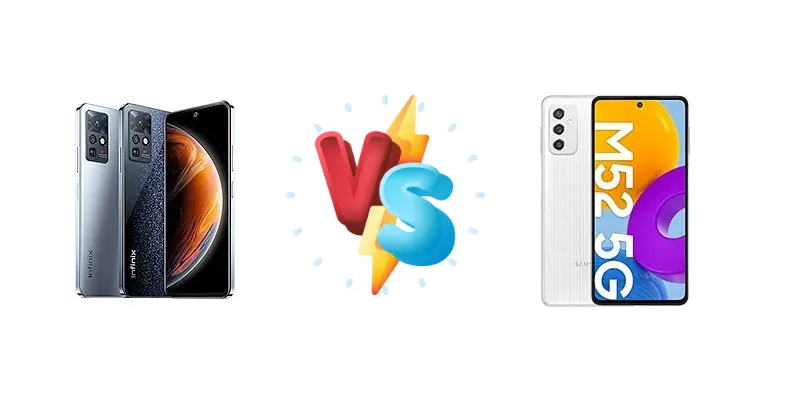
The Infinix Zero X and Samsung Galaxy M52 5G represent compelling options in the increasingly competitive mid-range 5G smartphone market. While both aim to deliver a balanced experience, they take distinctly different approaches to achieving it. The Zero X prioritizes charging speed and a potentially lower price point, while the M52 5G leverages Qualcomm’s Snapdragon 778G for a more refined performance profile and a brighter display.
🏆 Quick Verdict
For the average user prioritizing consistent performance and a superior viewing experience, the Samsung Galaxy M52 5G is the stronger choice. Its Snapdragon 778G chipset offers a noticeable advantage in processing power and efficiency, complemented by a significantly brighter 777-nit display. However, the Infinix Zero X’s 45W charging is a compelling feature for those who value rapid top-ups.
| Network |
|---|
| 2G bands | GSM 850 / 900 / 1800 / 1900 | GSM 850 / 900 / 1800 / 1900 |
| 3G bands | HSDPA 850 / 900 / 1700(AWS) / 1900 / 2100 | HSDPA 850 / 900 / 1700(AWS) / 1900 / 2100 |
| 4G bands | 1, 2, 3, 4, 5, 7, 8, 20, 28, 38, 40, 41 | 1, 2, 3, 4, 5, 7, 8, 12, 17, 20, 26, 28, 38, 40, 41, 66 |
| 5G bands | - | SA/NSA/Sub6 |
| Speed | HSPA, LTE | HSPA, LTE, 5G |
| Technology | GSM / HSPA / LTE | GSM / HSPA / LTE / 5G |
| Launch |
|---|
| Announced | 2021, September 13 | 2021, September 24 |
| Status | Available. Released 2021, September 17 | Available. Released 2021, October 03 |
| Body |
|---|
| Build | Glass front, glass back, plastic frame | Glass front (Gorilla Glass 5), plastic frame, plastic back |
| Dimensions | 164.1 x 75.7 x 7.8 mm (6.46 x 2.98 x 0.31 in) | 164.2 x 76.4 x 7.4 mm (6.46 x 3.01 x 0.29 in) |
| SIM | Nano-SIM + Nano-SIM | Nano-SIM + Nano-SIM |
| Weight | 193 g (6.81 oz) | 173 g (6.10 oz) |
| Display |
|---|
| Protection | - | Corning Gorilla Glass 5 |
| Resolution | 1080 x 2400 pixels, 20:9 ratio (~395 ppi density) | 1080 x 2400 pixels, 20:9 ratio (~393 ppi density) |
| Size | 6.67 inches, 107.4 cm2 (~86.5% screen-to-body ratio) | 6.7 inches, 108.4 cm2 (~86.4% screen-to-body ratio) |
| Type | AMOLED, 120Hz, 700 nits (peak) | Super AMOLED Plus, 120Hz |
| Platform |
|---|
| CPU | Octa-core (2x2.05 GHz Cortex-A76 & 6x2.0 GHz Cortex-A55) | Octa-core (1x2.4 GHz Cortex-A78 & 3x2.2 GHz Cortex-A78 & 4x1.9 GHz Cortex-A55) |
| Chipset | Mediatek MT6785V/CD Helio G95 (12 nm) | Qualcomm SM7325 Snapdragon 778G 5G (6 nm) |
| GPU | Mali-G76 MC4 | Adreno 642L |
| OS | Android 11, XOS 7.6 | Android 11, upgradable to Android 13, One UI 5.1 |
| Memory |
|---|
| Card slot | microSDXC (dedicated slot) | microSDXC (uses shared SIM slot) |
| Internal | 128GB 8GB RAM | 128GB 6GB RAM, 128GB 8GB RAM |
| | UFS 2.2 | - |
| Main Camera |
|---|
| Features | Quad-LED flash, HDR, panorama | LED flash, panorama, HDR |
| Single | 16 MP, (wide) | 32 MP, f/2.2, 26mm (wide) |
| Triple | 64 MP, f/1.9, (wide), PDAF, OIS
8 MP, f/3.4, 125mm (periscope telephoto), PDAF, 5x optical zoom, OIS
8 MP, f/2.3, 13mm, 120˚ (ultrawide), 1/4.0", 1.12µm, AF | 64 MP, f/1.8, 26mm (wide), 1/1.97", 0.7um, PDAF
12 MP, f/2.2, 123˚, (ultrawide), 1/3.06", 1.12µm
5 MP (macro) |
| Video | 4K@30fps, 1080p@30fps | 4K@30fps, 1080p@30/60fps |
| Selfie camera |
|---|
| Features | Dual-LED flash | - |
| Single | 16 MP, (wide) | 32 MP, f/2.2, 26mm (wide) |
| Video | 1080p@30fps | 4K@30fps, 1080p@30fps |
| Sound |
|---|
| 3.5mm jack | Yes | No |
| 35mm jack | Yes | No |
| Loudspeaker | Yes, with dual speakers | Yes |
| Comms |
|---|
| Bluetooth | Yes | 5.0, A2DP, LE |
| NFC | No | Yes |
| Positioning | GPS | GPS, GLONASS, GALILEO, BDS, QZSS |
| Radio | FM radio | Unspecified |
| USB | USB Type-C 2.0, OTG | USB Type-C 2.0, OTG |
| WLAN | Wi-Fi 802.11 a/b/g/n, dual-band, Wi-Fi Direct | Wi-Fi 802.11 a/b/g/n/ac/6, dual-band, Wi-Fi Direct |
| Features |
|---|
| Sensors | Fingerprint (under display, optical), accelerometer, gyro, proximity, compass | Fingerprint (side-mounted), accelerometer, gyro, proximity, compass |
| Battery |
|---|
| Charging | 45W wired, 40% in 15 min | 25W wired |
| Type | 4500 mAh | Li-Ion 5000 mAh |
| Misc |
|---|
| Colors | Nebula Black, Starry Silver | Icy Blue, Blazing Black, White |
| Models | - | SM-M526BR, SM-M526BR/DS, SM-M526B, SM-M526B/DS |
| Price | About 320 EUR | About 300 EUR |
| SAR EU | - | 0.79 W/kg (head) 1.40 W/kg (body) |
| Tests |
|---|
| Battery life | - |
Endurance rating 123h
|
| Camera | - |
Photo / Video |
| Display | - |
Contrast ratio: Infinite (nominal) |
| Loudspeaker | - |
-30.0 LUFS (Average)
|
| Performance | - |
AnTuTu: 504424 (v9)
GeekBench: 2796 (v5.1)
GFXBench: 28fps (ES 3.1 onscreen) |
Infinix Zero X
- Extremely fast 45W charging
- Potentially lower price point
- Decent battery endurance (123h)
- Less efficient Helio G95 chipset
- Display specifications are unknown, likely inferior to M52 5G
- Camera details are lacking
Samsung Galaxy M52 5G
- Powerful and efficient Snapdragon 778G 5G
- Bright 777-nit display for excellent visibility
- Strong brand reputation for camera performance
- Slower 25W charging
- May be more expensive than the Infinix Zero X
- Endurance rating is the same as the Zero X, despite chipset efficiency
Display Comparison
The Samsung Galaxy M52 5G boasts a clear advantage in display quality, achieving a measured peak brightness of 777 nits. This is crucial for outdoor visibility, a scenario where the Infinix Zero X’s display specifications are not provided, suggesting it will likely fall short. While the M52 5G’s contrast ratio is listed as ‘Infinite (nominal)’ – a common marketing term – the higher peak brightness alone makes it the superior choice for everyday use. The absence of refresh rate data for the Zero X also suggests the M52 5G may offer a smoother scrolling experience if it includes a higher refresh rate panel.
Camera Comparison
Both devices are listed as having Photo/Video capabilities, but detailed sensor information is lacking for the Infinix Zero X. The Samsung Galaxy M52 5G’s camera performance will likely depend on its main sensor and image processing algorithms. Without specific details on the Zero X’s camera hardware, it’s difficult to make a direct comparison. However, the M52 5G’s brand reputation suggests a more refined and consistent camera experience. The prevalence of low-resolution auxiliary cameras in this price segment suggests avoiding reliance on 2MP macro lenses on either device.
Performance
The core difference lies in the chipsets: the Infinix Zero X utilizes the Mediatek Helio G95 (12nm), while the Samsung Galaxy M52 5G is powered by the Qualcomm Snapdragon 778G 5G (6nm). The Snapdragon 778G’s 6nm process node is significantly more efficient than the Helio G95’s 12nm node, translating to better thermal management and sustained performance. Furthermore, the Snapdragon 778G’s CPU configuration – a 1x2.4 GHz Cortex-A78 prime core alongside 3x2.2 GHz Cortex-A78 cores – is architecturally superior to the Zero X’s 2x2.05 GHz Cortex-A76 and 6x2.0 GHz Cortex-A55 setup, promising faster application loading and smoother multitasking. The Snapdragon 778G also benefits from a more advanced GPU, making it the better choice for gaming.
Battery Life
Both phones share an endurance rating of 123 hours, indicating similar overall battery life despite differing charging speeds. However, the Infinix Zero X’s 45W wired charging significantly outperforms the Samsung Galaxy M52 5G’s 25W charging. The Zero X claims a 40% charge in just 15 minutes, a substantial advantage for users who need a quick power boost. While the M52 5G’s battery life is comparable, the Zero X offers a faster path to a full charge, potentially mitigating any concerns about battery drain.
Buying Guide
Buy the Infinix Zero X if you need exceptionally fast charging and are comfortable with potentially making some compromises in sustained performance. This phone is ideal for users who frequently find themselves needing to quickly replenish their battery. Buy the Samsung Galaxy M52 5G if you prefer a smoother, more responsive user experience, a brighter and more visible display, and a chipset known for its efficiency and gaming capabilities. This is the better option for media consumption and demanding applications.
Frequently Asked Questions
❓ Does the Snapdragon 778G in the Galaxy M52 5G get hot during extended gaming sessions?
The Snapdragon 778G is known for its efficiency. While it will generate heat during prolonged gaming, its 6nm process node and Qualcomm’s thermal management technologies help to mitigate throttling, providing a more consistent gaming experience compared to the 12nm Helio G95 in the Zero X.
❓ How much faster is the 45W charging on the Infinix Zero X compared to the 25W charging on the Samsung Galaxy M52 5G in real-world use?
The Infinix Zero X claims a 40% charge in 15 minutes with its 45W charging. While a precise comparison requires testing, this suggests a significantly faster initial charging rate than the M52 5G’s 25W, making it ideal for quick top-ups. However, the difference in total 0-100% charge time may be less dramatic.
❓ Is the camera on the Samsung Galaxy M52 5G good for low-light photography?
While specific low-light performance data isn't available, Samsung generally excels in image processing. The M52 5G likely utilizes software algorithms to improve low-light shots, but the aperture and sensor size will ultimately determine its capabilities. Expect decent results, but don't anticipate flagship-level performance.