
OnePlus Nord 2 5G vs. Infinix Zero X: Which Mid-Range Phone Reigns Supreme?
| Phones Images | |||||
|---|---|---|---|---|---|
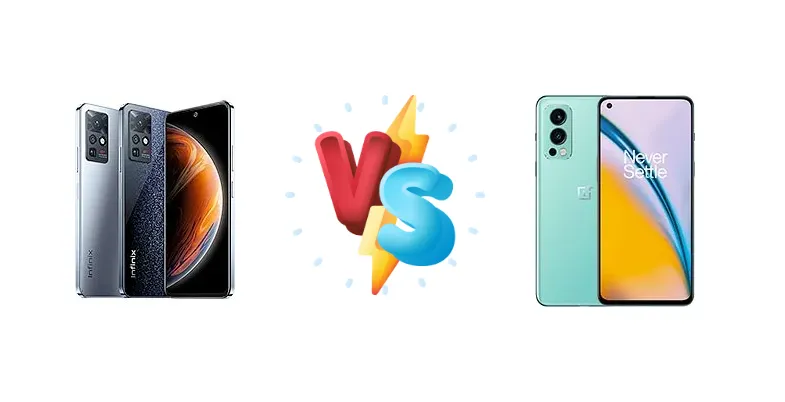
|
🏆 Quick Verdict
For most users, the OnePlus Nord 2 5G is the superior choice. Its significantly more powerful Dimensity 1200 chipset, coupled with faster 65W charging, provides a smoother, more responsive experience and reduces downtime. While the Infinix Zero X offers a competitive price, the performance gap is substantial.
| PHONES | ||
|---|---|---|
| Phone Names | Infinix Zero X | OnePlus Nord 2 5G |
| Network | ||
|---|---|---|
| 2G bands | GSM 850 / 900 / 1800 / 1900 | GSM 850 / 900 / 1800 / 1900 |
| 3G bands | HSDPA 850 / 900 / 1700(AWS) / 1900 / 2100 | HSDPA 800 / 850 / 900 / 1700(AWS) / 1800 / 1900 / 2100 |
| 4G bands | 1, 2, 3, 4, 5, 7, 8, 20, 28, 38, 40, 41 | 1, 2, 3, 4, 5, 7, 8, 12, 17, 18, 19, 20, 26, 28, 32, 34, 38, 39, 40, 41, 66 - EU |
| 5G bands | - | 1, 3, 7, 8, 20, 28, 38, 41, 66, 78 SA/NSA - EU |
| Speed | HSPA, LTE | HSPA 42.2/5.76 Mbps, LTE Cat18 1200/150 Mbps, 5G |
| Technology | GSM / HSPA / LTE | GSM / HSPA / LTE / 5G |
| Launch | ||
|---|---|---|
| Announced | 2021, September 13 | 2021, July 22 |
| Status | Available. Released 2021, September 17 | Available. Released 2021, July 28 |
| Body | ||
|---|---|---|
| Build | Glass front, glass back, plastic frame | Glass front (Gorilla Glass 5), glass back (Gorilla Glass 5), plastic frame |
| Dimensions | 164.1 x 75.7 x 7.8 mm (6.46 x 2.98 x 0.31 in) | 159.1 x 73.3 x 8.3 mm (6.26 x 2.89 x 0.33 in) |
| SIM | Nano-SIM + Nano-SIM | Nano-SIM + Nano-SIM |
| Weight | 193 g (6.81 oz) | 189 g (6.67 oz) |
| Display | ||
|---|---|---|
| Protection | - | Corning Gorilla Glass 5 |
| Resolution | 1080 x 2400 pixels, 20:9 ratio (~395 ppi density) | 1080 x 2400 pixels, 20:9 ratio (~409 ppi density) |
| Size | 6.67 inches, 107.4 cm2 (~86.5% screen-to-body ratio) | 6.43 inches, 99.8 cm2 (~85.6% screen-to-body ratio) |
| Type | AMOLED, 120Hz, 700 nits (peak) | Fluid AMOLED, 90Hz, HDR10+ |
| Platform | ||
|---|---|---|
| CPU | Octa-core (2x2.05 GHz Cortex-A76 & 6x2.0 GHz Cortex-A55) | Octa-core (1x3.0 GHz Cortex-A78 & 3x2.6 GHz Cortex-A78 & 4x2.0 GHz Cortex-A55) |
| Chipset | Mediatek MT6785V/CD Helio G95 (12 nm) | Mediatek Dimensity 1200 (6 nm) |
| GPU | Mali-G76 MC4 | Mali-G77 MC9 |
| OS | Android 11, XOS 7.6 | Android 11, upgradable to Android 13, OxygenOS 13 |
| Memory | ||
|---|---|---|
| Card slot | microSDXC (dedicated slot) | No |
| Internal | 128GB 8GB RAM | 128GB 6GB RAM, 128GB 8GB RAM, 256GB 8GB RAM, 256GB 12GB RAM |
| UFS 2.2 | - | |
| Main Camera | ||
|---|---|---|
| Features | Quad-LED flash, HDR, panorama | Dual-LED flash, HDR, panorama |
| Single | 16 MP, (wide) | - |
| Triple | 64 MP, f/1.9, (wide), PDAF, OIS 8 MP, f/3.4, 125mm (periscope telephoto), PDAF, 5x optical zoom, OIS 8 MP, f/2.3, 13mm, 120˚ (ultrawide), 1/4.0", 1.12µm, AF | 50 MP, f/1.9, 24mm (wide), 1/1.56", 1.0µm, PDAF, OIS 8 MP, f/2.3, 120˚ (ultrawide) Auxiliary lens |
| Video | 4K@30fps, 1080p@30fps | 4K@30fps, 1080p@30/60/120fps, gyro-EIS |
| Selfie camera | ||
|---|---|---|
| Features | Dual-LED flash | Auto HDR |
| Single | 16 MP, (wide) | 32 MP, f/2.5, (wide), 1/2.8", 0.8µm |
| Video | 1080p@30fps | 1080p@30fps, gyro-EIS |
| Sound | ||
|---|---|---|
| 3.5mm jack | Yes | No |
| 35mm jack | Yes | No |
| Loudspeaker | Yes, with dual speakers | Yes, with stereo speakers |
| Comms | ||
|---|---|---|
| Bluetooth | Yes | 5.2, A2DP, LE, aptX HD |
| NFC | No | Yes |
| Positioning | GPS | GPS, GLONASS, GALILEO, BDS, SBAS, NavIC |
| Radio | FM radio | No |
| USB | USB Type-C 2.0, OTG | USB Type-C 2.0, OTG |
| WLAN | Wi-Fi 802.11 a/b/g/n, dual-band, Wi-Fi Direct | Wi-Fi 802.11 a/b/g/n/ac/6, dual-band, Wi-Fi Direct |
| Features | ||
|---|---|---|
| Sensors | Fingerprint (under display, optical), accelerometer, gyro, proximity, compass | Fingerprint (under display, optical), accelerometer, gyro, proximity, compass |
| Battery | ||
|---|---|---|
| Charging | 45W wired, 40% in 15 min | 65W wired, PD, 100% in 30 min |
| Type | 4500 mAh | Li-Po 4500 mAh |
| Misc | ||
|---|---|---|
| Colors | Nebula Black, Starry Silver | Gray Sierra, Blue Haze, Green Wood, Pac-Man Edition |
| Models | - | DN2101, DN2103 |
| Price | About 320 EUR | € 189.00 / $ 219.99 / £ 148.00 |
| Tests | ||
|---|---|---|
| Battery life | - | Endurance rating 102h |
| Camera | - | Photo / Video |
| Display | - | Contrast ratio: Infinite (nominal) |
| Loudspeaker | - | -24.3 LUFS (Very good) |
| Performance | - | AnTuTu: 512164 (v8) | 598022 (v9) GeekBench: 2792 (v5.1) GFXBench: 38fps (ES 3.1 onscreen) |
Infinix Zero X
- More powerful Dimensity 1200 chipset
- Faster 65W SuperVOOC charging
- Likely superior camera image processing
- Generally higher price point
- May lack expandable storage (depending on variant)
OnePlus Nord 2 5G
- More affordable price
- Competitive 45W fast charging
- Potentially good value for basic users
- Significantly weaker Helio G95 chipset
- Uncertain camera performance
- Potentially lower display brightness
Display Comparison
The OnePlus Nord 2 5G boasts a display capable of reaching 633 nits of peak brightness, ensuring excellent visibility even outdoors. While the Infinix Zero X’s display specifications are not provided, it’s likely to be lower, potentially impacting outdoor usability. Both displays feature an 'infinite' contrast ratio, a marketing term indicating deep blacks, but the Nord 2 5G’s higher brightness provides a tangible advantage in real-world viewing conditions. The absence of refresh rate data for the Zero X suggests it may not offer the smoother scrolling experience found on many Nord 2 5G units.
Camera Comparison
Both phones offer photo and video capabilities, but detailed sensor information is lacking for the Infinix Zero X. The OnePlus Nord 2 5G likely benefits from MediaTek’s Imagiq 760 ISP, offering advanced image processing. Without specifics on the Zero X’s sensor size and aperture, it’s difficult to assess its low-light performance. The Nord 2 5G’s image processing is generally known for its natural color reproduction, while the Zero X’s approach remains unknown. The presence of OIS (Optical Image Stabilization) on the Nord 2 5G is a strong advantage for video recording and low-light photography.
Performance
The core difference lies in the chipsets. The OnePlus Nord 2 5G’s MediaTek Dimensity 1200 (6nm) is a significant leap ahead of the Infinix Zero X’s Helio G95 (12nm). The Dimensity 1200 features a more advanced CPU configuration – a 1x3.0 GHz Cortex-A78 core alongside 3x2.6 GHz Cortex-A78 cores, versus the Zero X’s 2x2.05 GHz Cortex-A76 and 6x2.0 GHz Cortex-A55. This translates to substantially faster application loading, smoother multitasking, and superior gaming performance. The 6nm process node of the Dimensity 1200 also contributes to better thermal efficiency, minimizing throttling during sustained workloads. The Zero X will handle daily tasks, but the Nord 2 5G offers a future-proofed experience.
Battery Life
Both devices achieve an endurance rating of 102 hours, suggesting comparable battery life under similar usage scenarios. However, the charging speeds differ dramatically. The OnePlus Nord 2 5G’s 65W SuperVOOC charging can fully charge the battery in just 30 minutes, while the Infinix Zero X’s 45W charging reaches 40% in 15 minutes. While the Zero X’s initial charge is quick, the Nord 2 5G’s complete charge time is significantly faster, minimizing downtime. The efficiency of the Dimensity 1200’s 6nm process may also contribute to slightly better real-world battery performance.
Buying Guide
Buy the Infinix Zero X if you prioritize affordability and are willing to compromise on raw processing power for everyday tasks like social media and light browsing. Buy the OnePlus Nord 2 5G if you demand a smoother experience for gaming, multitasking, and content creation, and value faster charging and a more refined software experience.