
Motorola Edge 20 Fusion vs. Infinix Zero X: Which Mid-Range Phone Reigns Supreme?
| Phones Images | |||||
|---|---|---|---|---|---|
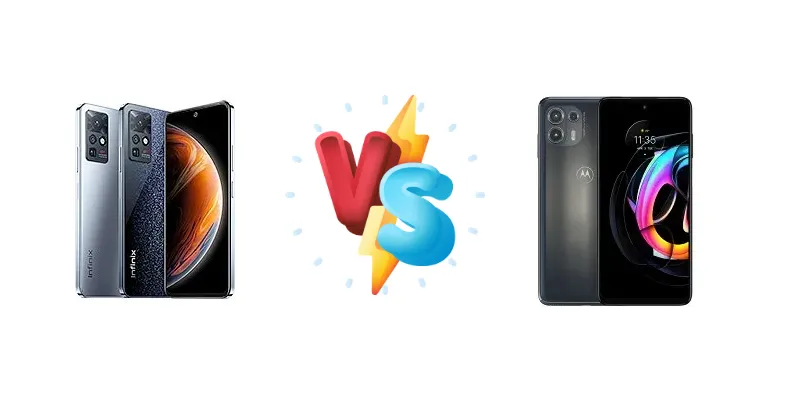
|
🏆 Quick Verdict
For most users, the Motorola Edge 20 Fusion emerges as the stronger contender. Its Dimensity 800U chipset, built on a more efficient 7nm process, provides a noticeable performance advantage over the Infinix Zero X’s Helio G95, particularly in sustained workloads. While the Zero X boasts faster 45W charging, the Fusion’s overall package delivers a more refined experience.
| PHONES | ||
|---|---|---|
| Phone Names | Infinix Zero X | Motorola Edge 20 Fusion |
| Network | ||
|---|---|---|
| 2G bands | GSM 850 / 900 / 1800 / 1900 | GSM 850 / 900 / 1800 / 1900 |
| 3G bands | HSDPA 850 / 900 / 1700(AWS) / 1900 / 2100 | HSDPA 850 / 900 / 1700(AWS) / 1900 / 2100 |
| 4G bands | 1, 2, 3, 4, 5, 7, 8, 20, 28, 38, 40, 41 | 1, 2, 3, 4, 5, 7, 8, 12, 13, 17, 18, 19, 20, 26, 28, 32, 34, 38, 39, 40, 41, 42, 43, 66 |
| 5G bands | - | 1, 3, 5, 7, 8, 20, 28, 38, 40, 41, 77, 78, 66 SA/NSA/Sub6 |
| Speed | HSPA, LTE | HSPA 42.2/5.76 Mbps, LTE Cat18 1200/150 Mbps, 5G |
| Technology | GSM / HSPA / LTE | GSM / HSPA / LTE / 5G |
| Launch | ||
|---|---|---|
| Announced | 2021, September 13 | 2021, August 17 |
| Status | Available. Released 2021, September 17 | Available. Released 2021, August 27 |
| Body | ||
|---|---|---|
| Build | Glass front, glass back, plastic frame | Glass front |
| Dimensions | 164.1 x 75.7 x 7.8 mm (6.46 x 2.98 x 0.31 in) | 166 x 76 x 8.3 mm (6.54 x 2.99 x 0.33 in) |
| SIM | Nano-SIM + Nano-SIM | Nano-SIM + Nano-SIM |
| Weight | 193 g (6.81 oz) | 185 g (6.53 oz) |
| - | Water-repellent design | |
| Display | ||
|---|---|---|
| Resolution | 1080 x 2400 pixels, 20:9 ratio (~395 ppi density) | 1080 x 2400 pixels, 20:9 ratio (~393 ppi density) |
| Size | 6.67 inches, 107.4 cm2 (~86.5% screen-to-body ratio) | 6.7 inches, 108.4 cm2 (~85.9% screen-to-body ratio) |
| Type | AMOLED, 120Hz, 700 nits (peak) | OLED, 1B colors, 90Hz, HDR10+ |
| Platform | ||
|---|---|---|
| CPU | Octa-core (2x2.05 GHz Cortex-A76 & 6x2.0 GHz Cortex-A55) | Octa-core (2x2.4 GHz Cortex-A76 & 6x2.0 GHz Cortex-A55) |
| Chipset | Mediatek MT6785V/CD Helio G95 (12 nm) | Mediatek Dimensity 800U (7 nm) |
| GPU | Mali-G76 MC4 | Mali-G57 MC3 |
| OS | Android 11, XOS 7.6 | Android 11 |
| Memory | ||
|---|---|---|
| Card slot | microSDXC (dedicated slot) | microSDXC |
| Internal | 128GB 8GB RAM | 128GB 6GB RAM, 128GB 8GB RAM |
| UFS 2.2 | - | |
| Main Camera | ||
|---|---|---|
| Features | Quad-LED flash, HDR, panorama | LED flash, HDR, panorama |
| Single | 16 MP, (wide) | - |
| Triple | 64 MP, f/1.9, (wide), PDAF, OIS 8 MP, f/3.4, 125mm (periscope telephoto), PDAF, 5x optical zoom, OIS 8 MP, f/2.3, 13mm, 120˚ (ultrawide), 1/4.0", 1.12µm, AF | 108 MP, f/1.9, (wide), 1/1.52", 0.7µm, PDAF 8 MP, f/2.2, 118˚ (ultrawide) Auxiliary lens |
| Video | 4K@30fps, 1080p@30fps | 4K@30fps, 1080p@30/60/120fps, gyro-EIS |
| Selfie camera | ||
|---|---|---|
| Features | Dual-LED flash | HDR |
| Single | 16 MP, (wide) | 32 MP, f/2.3, (wide), 0.7µm |
| Video | 1080p@30fps | 1080p@30fps |
| Sound | ||
|---|---|---|
| 3.5mm jack | Yes | Yes |
| 35mm jack | Yes | Yes |
| Loudspeaker | Yes, with dual speakers | Yes |
| Comms | ||
|---|---|---|
| Bluetooth | Yes | 5.0, A2DP, LE |
| NFC | No | Yes |
| Positioning | GPS | GPS, GLONASS, GALILEO |
| Radio | FM radio | FM radio |
| USB | USB Type-C 2.0, OTG | USB Type-C 2.0 |
| WLAN | Wi-Fi 802.11 a/b/g/n, dual-band, Wi-Fi Direct | Wi-Fi 802.11 a/b/g/n/ac, dual-band, Wi-Fi Direct |
| Features | ||
|---|---|---|
| Sensors | Fingerprint (under display, optical), accelerometer, gyro, proximity, compass | Fingerprint (side-mounted), accelerometer, gyro, proximity, compass |
| Battery | ||
|---|---|---|
| Charging | 45W wired, 40% in 15 min | 30W wired |
| Type | 4500 mAh | Li-Po 5000 mAh |
| Misc | ||
|---|---|---|
| Colors | Nebula Black, Starry Silver | Electric Graphite, Cyber Teal |
| Price | About 320 EUR | About 250 EUR |
Infinix Zero X
- Extremely fast 45W charging
- Potentially lower price point (depending on region)
- Helio G95 is still a capable processor for everyday tasks
- Helio G95 chipset is less efficient than Dimensity 800U
- Likely to experience more thermal throttling during gaming
- Missing details on display quality
Motorola Edge 20 Fusion
- More efficient Dimensity 800U chipset
- Higher CPU clock speeds for improved performance
- Potentially better image processing capabilities
- Slower 30W charging compared to Infinix Zero X
- May be slightly more expensive
- Display specs are unknown
Display Comparison
Neither device boasts a standout display. Both likely utilize IPS LCD panels, a common choice in this price bracket. However, detailed specs like resolution and refresh rate are missing. The key difference lies under the hood: processing power impacts UI smoothness, which indirectly affects display experience. Without knowing the panel quality, the Edge 20 Fusion’s superior chipset will likely translate to a more responsive user interface.
Camera Comparison
Without detailed camera specifications beyond the chipsets, a direct comparison is limited. However, the chipset plays a role in image signal processing (ISP) capabilities. The Dimensity 800U generally offers more advanced ISP features, potentially leading to better image quality, especially in low-light conditions. The absence of information regarding sensor size and optical image stabilization (OIS) makes a definitive judgment impossible, but the Fusion’s chipset provides a foundation for a more capable camera system. We can assume both phones will include standard features like portrait mode and HDR, but the quality of these features will vary.
Performance
The Motorola Edge 20 Fusion’s Mediatek Dimensity 800U (7nm) holds a significant advantage over the Infinix Zero X’s Helio G95 (12nm). The 7nm fabrication process is inherently more efficient, leading to lower power consumption and reduced heat generation. While both CPUs feature the same Cortex-A76 and A55 core configuration, the Fusion’s cores are clocked higher (2.4 GHz vs 2.05 GHz), resulting in faster processing speeds. This translates to quicker app launches, smoother multitasking, and improved gaming performance. The G95, while capable, will likely exhibit more thermal throttling during extended gaming sessions.
Battery Life
The Infinix Zero X’s 45W wired charging is its standout feature, promising a quick power boost. The claim of 40% charge in 15 minutes is compelling for users who need a rapid top-up. However, the Motorola Edge 20 Fusion’s 30W charging, coupled with the more efficient Dimensity 800U chipset, could result in comparable real-world battery life despite potentially having a smaller battery capacity (spec not provided). The efficiency gain from the 7nm process offsets some of the charging speed difference, meaning the Fusion may not require as frequent charging.
Buying Guide
Buy the Infinix Zero X if you prioritize extremely fast charging and frequently top up your phone throughout the day. Its 45W charging can add 40% battery in just 15 minutes, making it ideal for users on the go. Buy the Motorola Edge 20 Fusion if you value consistent performance, especially for gaming and multitasking, and prefer a more power-efficient chipset that won't throttle as quickly under load. The Fusion is the better choice for users who demand a smoother, more reliable experience.