
Google Pixel 6a vs. Infinix Zero X Pro: A Detailed Comparison of Mid-Range Powerhouses
| Phones Images | |||||
|---|---|---|---|---|---|
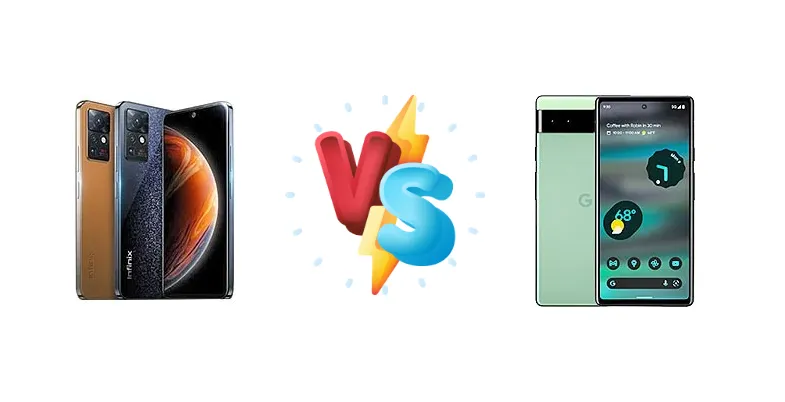
|
🏆 Quick Verdict
For most users, the Google Pixel 6a is the superior choice. Its Google Tensor chip provides a smoother, more responsive experience, and its significantly brighter display enhances outdoor visibility. While the Infinix Zero X Pro boasts faster charging and longer battery life, the Pixel 6a’s overall polish and software support are compelling advantages.
| PHONES | ||
|---|---|---|
| Phone Names | Infinix Zero X Pro | Google Pixel 6a |
| Network | ||
|---|---|---|
| 2G bands | GSM 850 / 900 / 1800 / 1900 | GSM 850 / 900 / 1800 / 1900 |
| 3G bands | HSDPA 850 / 900 / 1700(AWS) / 1900 / 2100 | HSDPA 800 / 850 / 900 / 1700(AWS) / 1900 / 2100 |
| 4G bands | 1, 2, 3, 4, 5, 7, 8, 20, 28, 38, 40, 41 | 1, 2, 3, 4, 5, 7, 8, 12, 13, 14, 17, 18, 19, 20, 25, 26, 28, 29, 30, 38, 39, 40, 41, 42, 48, 66, 71 - GX7AS, GB62Z (USA/Canada) |
| 5G bands | - | 1, 2, 3, 5, 7, 8, 12, 20, 25, 28, 30, 38, 40, 41, 48, 66, 71, 77, 78 SA/NSA/Sub6 - GX7AS (USA/Canada) |
| Speed | HSPA, LTE | HSPA, LTE, 5G |
| Technology | GSM / HSPA / LTE | GSM / HSPA / LTE / 5G |
| - | 1, 2, 3, 5, 7, 8, 12, 20, 25, 28, 30, 40, 48, 66, 71, 77, 78 SA/NSA/Sub6 - G1AZG (International) | |
| Launch | ||
|---|---|---|
| Announced | 2021, September 13 | 2022, May 11 |
| Status | Available. Released 2021, September 17 | Available. Released 2022, July 21 |
| Body | ||
|---|---|---|
| Build | Glass front, glass back, plastic frame | Glass front (Gorilla Glass 3), aluminum frame, plastic back |
| Dimensions | 164.1 x 75.7 x 7.8 mm (6.46 x 2.98 x 0.31 in) | 152.2 x 71.8 x 8.9 mm (5.99 x 2.83 x 0.35 in) |
| SIM | Nano-SIM + Nano-SIM | Nano-SIM + eSIM |
| Weight | 193 g (6.81 oz) | 178 g (6.28 oz) |
| - | IP67 dust/water resistant (up to 1m for 30 min) | |
| Display | ||
|---|---|---|
| Protection | - | Corning Gorilla Glass 3 |
| Resolution | 1080 x 2400 pixels, 20:9 ratio (~395 ppi density) | 1080 x 2400 pixels, 20:9 ratio (~429 ppi density) |
| Size | 6.67 inches, 107.4 cm2 (~86.5% screen-to-body ratio) | 6.1 inches, 90.7 cm2 (~83.0% screen-to-body ratio) |
| Type | AMOLED, 120Hz, 700 nits (peak) | OLED, HDR |
| - | Always-on display | |
| Platform | ||
|---|---|---|
| CPU | Octa-core (2x2.05 GHz Cortex-A76 & 6x2.0 GHz Cortex-A55) | Octa-core (2x2.80 GHz Cortex-X1 & 2x2.25 GHz Cortex-A76 & 4x1.80 GHz Cortex-A55) |
| Chipset | Mediatek MT6785V/CD Helio G95 (12 nm) | Google Tensor (5 nm) |
| GPU | Mali-G76 MC4 | Mali-G78 MP20 |
| OS | Android 11, XOS 10 | Android 12, upgradable to Android 15, up to 5 major Android upgrades |
| Memory | ||
|---|---|---|
| Card slot | microSDXC (dedicated slot) | No |
| Internal | 128GB 8GB RAM, 256GB 8GB RAM | 128GB 6GB RAM |
| UFS 2.2 | UFS 3.1 | |
| Main Camera | ||
|---|---|---|
| Dual | - | 12.2 MP, f/1.7, 27mm, (wide), 1/2.55", 1.4µm, dual pixel PDAF, OIS 12 MP, f/2.2, 17mm, 114˚ (ultrawide), 1.25µm |
| Features | Quad-LED flash, HDR, panorama | Dual-LED flash, Pixel Shift, Auto-HDR, panorama |
| Single | 16 MP, (wide), 1/2.76", 1.12µm | 8 MP, f/2.0, 24mm (wide), 1.12µm |
| Triple | 108 MP, f/1.8, (wide), 1/1.52", 0.7µm, PDAF, OIS 8 MP, f/3.4, 125mm (periscope telephoto), 1/4.4", 1.0µm, PDAF, 5x optical zoom, OIS 8 MP, f/2.3, 13mm, 120˚ (ultrawide), 1/4.0", 1.12µm, AF | - |
| Video | 4K@30/60fps, 1080p@30fps | 4K@30/60fps, 1080p@30/60/120/240fps; gyro-EIS, OIS |
| Selfie camera | ||
|---|---|---|
| Features | Dual-LED flash | HDR, panorama |
| Single | 16 MP, (wide), 1/2.76", 1.12µm | 8 MP, f/2.0, 24mm (wide), 1.12µm |
| Video | 4K@30fps, 1080p@30/60fps | 1080p@30fps |
| Sound | ||
|---|---|---|
| 3.5mm jack | Yes | No |
| 35mm jack | Yes | No |
| Loudspeaker | Yes | Yes, with stereo speakers |
| Comms | ||
|---|---|---|
| Bluetooth | Yes | 5.2, A2DP, LE |
| NFC | No | Yes |
| Positioning | GPS | GPS, GLONASS, GALILEO, QZSS |
| Radio | FM radio | No |
| USB | USB Type-C 2.0, OTG | USB Type-C 3.1 |
| WLAN | Wi-Fi 802.11 a/b/g/n, dual-band, Wi-Fi Direct | Wi-Fi 802.11 a/b/g/n/ac/6e, dual-band, Wi-Fi Direct |
| Features | ||
|---|---|---|
| Sensors | Fingerprint (under display, optical), accelerometer, gyro, proximity, compass | Fingerprint (under display, optical), accelerometer, gyro, proximity, compass, barometer |
| Battery | ||
|---|---|---|
| Charging | 45W wired, 40% in 15 min | 18W wired, PD3.0 |
| Type | 4500 mAh | Li-Po 4410 mAh |
| Misc | ||
|---|---|---|
| Colors | Nebula Black, Starry Silver, Tuscany Brown | Chalk, Charcoal, Sage |
| Models | X6810, X6811, X6811B, MZ-Infinix X6811 | GX7AS, GB62Z, G1AZG, GB17L |
| Price | About 180 EUR | $ 138.99 / C$ 228.74 / ₹ 23,999 |
| Tests | ||
|---|---|---|
| Battery life | Endurance rating 119h | Endurance rating 94h |
| Camera | Photo / Video | - |
| Display | - | Contrast ratio: Infinite (nominal) |
| Loudspeaker | -28.3 LUFS (Average) | - |
| Performance | AnTuTu: 313652 (v8), 363939 (v9) GeekBench: 1674 (v5.1) GFXBench: 18fps (ES 3.1 onscreen) | - |
Infinix Zero X Pro
- Superior processor performance with Google Tensor
- Brighter and more vibrant display
- Excellent camera image processing
- Clean and optimized Android experience
- Slower charging speed
- Shorter battery life compared to Infinix Zero X Pro
Google Pixel 6a
- Impressive battery endurance
- Extremely fast 45W charging
- Competitive price point
- Large internal storage options
- Less powerful processor
- Dimmer display with lower contrast
Display Comparison
The Pixel 6a’s display is a clear winner in terms of brightness, achieving a measured peak of 876 nits compared to the Infinix Zero X Pro’s 515 nits. This translates to significantly better visibility under direct sunlight. While the Infinix Zero X Pro’s display is adequate for indoor use, the Pixel 6a’s superior brightness and infinite contrast ratio (nominal) provide a more vibrant and immersive viewing experience. Both devices lack high refresh rate panels, which is a common omission in this price bracket, but the Pixel 6a’s OLED panel offers better color accuracy and viewing angles.
Camera Comparison
Both phones feature capable camera systems, but the Pixel 6a leverages Google’s computational photography expertise to deliver consistently superior image quality. While specific sensor details are not provided for the Infinix Zero X Pro, the Pixel 6a’s image processing excels in dynamic range, detail preservation, and low-light performance. Google’s software algorithms compensate for hardware limitations, resulting in photos that often surpass those taken with phones boasting higher megapixel counts. The Pixel 6a’s video capabilities are also more refined, offering better stabilization and dynamic range. The Infinix Zero X Pro likely relies more heavily on hardware specifications, potentially leading to inconsistent results.
Performance
The Google Pixel 6a’s Google Tensor chip, fabricated on a 5nm process, represents a substantial leap in performance over the Infinix Zero X Pro’s MediaTek Helio G95 (12nm). The Tensor’s octa-core CPU, featuring Cortex-X1 cores clocked at 2.80 GHz, delivers significantly faster processing speeds for demanding tasks like video editing and gaming. While the Helio G95 is capable for everyday use, it will struggle with more intensive applications. The Tensor chip also benefits from Google’s dedicated AI processing capabilities, enhancing features like voice recognition and image processing. The Pixel 6a’s performance advantage is further amplified by its optimized software integration.
Battery Life
The Infinix Zero X Pro boasts an endurance rating of 119 hours, exceeding the Pixel 6a’s 94 hours. This suggests the Zero X Pro will last longer on a single charge, particularly with moderate usage. However, the Pixel 6a’s more efficient Tensor chip partially mitigates this difference. The Infinix Zero X Pro’s 45W wired charging is significantly faster than the Pixel 6a’s 18W charging, allowing it to reach 40% charge in just 15 minutes. The Pixel 6a, while supporting PD3.0, will take considerably longer to fully charge.
Buying Guide
Buy the Infinix Zero X Pro if you prioritize all-day battery life and extremely fast charging, and are comfortable with a less refined software experience. It’s ideal for users who frequently travel or rely heavily on their phone throughout the day. Buy the Google Pixel 6a if you value a clean Android experience, excellent camera performance, and a more powerful processor for demanding tasks, even if it means sacrificing some battery endurance and charging speed.