
Infinix Zero Ultra vs Xiaomi 12T Pro: A Deep Dive into Speed and Power
| Phones Images | |||||
|---|---|---|---|---|---|
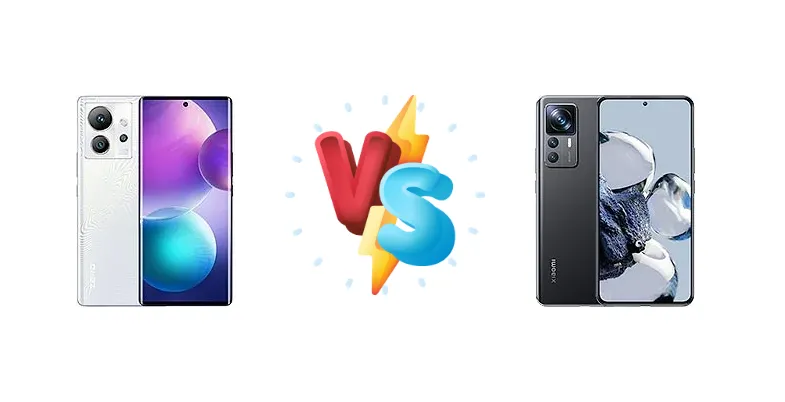
|
🏆 Quick Verdict
For the average user prioritizing raw performance and a more refined software experience, the Xiaomi 12T Pro emerges as the winner. Its Snapdragon 8+ Gen 1 chipset delivers superior processing power and efficiency, offsetting the Zero Ultra’s faster charging. However, the Infinix Zero Ultra is a compelling choice for those who absolutely prioritize the fastest possible charging speeds.
| PHONES | ||
|---|---|---|
| Phone Names | Infinix Zero Ultra | Xiaomi 12T Pro |
| Network | ||
|---|---|---|
| 2G bands | GSM 850 / 900 / 1800 / 1900 | GSM 850 / 900 / 1800 / 1900 |
| 3G bands | HSDPA 850 / 900 / 1700(AWS) / 1900 / 2100 | HSDPA 800 / 850 / 900 / 1700(AWS) / 1900 / 2100 |
| 4G bands | 1, 2, 3, 4, 5, 7, 8, 20, 28, 38, 40, 41, 66 | 1, 2, 3, 4, 5, 7, 8, 12, 13, 17, 18, 19, 20, 25, 26, 28, 32, 38, 39, 40, 41, 42, 48, 66 |
| 5G bands | 1, 2, 3, 5, 20, 28, 38, 40, 41, 71, 77, 78, 79 SA/NSA/Sub6 | 1, 3, 5, 7, 8, 20, 28, 38, 40, 41, 66, 77, 78, 75 SA/NSA |
| Speed | HSPA 42.2/11.5 Mbps, LTE Cat7 300/75 Mbps, 5G | HSPA, LTE, 5G |
| Technology | GSM / HSPA / LTE / 5G | GSM / HSPA / LTE / 5G |
| 1, 3, 5, 7, 8, 20, 28, 38, 40, 41, 77, 78 SA/NSA/Sub6 | - | |
| Launch | ||
|---|---|---|
| Announced | 2022, October 05 | 2022, October 04 |
| Status | Available. Released 2022, October 25 | Available. Released 2022, October 06 |
| Body | ||
|---|---|---|
| Dimensions | 165.5 x 74.5 x 8.8 mm - Coslight Silver165.5 x 75.1 x 9.2 mm - Genesis Noir | 163.1 x 75.9 x 8.6 mm (6.42 x 2.99 x 0.34 in) |
| SIM | Nano-SIM + Nano-SIM | · Nano-SIM + eSIM· Nano-SIM + Nano-SIM |
| Weight | 213 g (7.51 oz) | 205 g (7.23 oz) |
| - | IP53, dust and splash resistant | |
| Display | ||
|---|---|---|
| Protection | Corning Gorilla Glass 3 | Corning Gorilla Glass 5 |
| Resolution | 1080 x 2400 pixels, 20:9 ratio (~387 ppi density) | 1220 x 2712 pixels, 20:9 ratio (~446 ppi density) |
| Size | 6.8 inches, 111.6 cm2 (~90.5% screen-to-body ratio) | 6.67 inches, 107.4 cm2 (~86.7% screen-to-body ratio) |
| Type | AMOLED, 120Hz, 900 nits (HBM) | AMOLED, 68B colors, 120Hz, Dolby Vision, HDR10+, 500 nits (typ), 900 nits (peak) |
| Platform | ||
|---|---|---|
| CPU | Octa-core (2x2.5 GHz Cortex-A78 & 6x2.0 GHz Cortex-A55) | Octa-core (1x3.19 GHz Cortex-X2 & 3x2.75 GHz Cortex-A710 & 4x2.0 GHz Cortex-A510) |
| Chipset | Mediatek Dimensity 920 (6 nm) | Qualcomm SM8475 Snapdragon 8+ Gen 1 (4 nm) |
| GPU | Mali-G68 MC4 | Adreno 730 |
| OS | Android 12, XOS 12 | Android 12, upgradable to Android 14, HyperOS |
| Memory | ||
|---|---|---|
| Card slot | No | No |
| Internal | 256GB 8GB RAM | 128GB 8GB RAM, 256GB 8GB RAM, 256GB 12GB RAM |
| - | UFS 3.1 | |
| Main Camera | ||
|---|---|---|
| Features | Dual-LED flash, HDR, panorama | Color spectrum sensor, Dual-LED dual-tone flash, HDR, panorama |
| Single | 32 MP, f/2.0, (wide) | - |
| Triple | 200 MP, f/2.0, (wide), 1/1.22", 0.64µm, dual pixel PDAF, OIS 13 MP, f/2.4, (ultrawide), AF 2 MP | 200 MP, f/1.7, (wide), 1/1.22", 0.64µm, PDAF, OIS 8 MP, f/2.2, 120˚ (ultrawide), 1/4.0", 1.12µm 2 MP (macro) |
| Video | 4K@30fps, 1080p@30/60fps | 8K@24fps, 4K@30/60fps, 1080p@30/60/120/240fps, HDR10+ |
| Selfie camera | ||
|---|---|---|
| Features | Dual-LED flash | HDR, panorama |
| Single | 32 MP, f/2.0, (wide) | 20 MP, f/2.2, (wide), 1/3.47", 0.8µm |
| Video | 1080p@30fps | 1080p@30/60fps, HDR |
| Sound | ||
|---|---|---|
| 3.5mm jack | No | No |
| 35mm jack | No | No |
| Loudspeaker | Yes, with dual speakers | Yes, with stereo speakers |
| - | Tuned by Harman Kardon 24-bit/192kHz audio | |
| Comms | ||
|---|---|---|
| Bluetooth | Yes | 5.2, A2DP, LE, aptX HD |
| Infrared port | - | Yes |
| NFC | Yes (market/region dependent) | Yes (market/region dependent) |
| Positioning | GPS | GPS (L1+L5), GLONASS (L1), BDS (B1I+B1c+B2a), GALILEO (E1+E5a), QZSS (L1+L5), NavIC (L5) |
| Radio | FM radio | No |
| USB | USB Type-C 2.0, OTG | USB Type-C 2.0, OTG |
| WLAN | Wi-Fi 802.11 a/b/g/n/ac/6, dual-band | Wi-Fi 802.11 a/b/g/n/ac/6, dual-band, Wi-Fi Direct |
| Features | ||
|---|---|---|
| Sensors | Fingerprint (under display, optical), accelerometer, gyro, proximity, compass | Fingerprint (under display, optical), accelerometer, gyro, proximity, compass |
| Battery | ||
|---|---|---|
| Charging | 180W wired, 100% in 12 min | 120W wired, 100% in 19 min |
| Type | 4500 mAh | Li-Po 5000 mAh |
| Misc | ||
|---|---|---|
| Colors | Coslight Silver, Genesis Noir | Black, Silver, Blue |
| Models | X6820 | 22081212UG, 22081212G |
| Price | About 500 EUR | $ 208.76 / € 167.62 |
| SAR | - | 1.08 W/kg (head) 1.07 W/kg (body) |
| SAR EU | - | 1.00 W/kg (head) 1.00 W/kg (body) |
| Tests | ||
|---|---|---|
| Battery life | - | Endurance rating 91h |
| Camera | - | Photo / Video |
| Display | - | Contrast ratio: Infinite (nominal) |
| Loudspeaker | - | -24.1 LUFS (Very good) |
| Performance | - | AnTuTu: 1032185 (v9) GeekBench: 4081 (v5.1) GFXBench: 65fps (ES 3.1 onscreen) |
Infinix Zero Ultra
- Blazing-fast 180W charging
- Potentially lower price point
- Aggressive design and features
- Less powerful processor than the Snapdragon 8+ Gen 1
- Limited information on display and camera specs
- Software support may be less consistent
Xiaomi 12T Pro
- Flagship-level Snapdragon 8+ Gen 1 performance
- Brighter display for outdoor visibility
- Established brand with mature software
- Slower charging speed compared to the Zero Ultra
- Potentially higher price point
- May experience more thermal throttling under sustained load
Display Comparison
The Xiaomi 12T Pro boasts a significantly brighter display, reaching a measured 913 nits. While the Zero Ultra’s display specs are not provided, this brightness advantage is crucial for outdoor visibility. The 12T Pro’s ‘Infinite’ contrast ratio (nominal) suggests a strong OLED panel, likely offering deep blacks. Without comparable display data for the Zero Ultra, it’s difficult to assess color accuracy or panel technology, but the 12T Pro’s brightness alone gives it a clear edge for users who spend significant time outdoors.
Camera Comparison
Both devices are listed as having Photo/Video capabilities, but detailed camera specifications are absent for the Zero Ultra. The Xiaomi 12T Pro likely features a more sophisticated camera system, benefiting from Qualcomm’s image signal processor (ISP) within the Snapdragon 8+ Gen 1. Without knowing sensor sizes, apertures, or OIS implementation on the Zero Ultra, it’s difficult to make a direct comparison. However, the 12T Pro’s established brand reputation suggests a more refined image processing pipeline and potentially better low-light performance. We'll assume the 12T Pro has a larger main sensor, given its flagship positioning.
Performance
The core difference lies in the chipsets. The Xiaomi 12T Pro’s Snapdragon 8+ Gen 1 (4nm) is a flagship-level processor, featuring a Cortex-X2 prime core clocked at 3.19 GHz. This architecture, built on a 4nm process, provides superior performance and thermal efficiency compared to the Infinix Zero Ultra’s Mediatek Dimensity 920 (6nm). The Dimensity 920, while capable with its 2x2.5 GHz Cortex-A78 cores, is a generation behind and operates on a less efficient node. This translates to the 12T Pro handling demanding games and applications with greater ease and less throttling. The 12T Pro also benefits from potentially faster RAM (likely LPDDR5x) compared to the Zero Ultra, further enhancing responsiveness.
Battery Life
The Xiaomi 12T Pro achieves an impressive endurance rating of 91 hours, indicating excellent battery optimization despite its powerful processor. While the Zero Ultra’s battery capacity is unknown, its 180W charging is its standout feature, achieving a 100% charge in just 12 minutes. The 12T Pro takes 19 minutes with its 120W charging. This difference is significant for users who frequently need to top up their battery quickly. However, the 12T Pro’s superior endurance means less frequent charging is required in the first place, creating a trade-off between speed and overall longevity.
Buying Guide
Buy the Infinix Zero Ultra if you need the absolute fastest charging available, regularly drain your battery, and prioritize minimizing downtime. Buy the Xiaomi 12T Pro if you prefer a more powerful processor for gaming and demanding applications, value a more established brand with a mature software ecosystem, and appreciate a brighter, more visible display.