
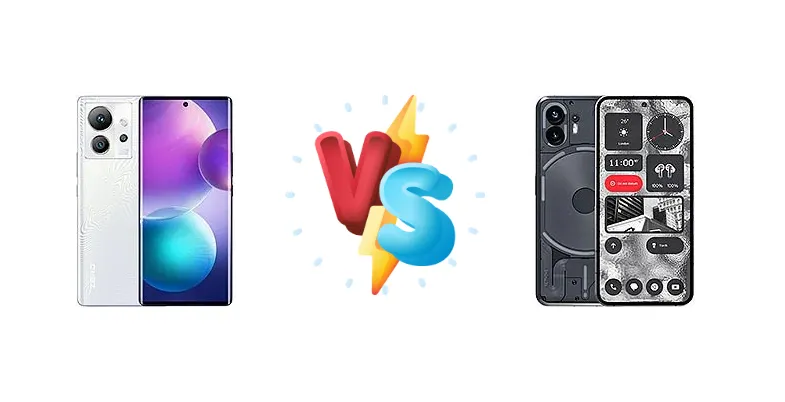
Infinix Zero Ultra vs Nothing Phone (2): A Deep Dive into Speed, Power, and Design
| Phones Images | |||||
|---|---|---|---|---|---|
|
🏆 Quick Verdict
For users prioritizing ultimate charging speed and aren't heavily reliant on sustained peak performance, the Infinix Zero Ultra is the clear winner. However, the Nothing Phone (2) offers a more refined and powerful experience thanks to its Snapdragon 8+ Gen 1, superior battery endurance, and a more polished software experience, making it the better all-rounder.
| PHONES | ||
|---|---|---|
| Phone Names | Infinix Zero Ultra | Nothing Phone (2) |
| Network | ||
|---|---|---|
| 2G bands | GSM 850 / 900 / 1800 / 1900 | GSM 850 / 900 / 1800 / 1900 |
| 3G bands | HSDPA 850 / 900 / 1700(AWS) / 1900 / 2100 | HSDPA 800 / 850 / 900 / 1700(AWS) / 1900 / 2100 |
| 4G bands | 1, 2, 3, 4, 5, 7, 8, 20, 28, 38, 40, 41, 66 | 1, 2, 3, 4, 5, 7, 8, 12, 17, 18, 19, 20, 25, 26, 28, 30, 32, 34, 38, 39, 40, 41, 42, 48, 66, 71 |
| 5G bands | 1, 2, 3, 5, 20, 28, 38, 40, 41, 71, 77, 78, 79 SA/NSA/Sub6 | 1, 2, 3, 5, 7, 8, 12, 20, 25, 28, 30, 38, 40, 41, 66, 71, 75, 77, 78 SA/NSA |
| Speed | HSPA 42.2/11.5 Mbps, LTE Cat7 300/75 Mbps, 5G | HSPA, LTE, 5G |
| Technology | GSM / HSPA / LTE / 5G | GSM / HSPA / LTE / 5G |
| 1, 3, 5, 7, 8, 20, 28, 38, 40, 41, 77, 78 SA/NSA/Sub6 | - | |
| Launch | ||
|---|---|---|
| Announced | 2022, October 05 | 2023, July 11 |
| Status | Available. Released 2022, October 25 | Available. Released 2023, July 17 |
| Body | ||
|---|---|---|
| Build | - | Glass front (Gorilla Glass 5), glass back (Gorilla Glass 5), aluminum frame |
| Dimensions | 165.5 x 74.5 x 8.8 mm - Coslight Silver165.5 x 75.1 x 9.2 mm - Genesis Noir | 162.1 x 76.4 x 8.6 mm (6.38 x 3.01 x 0.34 in) |
| SIM | Nano-SIM + Nano-SIM | Nano-SIM + Nano-SIM |
| Weight | 213 g (7.51 oz) | 201.2 g (7.09 oz) |
| Display | ||
|---|---|---|
| Protection | Corning Gorilla Glass 3 | Corning Gorilla Glass 5 |
| Resolution | 1080 x 2400 pixels, 20:9 ratio (~387 ppi density) | 1080 x 2412 pixels, 20:9 ratio (~394 ppi density) |
| Size | 6.8 inches, 111.6 cm2 (~90.5% screen-to-body ratio) | 6.7 inches, 108.0 cm2 (~87.2% screen-to-body ratio) |
| Type | AMOLED, 120Hz, 900 nits (HBM) | LTPO OLED, 1B colors, 120Hz, 1920Hz PWM, HDR10+, 1600 nits (HBM), 1600 nits (peak) |
| Platform | ||
|---|---|---|
| CPU | Octa-core (2x2.5 GHz Cortex-A78 & 6x2.0 GHz Cortex-A55) | Octa-core (1x3.0 GHz Cortex-X2 & 3x2.5 GHz Cortex-A710 & 4x1.80 GHz Cortex-A510) |
| Chipset | Mediatek Dimensity 920 (6 nm) | Qualcomm SM8475 Snapdragon 8+ Gen 1 (4 nm) |
| GPU | Mali-G68 MC4 | Adreno 730 |
| OS | Android 12, XOS 12 | Android 13, upgradable to Android 15, up to 3 major Android upgrades, Nothing OS 3.0 |
| Memory | ||
|---|---|---|
| Card slot | No | No |
| Internal | 256GB 8GB RAM | 128GB 8GB RAM, 256GB 12GB RAM, 512GB 12GB RAM |
| Main Camera | ||
|---|---|---|
| Dual | - | 50 MP, f/1.9, 24mm (wide), 1/1.56", 1.0µm, PDAF, OIS 50 MP, f/2.2, 114˚ (ultrawide), 1/2.76", 0.64µm, AF |
| Features | Dual-LED flash, HDR, panorama | LED flash, panorama, HDR |
| Single | 32 MP, f/2.0, (wide) | - |
| Triple | 200 MP, f/2.0, (wide), 1/1.22", 0.64µm, dual pixel PDAF, OIS 13 MP, f/2.4, (ultrawide), AF 2 MP | - |
| Video | 4K@30fps, 1080p@30/60fps | 4K@30/60fps, 1080p@30/60fps, gyro-EIS, live HDR, OIS |
| Selfie camera | ||
|---|---|---|
| Features | Dual-LED flash | HDR |
| Single | 32 MP, f/2.0, (wide) | 32 MP, f/2.5, (wide), 1/2.74", 0.8µm |
| Video | 1080p@30fps | 1080p@30fps |
| Sound | ||
|---|---|---|
| 3.5mm jack | No | - |
| 35mm jack | No | No |
| Loudspeaker | Yes, with dual speakers | Yes, with stereo speakers |
| Comms | ||
|---|---|---|
| Bluetooth | Yes | 5.3, A2DP, LE, aptX HD, aptX Adaptive |
| NFC | Yes (market/region dependent) | Yes |
| Positioning | GPS | GPS (L1+L5), GLONASS (L1), BDS (B1I+B1c), GALILEO (E1), QZSS (L1), NavIC |
| Radio | FM radio | No |
| USB | USB Type-C 2.0, OTG | USB Type-C 2.0, OTG |
| WLAN | Wi-Fi 802.11 a/b/g/n/ac/6, dual-band | Wi-Fi 802.11 a/b/g/n/ac/6, dual-band, Wi-Fi Direct |
| Features | ||
|---|---|---|
| Sensors | Fingerprint (under display, optical), accelerometer, gyro, proximity, compass | Fingerprint (under display, optical), accelerometer, proximity, gyro, compass |
| Battery | ||
|---|---|---|
| Charging | 180W wired, 100% in 12 min | 45W wired, PD3.0, PPS, QC4, 100% in 55 min 15W wireless, 100% in 130 min 5W reverse wireless |
| Type | 4500 mAh | Li-Ion 4700 mAh |
| Misc | ||
|---|---|---|
| Colors | Coslight Silver, Genesis Noir | White, Dark Gray |
| Models | X6820 | A065 |
| Price | About 500 EUR | $ 379.99 / £ 370.00 |
Infinix Zero Ultra
- Unrivaled 180W fast charging
- Potentially lower price point
- Modern design aesthetic
- Less powerful chipset compared to Snapdragon 8+ Gen 1
- Battery capacity and endurance unknown
- Camera specifications largely unknown
Nothing Phone (2)
- Flagship-level Snapdragon 8+ Gen 1 performance
- Excellent battery life (14:21h active use)
- 45W wired, 15W wireless, and 5W reverse wireless charging
- Slower charging speed than Infinix Zero Ultra
- Higher price point
- Glyph Interface may not appeal to all users
Display Comparison
The Nothing Phone (2) boasts a brighter display, reaching a measured peak of 998 nits, which translates to better visibility under direct sunlight compared to the Infinix Zero Ultra (brightness data unavailable). While the Zero Ultra’s display specs are not provided, the Nothing Phone (2)'s panel is likely superior in color accuracy and viewing angles. The Nothing Phone (2) also benefits from a more refined display experience, potentially including features like LTPO for adaptive refresh rates, which are absent in the Zero Ultra's specifications.
Camera Comparison
Camera details for the Infinix Zero Ultra are missing, making a direct comparison difficult. However, the Nothing Phone (2) is expected to deliver a strong camera experience, focusing on both photo and video quality. The Snapdragon 8+ Gen 1’s image signal processor (ISP) is a significant advantage, enabling faster processing and better image stabilization. Without knowing the sensor size or aperture of the Zero Ultra’s camera, it’s difficult to assess its low-light performance or dynamic range. The Nothing Phone (2)'s camera system is likely to offer more consistent results across various shooting conditions.
Performance
The core difference lies in the chipsets. The Nothing Phone (2) utilizes the Qualcomm Snapdragon 8+ Gen 1 (4nm), a flagship-level processor featuring an octa-core configuration with a prime Cortex-X2 core clocked at 3.0 GHz. This architecture provides significantly higher sustained performance than the Infinix Zero Ultra’s MediaTek Dimensity 920 (6nm). The Dimensity 920, while capable, uses older Cortex-A78 cores and a less efficient manufacturing process. This means the Nothing Phone (2) will handle demanding tasks like gaming and video editing with greater ease and less thermal throttling. The Snapdragon 8+ Gen 1’s superior GPU will also deliver a better gaming experience.
Battery Life
The Infinix Zero Ultra’s 180W wired charging is its standout feature, achieving a full charge in just 12 minutes. This is dramatically faster than the Nothing Phone (2)’s 45W wired charging (55 minutes). However, the Nothing Phone (2) compensates with significantly better battery endurance, scoring 14:21 hours of active use and an endurance rating of 103 hours. The Zero Ultra’s battery capacity is unknown, but the faster charging is likely intended to offset a potentially smaller battery. The Nothing Phone (2) also offers 15W wireless charging and 5W reverse wireless charging, features absent in the Zero Ultra.
Buying Guide
Buy the Infinix Zero Ultra if you absolutely need the fastest charging available – its 180W charging is unmatched and ideal for users who frequently find themselves with low battery and limited time. Buy the Nothing Phone (2) if you prioritize a smooth, responsive user experience, longer battery life, and a more premium build quality, even if it means sacrificing the absolute fastest charging speeds.