
Infinix Zero Flip vs. Google Pixel Fold: A Deep Dive into Foldable Value
| Phones Images | |||||
|---|---|---|---|---|---|
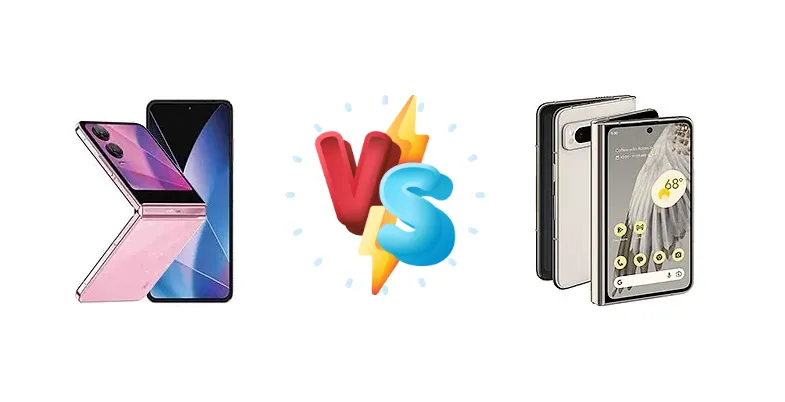
|
🏆 Quick Verdict
For the average user prioritizing value and efficient performance, the Infinix Zero Flip emerges as the stronger contender. Its Mediatek Dimensity 8020 chipset delivers solid performance, coupled with a remarkably fast 70W charging solution. While the Pixel Fold boasts Google’s software and a refined experience, its higher price tag doesn’t necessarily translate to a proportionally better experience for most users.
| PHONES | ||
|---|---|---|
| Phone Names | Infinix Zero Flip | Google Pixel Fold |
| Network | ||
|---|---|---|
| 2G bands | GSM 850 / 900 / 1800 / 1900 | GSM 850 / 900 / 1800 / 1900 |
| 3G bands | HSDPA 850 / 900 / 1700(AWS) / 1900 / 2100 | HSDPA 800 / 850 / 900 / 1700(AWS) / 1900 / 2100 |
| 4G bands | 1, 2, 3, 4, 5, 7, 8, 12, 13, 17, 20, 28, 34, 38, 39, 40, 41, 42, 66 | 1, 2, 3, 4, 5, 7, 8, 12, 13, 14, 17, 18, 19, 20, 21, 25, 26, 28, 29, 30, 32, 38, 39, 40, 41, 42, 46, 48, 66, 71 |
| 5G bands | 1, 3, 5, 7, 8, 12, 20, 28, 38, 40, 41, 66, 77, 78 SA/NSA | 1, 2, 3, 5, 7, 8, 12, 14, 20, 25, 28, 30, 38, 40, 41, 48, 66, 71, 75, 76, 77, 78, 79, 257, 258, 260, 261 SA/NSA/Sub6/mmWave |
| Speed | HSPA, LTE, 5G | HSPA, LTE, 5G |
| Technology | GSM / HSPA / LTE / 5G | GSM / CDMA / HSPA / EVDO / LTE / 5G |
| - | CDMA2000 1xEV-DO | |
| Launch | ||
|---|---|---|
| Announced | 2024, September 27 | 2023, May 10 |
| Status | Available. Released 2024, October | Available. Released 2023, June 27 |
| Body | ||
|---|---|---|
| Build | - | Glass front (Gorilla Glass Victus) (folded), plastic front (unfolded), glass back (Gorilla Glass Victus), aluminum frame |
| Dimensions | Unfolded: 170.4 x 73.4 x 7.6 mmFolded: 87.5 x 73.4 x 16 mm | Unfolded: 139.7 x 158.7 x 5.8 mmFolded: 139.7 x 79.5 x 12.1 mm |
| SIM | · Nano-SIM· Nano-SIM + Nano-SIM | Nano-SIM + eSIM |
| Weight | 195 g (6.88 oz) | 283 g (9.98 oz) |
| - | IPX8 water resistant | |
| Display | ||
|---|---|---|
| Resolution | 1080 x 2640 pixels (~413 ppi density) | 1840 x 2208 pixels (~378 ppi density) |
| Size | 6.9 inches, 107.6 cm2 (~86.1% screen-to-body ratio) | 7.6 inches, 183.3 cm2 (~82.7% screen-to-body ratio) |
| Type | Foldable LTPO AMOLED, 120Hz, 1400 nits (peak) | Foldable OLED, 120Hz, HDR10+, 1000 nits (HBM), 1450 nits (peak) |
| - | Cover display: OLED, 120Hz, HDR, Corning Gorilla Glass Victus 5.8 inches, 1080 x 2092 pixels, 17.4:9 ratio, 408 ppi 1200 nits (HBM), 1550 nits (peak) | |
| Platform | ||
|---|---|---|
| CPU | Octa-core (4x2.6 GHz Cortex-A78 & 4x2.0 GHz Cortex-A55) | Octa-core (2x2.85 GHz Cortex-X1 & 2x2.35 GHz Cortex-A78 & 4x1.80 GHz Cortex-A55) |
| Chipset | Mediatek Dimensity 8020 (6 nm) | Google Tensor G2 (5 nm) |
| GPU | Mali-G77 MC9 | Mali-G710 MP7 |
| OS | Android 14, up to 2 major Android upgrades, XOS 14.5 | Android 13, upgradable to Android 15, up to 5 major Android upgrades |
| Memory | ||
|---|---|---|
| Card slot | No | No |
| Internal | 256GB 8GB RAM, 512GB 8GB RAM | 256GB 12GB RAM, 512GB 12GB RAM |
| - | UFS 3.1 | |
| Main Camera | ||
|---|---|---|
| Dual | 50 MP, f/1.9, 24mm (wide), 1/1.57", 1.0µm, PDAF, OIS 50 MP, f/2.2, 115˚ (ultrawide), 1/2.8", 0.64µm, PDAF | - |
| Features | Dual-LED flash, HDR, panorama | Laser AF, Dual-LED flash, HDR, panorama |
| Triple | - | 48 MP, f/1.7, 25mm (wide), 1/2.0", 0.8µm, dual pixel PDAF, OIS 10.8 MP, f/3.1, 112mm (telephoto), 1/3.1", 1.22µm, dual pixel PDAF, OIS, 5x optical zoom 10.8 MP, f/2.2, 121˚, (ultrawide), 1/3.0", 1.25µm |
| Video | 4K@30fps, 1080p@30/60/120fps | 4K@30/60fps, 1080p@30/60/120/240fps, 10-bit HDR |
| Selfie camera | ||
|---|---|---|
| Features | Dual-LED flash | HDR, panorama |
| Single | 50 MP, f/2.5, 25mm (wide), 1/2.76", 0.64µm, PDAF | 8 MP, f/2.0, 24mm (wide), 1/4.0", 1.12µm Cover camera: 9.5 MP, f/2.2, 24mm (wide), 1.22µm, dual pixel PDAF |
| Video | 4K@30/60fps, 1080p@30/60/120fps | 4K@30/60fps, 1080p@30/60fps |
| Sound | ||
|---|---|---|
| 3.5mm jack | - | No |
| 35mm jack | No | No |
| Loudspeaker | Yes, with stereo speakers | Yes, with stereo speakers |
| Comms | ||
|---|---|---|
| Bluetooth | 5.4, A2DP, LE | 5.2, A2DP, LE, aptX HD |
| NFC | Yes | Yes |
| Positioning | GPS | GPS, GLONASS, GALILEO, BDS |
| Radio | FM radio | No |
| USB | USB Type-C, OTG | USB Type-C 3.2, OTG |
| WLAN | Wi-Fi 802.11 a/b/g/n/ac/6, dual-band | Wi-Fi 802.11 a/b/g/n/ac/6e, tri-band, Wi-Fi Direct |
| Features | ||
|---|---|---|
| Sensors | Fingerprint (side-mounted), accelerometer, gyro, proximity, compass | Fingerprint (side-mounted), accelerometer, gyro, proximity, compass, barometer |
| - | Ultra Wideband (UWB) support | |
| Battery | ||
|---|---|---|
| Charging | 70W wired 10W reverse wired | Wired, PD3.0 Wireless |
| Type | 4720 mAh | Li-Po 4821 mAh |
| Misc | ||
|---|---|---|
| Colors | Rock Black, Blossom Glow | Porcelain, Obsidian |
| Models | X6962 | G9FPL |
| Price | ₹ 39,999 | € 670.87 / $ 389.26 / £ 899.99 |
Infinix Zero Flip
- 70W Fast Charging: Significantly faster than the Pixel Fold.
- Efficient Chipset: Mediatek Dimensity 8020 offers good performance and thermal management.
- Value Proposition: Offers a foldable experience at a more accessible price point.
- Limited Camera Information: Camera specs are unknown, potentially a weaker point.
- Software Experience: Likely lacks the polish and features of Google’s Pixel software.
Google Pixel Fold
- Google Tensor G2: Excellent AI and machine learning capabilities.
- Superior Camera: Renowned for its computational photography and image quality.
- Seamless Software: Integrated Google experience with timely updates.
- High Price: Significantly more expensive than the Infinix Zero Flip.
- Slower Charging: Charging speeds are slower compared to the Zero Flip.
Display Comparison
Detailed display specifications are unavailable for the Infinix Zero Flip, but its foldable nature suggests a focus on maximizing screen real estate. The Pixel Fold features an inner 7.6-inch foldable display and a 5.8-inch cover display. The Pixel Fold’s display benefits from Google’s color calibration expertise, ensuring accurate and vibrant visuals. The absence of LTPO technology in the Zero Flip (assumed based on price point) may result in slightly less efficient power consumption compared to the Pixel Fold, which likely utilizes LTPO for adaptive refresh rates. Bezels are expected to be more pronounced on the Zero Flip to manage costs.
Camera Comparison
Camera details for the Infinix Zero Flip are limited. The Pixel Fold is known for its computational photography prowess, leveraging Google’s image processing algorithms to deliver consistently excellent results. While megapixel counts aren’t everything, the Pixel Fold’s sensor size and optical image stabilization (OIS) contribute to superior low-light performance and image clarity. The Pixel Fold’s camera system is designed for versatility, excelling in various shooting scenarios. Without specific camera specs for the Zero Flip, it’s reasonable to assume a more modest camera experience focused on everyday snapshots.
Performance
The core of the performance difference lies in the chipsets. The Google Pixel Fold’s Tensor G2 (5nm) prioritizes AI and machine learning tasks, enhancing features like voice recognition and image processing. However, the Infinix Zero Flip’s Mediatek Dimensity 8020 (6nm) offers a more traditional performance profile, with a focus on raw CPU and GPU power. The Dimensity 8020’s Cortex-A78 cores, clocked at 2.6 GHz, are competitive with the Pixel Fold’s Cortex-A78 cores, but the Tensor G2’s Cortex-X1 prime core provides a performance edge in single-threaded tasks. The 6nm process of the Dimensity 8020 should offer better thermal efficiency than the 5nm Tensor G2, potentially leading to less throttling during sustained workloads. The Pixel Fold likely benefits from optimized software integration with its Tensor chip.
Battery Life
The Infinix Zero Flip boasts a significant advantage in charging speed with its 70W wired charging, allowing for a full charge in a fraction of the time compared to the Pixel Fold’s wired and wireless charging options. The Zero Flip’s active use battery score of 11:01h suggests excellent battery optimization, potentially offsetting any capacity differences. While the Pixel Fold’s battery capacity is likely larger, the Dimensity 8020’s efficiency and the Zero Flip’s fast charging combine to create a compelling battery experience. The Pixel Fold’s wireless charging is a convenience feature, but the Zero Flip’s 70W wired charging is a game-changer.
Buying Guide
Buy the Infinix Zero Flip if you need a foldable that prioritizes battery life, fast charging, and strong performance without breaking the bank. It’s ideal for users who want a functional foldable for everyday tasks and media consumption. Buy the Google Pixel Fold if you prefer a seamless software experience, a top-tier camera system, and are willing to pay a premium for Google’s ecosystem and unique foldable features.