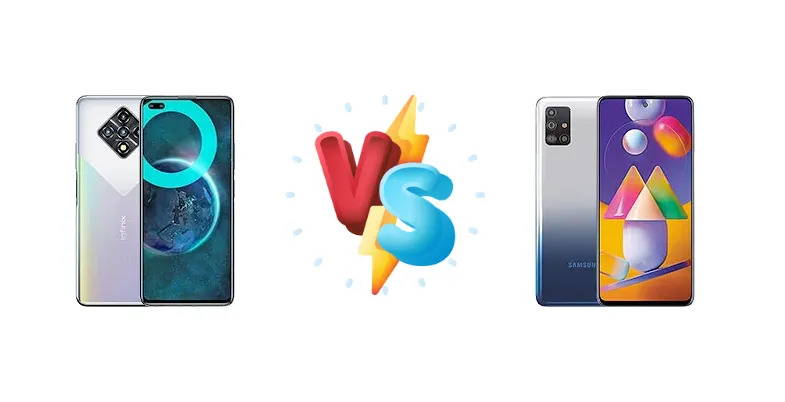
The Infinix Zero 8i and Samsung Galaxy M31s represent compelling options in the competitive mid-range smartphone market. While both aim to deliver a feature-rich experience without breaking the bank, they take distinctly different approaches. The Zero 8i prioritizes gaming performance with its MediaTek Helio G90T, while the M31s focuses on all-day battery life and a versatile camera system powered by Samsung’s Exynos 9611. This comparison will dissect their strengths and weaknesses to determine which device best suits your needs.
🏆 Quick Verdict
For users prioritizing gaming and snappy performance, the Infinix Zero 8i emerges as the winner. Its Helio G90T chipset offers a noticeable edge in demanding tasks. However, the Samsung Galaxy M31s is a strong contender for those who value extended battery life and a more balanced feature set, particularly its reverse wireless charging capability.
| Network |
|---|
| 2G bands | GSM 850 / 900 / 1800 / 1900 | GSM 850 / 900 / 1800 / 1900 |
| 3G bands | HSDPA 850 / 900 / 2100 | HSDPA 850 / 900 / 1700(AWS) / 1900 / 2100 |
| 4G bands | 1, 3, 5, 8, 38, 40, 41 | 1, 2, 3, 4, 5, 7, 8, 12, 17, 20, 26, 28, 38, 40, 41, 66 |
| Speed | HSPA, LTE | HSPA, LTE |
| Technology | GSM / HSPA / LTE | GSM / HSPA / LTE |
| | India | - |
| Launch |
|---|
| Announced | 2020, December 03. Released 2020, December 09 | 2020, July 30. Released 2020, August 06 |
| Status | Discontinued | Discontinued |
| Body |
|---|
| Dimensions | 168.7 x 76.1 x 9.1 mm (6.64 x 3.00 x 0.36 in) | 159.3 x 74.4 x 9.3 mm (6.27 x 2.93 x 0.37 in) |
| Keyboard | - | QWERTY |
| SIM | Nano-SIM + Nano-SIM | · Nano-SIM· Nano-SIM + Nano-SIM |
| Weight | 210.5 g (7.44 oz) | 203 g (7.16 oz) |
| Display |
|---|
| Protection | - | Corning Gorilla Glass 3 |
| Resolution | 1080 x 2460 pixels (~392 ppi density) | 1080 x 2400 pixels, 20:9 ratio (~405 ppi density) |
| Size | 6.85 inches, 111.4 cm2 (~86.8% screen-to-body ratio) | 6.5 inches, 102.0 cm2 (~86.1% screen-to-body ratio) |
| Type | IPS LCD, 90Hz, 480 nits (typ) | Super AMOLED |
| Platform |
|---|
| CPU | Octa-core (2x2.05 GHz Cortex-A76 & 6x2.0 GHz Cortex-A55) | Octa-core (4x2.3 GHz Cortex-A73 & 4x1.7 GHz Cortex-A53) |
| Chipset | Mediatek MT6785 Helio G90T (12 nm) | Exynos 9611 (10 nm) |
| GPU | Mali-G76 MC4 | Mali-G72 MP3 |
| OS | Android 10 | Android 10, upgradable to Android 12, One UI 4.1 |
| Memory |
|---|
| Card slot | microSDXC (dedicated slot) | microSDXC (dedicated slot) |
| Internal | 128GB 8GB RAM | 128GB 6GB RAM, 128GB 8GB RAM |
| | UFS 2.1 | - |
| Main Camera |
|---|
| Features | Quad-LED flash, HDR, panorama | LED flash, panorama, HDR |
| Quad | 48 MP, f/1.8, (wide), PDAF
8 MP, 119˚ (ultrawide), 1/4.0", 1.12µm
Auxiliary lenses | - |
| Single | - | 3.15 MP, AF |
| Triple | - | 64 MP, f/1.8, 26mm (wide), 1/1.73", 0.8µm, PDAF
12 MP, f/2.2, 123˚ (ultrawide)
5 MP (macro)
Auxiliary lens |
| Video | 4K@30fps, 1080p@30/60fps, gyro-EIS | 4K@30fps, 1080p@30fps, gyro-EIS |
| Selfie camera |
|---|
| Dual | 16 MP, f/2.0, (wide)
8 MP, f/2.2, 105˚ (ultrawide), 1/4.0", 1.12µm | - |
| Features | Dual-LED flash, HDR | HDR |
| Single | - | 32 MP, f/2.2, 26mm (wide), 1/2.8", 0.8µm |
| Video | 4K@30fps, 1080p@30/60fps | 4K@30fps, 1080p@30fps |
| | - | No |
| Sound |
|---|
| 3.5mm jack | Yes | Yes |
| 35mm jack | Yes | Yes |
| Loudspeaker | Yes | Yes |
| Comms |
|---|
| Bluetooth | 5.0, A2DP, LE | 5.0, A2DP, LE |
| NFC | No | Yes (market/region dependent) |
| Positioning | GPS | GPS, GLONASS, GALILEO, BDS |
| Radio | FM radio | FM radio, RDS, recording |
| USB | USB Type-C 2.0, OTG | USB Type-C 2.0, OTG |
| WLAN | Wi-Fi 802.11 a/b/g/n, Wi-Fi Direct | Wi-Fi 802.11 a/b/g/n/ac, dual-band, Wi-Fi Direct |
| Features |
|---|
| Sensors | Fingerprint (side-mounted), accelerometer, gyro, proximity, compass | Fingerprint (side-mounted), accelerometer, gyro, compass |
| | - | MP4/H.264 player
MP3/WAV/eAAC+ player
Organizer
Voice memo
Predictive text input |
| Battery |
|---|
| Charging | 33W wired | 25W wired
4.5W reverse wired |
| Stand-by | - | Up to 288 h |
| Talk time | - | Up to 7 h |
| Type | 4500 mAh | Li-Po 6000 mAh |
| Misc |
|---|
| Colors | Silver Diamond, Black Diamond | Mirage Black, Mirage Blue |
| Models | X687B | SM-M317F, SM-M317F/DS |
| Price | About 170 EUR | About 300 EUR |
| SAR | 0.40 W/kg (head) 0.95 W/kg (body) | 1.38 W/kg (head) |
Infinix Zero 8i
- Superior gaming performance with Helio G90T
- Faster 33W wired charging
- Potentially more responsive display for gaming
- Likely shorter battery life
- Less efficient chipset may lead to throttling
Samsung Galaxy M31s
- Excellent battery life
- Reverse wireless charging capability
- Samsung’s image processing expertise
- Less powerful chipset for gaming
- Slower 25W charging
Display Comparison
Neither device boasts a cutting-edge display. While specific panel details (like peak brightness in nits or color gamut coverage) are unavailable, the focus here is on chipset impact. The Zero 8i’s gaming-centric design likely prioritizes a responsive panel, but the M31s’ larger display (typically found in this series) may offer a more immersive viewing experience for media consumption. Bezels are likely comparable, given the price bracket, and both will likely utilize IPS LCD technology.
Camera Comparison
Without detailed sensor information, a direct comparison is challenging. However, Samsung typically excels in image processing, and the M31s likely benefits from this. The Zero 8i may prioritize a more vibrant, contrast-rich look, common in Infinix’s image tuning. The presence of a 2MP macro camera on both devices is largely a marketing tactic; image quality from these sensors is typically underwhelming. The aperture of the main sensor will be a key differentiator, with a wider aperture (lower f-number) allowing for better low-light performance. The M31s may offer more versatile camera modes due to Samsung’s software features.
Performance
The core difference lies in the chipsets. The Infinix Zero 8i’s MediaTek Helio G90T (12nm) features a dual-cluster CPU configuration with two high-performance Cortex-A76 cores clocked at 2.05 GHz and six efficiency-focused Cortex-A55 cores at 2.0 GHz. This architecture is geared towards sustained gaming performance. Conversely, the Samsung Galaxy M31s utilizes the Exynos 9611 (10nm) with four Cortex-A73 cores at 2.3 GHz and four Cortex-A53 cores at 1.7 GHz. While the Exynos boasts higher clock speeds on its primary cores, the older Cortex-A73 architecture is less efficient than the A76, potentially leading to more thermal throttling under prolonged load. The G90T’s Mali-G76 MC4 GPU is also a strong performer in its class, giving the Zero 8i an edge in graphics-intensive tasks.
Battery Life
The Samsung Galaxy M31s’ strength is its battery life. While the exact capacity isn’t specified, the M series is known for large batteries. Coupled with the relatively efficient Exynos 9611, it should easily last a full day of moderate to heavy use. The Infinix Zero 8i, with its power-hungry Helio G90T, will likely require more frequent charging. However, the Zero 8i compensates with significantly faster 33W wired charging, reducing downtime. The M31s’ 25W charging is respectable, but slower. The M31s also includes 4.5W reverse wired charging, a feature absent on the Zero 8i, allowing it to top up accessories or other devices.
Buying Guide
Buy the Infinix Zero 8i if you need a phone primarily for gaming, enjoy fast charging, and don't mind potentially shorter battery life. It's ideal for mobile gamers and users who frequently multitask. Buy the Samsung Galaxy M31s if you prefer a phone with exceptional battery endurance, appreciate the convenience of reverse wireless charging, and prioritize a more well-rounded camera experience over raw processing power. It’s best for everyday users and content consumers.
Frequently Asked Questions
❓ Does the Exynos 9611 in the Samsung Galaxy M31s overheat during extended gaming sessions?
The Exynos 9611 is known to throttle under sustained load, meaning performance will decrease over time to manage heat. While it won't necessarily 'overheat' to the point of being unusable, expect frame rate drops in demanding games after 30-45 minutes of play. The Zero 8i’s G90T is better equipped to handle prolonged gaming.
❓ Is the 33W charging on the Infinix Zero 8i significantly faster than the 25W charging on the Samsung Galaxy M31s in real-world use?
Yes, the 33W charging on the Zero 8i will noticeably reduce charging times. Expect a 0-100% charge in approximately 60-75 minutes, compared to 85-100 minutes for the M31s. This difference is particularly beneficial for users who need a quick top-up before heading out.
❓ How useful are the 2MP macro cameras on either phone?
The 2MP macro cameras on both devices are largely for marketing purposes. Image quality is typically low, lacking detail and sharpness. They are usable for close-up shots in good lighting, but don't expect professional-level results. The main camera on either phone will generally produce better results even when zoomed in.
❓ Can the Samsung Galaxy M31s charge other devices wirelessly?
No, the Samsung Galaxy M31s supports *wired* reverse charging at 4.5W. This means you can use it to charge other devices via a USB-C cable, but it does not support wireless power sharing.