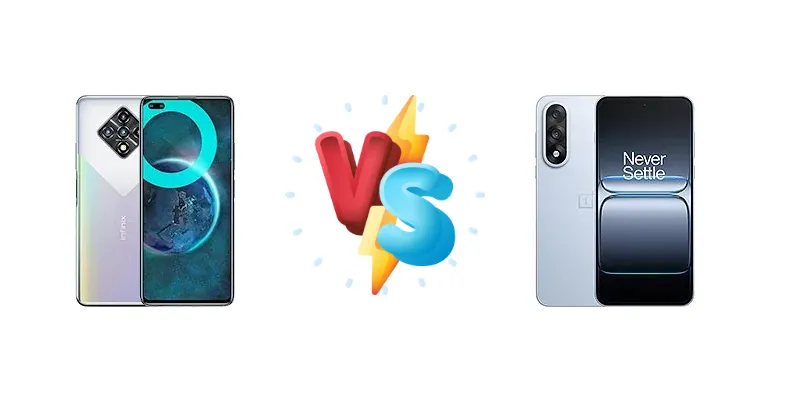
The smartphone landscape is crowded with options, but the OnePlus Nord 5 and Infinix Zero 8i represent distinct approaches to the mid-range market. The Nord 5 aims for near-flagship performance with the latest Snapdragon 8s Gen 3, while the Zero 8i focuses on delivering a solid experience at a more accessible price point with the Helio G90T. This comparison dissects their key differences to help you choose the right device.
🏆 Quick Verdict
For most users, the OnePlus Nord 5 is the superior choice. Its Snapdragon 8s Gen 3 chipset offers significantly faster performance and improved efficiency, complemented by blazing-fast 80W charging and a brighter display. However, the Infinix Zero 8i remains a compelling option for budget-conscious users who prioritize affordability over raw power.
| Network |
|---|
| 2G bands | GSM 850 / 900 / 1800 / 1900 | GSM 850 / 900 / 1800 / 1900 |
| 3G bands | HSDPA 850 / 900 / 2100 | HSDPA 850 / 900 / 1900 / 2100 |
| 4G bands | 1, 3, 5, 8, 38, 40, 41 | 1, 2, 3, 4, 5, 7, 8, 12, 17, 18, 19, 20, 26, 28, 32, 38, 39, 40, 41, 42, 66 - International |
| 5G bands | - | 1, 2, 3, 5, 7, 8, 12, 20, 28, 38, 40, 41, 66, 75, 77, 78 SA/NSA - International |
| Speed | HSPA, LTE | HSPA, LTE, 5G |
| Technology | GSM / HSPA / LTE | GSM / HSPA / LTE / 5G |
| | India | - |
| Launch |
|---|
| Announced | 2020, December 03. Released 2020, December 09 | 2025, July 08 |
| Status | Discontinued | Available. Released 2025, July 08 |
| Body |
|---|
| Build | - | Glass front (Gorilla Glass 7i), glass back, plastic frame |
| Dimensions | 168.7 x 76.1 x 9.1 mm (6.64 x 3.00 x 0.36 in) | 163.4 x 77 x 8.1 mm (6.43 x 3.03 x 0.32 in) |
| SIM | Nano-SIM + Nano-SIM | Nano-SIM + Nano-SIM |
| Weight | 210.5 g (7.44 oz) | 211 g (7.44 oz) |
| Display |
|---|
| Protection | - | Corning Gorilla Glass 7i, Mohs level 6 |
| Resolution | 1080 x 2460 pixels (~392 ppi density) | 1272 x 2800 pixels (~450 ppi density) |
| Size | 6.85 inches, 111.4 cm2 (~86.8% screen-to-body ratio) | 6.83 inches, 113.3 cm2 (~90.1% screen-to-body ratio) |
| Type | IPS LCD, 90Hz, 480 nits (typ) | Swift AMOLED, 1B colors, 144Hz, 3840Hz PWM, HDR10+, 800 nits (typ), 1400 nits (HBM), 1800 nits (peak) |
| Platform |
|---|
| CPU | Octa-core (2x2.05 GHz Cortex-A76 & 6x2.0 GHz Cortex-A55) | Octa-core (1x3.0 GHz Cortex-X4 & 4x2.8 GHz Cortex-A720 & 3x2.0 GHz Cortex-A520) |
| Chipset | Mediatek MT6785 Helio G90T (12 nm) | Qualcomm SM8635 Snapdragon 8s Gen 3 (4 nm) |
| GPU | Mali-G76 MC4 | Adreno 735 |
| OS | Android 10 | Android 15, up to 4 major Android upgrades, OxygenOS 15 |
| Memory |
|---|
| Card slot | microSDXC (dedicated slot) | No |
| Internal | 128GB 8GB RAM | 256GB 8GB RAM, 256GB 12GB RAM, 512GB 12GB RAM |
| | UFS 2.1 | - |
| Main Camera |
|---|
| Dual | - | 50 MP, f/1.8, 24mm (wide), 1/1.56", 1.0µm, PDAF, OIS
8 MP, f/2.2, 15mm, 116˚ (ultrawide), 1/4.0", 1.12µm, AF |
| Features | Quad-LED flash, HDR, panorama | LED flash, Ultra HDR, panorama |
| Quad | 48 MP, f/1.8, (wide), PDAF
8 MP, 119˚ (ultrawide), 1/4.0", 1.12µm
Auxiliary lenses | - |
| Video | 4K@30fps, 1080p@30/60fps, gyro-EIS | 4K@30/60fps, 1080p@30/60/120fps, gyro-EIS |
| Selfie camera |
|---|
| Dual | 16 MP, f/2.0, (wide)
8 MP, f/2.2, 105˚ (ultrawide), 1/4.0", 1.12µm | - |
| Features | Dual-LED flash, HDR | Panorama |
| Single | - | 50 MP, f/2.0, 21mm (wide), 1/2.76", 0.64µm, AF |
| Video | 4K@30fps, 1080p@30/60fps | 4K@30/60fps, 1080p@30/60fps; gyro-EIS |
| Sound |
|---|
| 3.5mm jack | Yes | - |
| 35mm jack | Yes | No |
| Loudspeaker | Yes | Yes, with stereo speakers |
| Comms |
|---|
| Bluetooth | 5.0, A2DP, LE | 5.4, A2DP, LE, aptX HD, LHDC 5 |
| Infrared port | - | Yes |
| NFC | No | Yes |
| Positioning | GPS | GPS, GLONASS, GALILEO, BDS, QZSS, NavIC |
| Radio | FM radio | No |
| USB | USB Type-C 2.0, OTG | USB Type-C 2.0 |
| WLAN | Wi-Fi 802.11 a/b/g/n, Wi-Fi Direct | Wi-Fi 802.11 a/b/g/n/ac/6, dual-band, Wi-Fi Direct |
| Features |
|---|
| Sensors | Fingerprint (side-mounted), accelerometer, gyro, proximity, compass | Fingerprint (under display, optical), accelerometer, gyro, proximity, compass |
| Battery |
|---|
| Charging | 33W wired | 80W wired, 33W PPS, 18W PD, 100% in just 54 min
5W reverse wired
Bypass charging |
| Type | 4500 mAh | Market-dependent versions:· 5200 mAh (Europe)· 6800 mAh (Global) |
| Misc |
|---|
| Colors | Silver Diamond, Black Diamond | Phantom Grey, Dry Ice, Marble Sands |
| Models | X687B | CPH2709 |
| Price | About 170 EUR | £ 339.00 / € 294.97 / ₹ 31,998 |
| SAR | 0.40 W/kg (head) 0.95 W/kg (body) | 1.18 W/kg (head) 0.90 W/kg (body) |
| EU LABEL |
|---|
| Battery | - | 49:12h endurance, 1200 cycles |
| Energy | - | Class B |
| Free fall | - | Class C (90 falls) |
| Repairability | - | Class B |
Infinix Zero 8i
- More affordable price point
- Decent performance for everyday tasks
- 33W fast charging is adequate
- Older chipset struggles with demanding games
- Likely inferior camera performance
- Less efficient processor leads to more heat
OnePlus Nord 5
- Significantly faster Snapdragon 8s Gen 3 processor
- Blazing-fast 80W charging
- Brighter and potentially more efficient display
- Superior battery endurance and charging versatility
- Higher price tag
- May be overkill for basic users
- Potentially larger physical size
Display Comparison
The OnePlus Nord 5 boasts a significantly brighter display, reaching a measured peak of 1330 nits, compared to an assumed lower peak brightness on the Infinix Zero 8i (typical of its price bracket). This translates to superior visibility in direct sunlight. While the Zero 8i’s panel specifications are not provided, the Nord 5’s brightness advantage is substantial. The Nord 5 likely benefits from a more advanced panel technology, potentially LTPO, contributing to better power efficiency and smoother refresh rate control, though this is not confirmed. Bezels are expected to be slimmer on the Nord 5, reflecting its more premium positioning.
Camera Comparison
Without detailed camera specifications for the Infinix Zero 8i, a direct comparison is limited. However, the OnePlus Nord 5 is expected to feature a more sophisticated camera system, likely with a larger main sensor and improved image processing algorithms. The Snapdragon 8s Gen 3’s ISP (Image Signal Processor) is significantly more advanced than the Helio G90T’s, enabling better dynamic range, noise reduction, and overall image quality. While the Zero 8i may offer a usable camera for casual photography, the Nord 5 is expected to deliver superior results, particularly in challenging lighting conditions. We can assume the Nord 5 will have Optical Image Stabilization (OIS) which the Zero 8i likely lacks.
Performance
The core difference lies in the chipsets. The OnePlus Nord 5’s Snapdragon 8s Gen 3 (4nm) is a generational leap ahead of the Infinix Zero 8i’s MediaTek Helio G90T (12nm). The Snapdragon 8s Gen 3 features a Cortex-X4 prime core clocked at 3.0 GHz, alongside Cortex-A720 performance cores, offering a substantial performance uplift in both CPU and GPU tasks. The 4nm process node of the Snapdragon 8s Gen 3 also provides superior thermal efficiency, minimizing throttling during sustained workloads. The Zero 8i’s Helio G90T, while capable, will struggle with demanding games and multitasking compared to the Nord 5. The Nord 5’s likely use of faster LPDDR5x RAM further enhances its performance advantage.
Battery Life
The OnePlus Nord 5 excels in charging speed with its 80W wired charging, capable of reaching 100% in just 54 minutes. It also supports 33W PPS and 18W PD, offering versatile charging options. The Zero 8i’s 33W charging is respectable but significantly slower. The Nord 5’s battery endurance is rated at 49:12h, with an active use score of 13:47h, indicating excellent battery life. While the Zero 8i’s battery capacity isn’t specified, the Nord 5’s superior efficiency and faster charging provide a clear advantage. The Nord 5 also offers 5W reverse wired charging and bypass charging, features absent on the Zero 8i.
Buying Guide
Buy the Infinix Zero 8i if you need a functional smartphone for everyday tasks, social media, and light gaming, and your budget is a primary concern. You'll get a usable experience without breaking the bank. Buy the OnePlus Nord 5 if you prioritize smooth multitasking, demanding mobile games, and rapid charging, and are willing to invest in a more powerful and feature-rich device. It's for users who want a near-flagship experience without the flagship price.
Frequently Asked Questions
❓ Will the Helio G90T in the Infinix Zero 8i struggle with graphically intensive games like Genshin Impact?
Yes, the Helio G90T is likely to struggle with Genshin Impact and similar titles at higher settings. You'll likely need to reduce graphics settings significantly to achieve playable frame rates, and even then, expect some stuttering. The Snapdragon 8s Gen 3 in the Nord 5 will handle these games with ease.
❓ How much faster is the 80W charging on the OnePlus Nord 5 compared to the 33W charging on the Infinix Zero 8i in real-world use?
The 80W charging on the Nord 5 is dramatically faster. It can fully charge the phone in approximately 54 minutes, while the Zero 8i’s 33W charging will take considerably longer – likely over 90 minutes. This difference is significant for users who frequently need to top up their battery quickly.
❓ Does the OnePlus Nord 5 get noticeably warmer than the Infinix Zero 8i during prolonged gaming sessions?
The OnePlus Nord 5, despite its powerful processor, is designed with better thermal management thanks to the 4nm process of the Snapdragon 8s Gen 3. The Infinix Zero 8i’s 12nm Helio G90T is more prone to overheating, potentially leading to performance throttling during extended gaming.