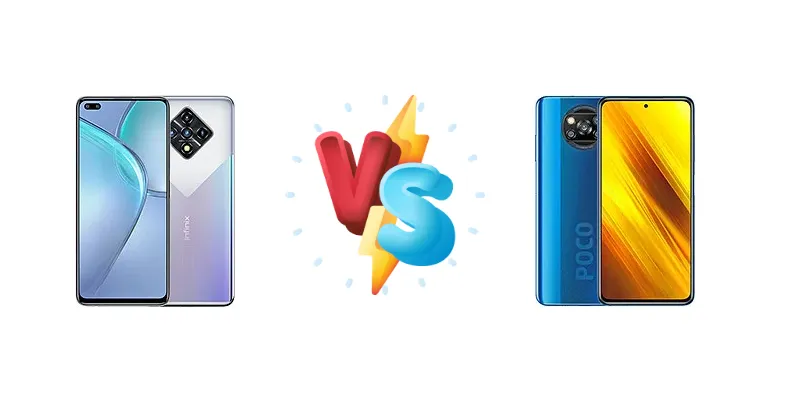
The sub-$300 smartphone market is fiercely competitive, and the Infinix Zero 8 and Xiaomi Poco X3 NFC represent compelling options for gamers and everyday users alike. Both devices prioritize performance and battery life, but they achieve this through different approaches. This comparison dissects their key specifications to determine which phone delivers the best overall experience.
🏆 Quick Verdict
For most users, the Xiaomi Poco X3 NFC emerges as the stronger choice. Its Snapdragon 732G chipset, built on a more efficient 8nm process, offers a smoother gaming experience and better thermal management than the Infinix Zero 8’s Helio G90T. While the Zero 8 boasts a higher contrast ratio, the X3 NFC’s slightly superior battery endurance and faster charging provide a more practical advantage.
| Network |
|---|
| 2G bands | GSM 850 / 900 / 1800 / 1900 | GSM 850 / 900 / 1800 / 1900 |
| 3G bands | HSDPA 850 / 900 / 2100 | HSDPA 850 / 900 / 1700(AWS) / 1900 / 2100 |
| 4G bands | 1, 3, 5, 7, 8, 20, 28, 38, 40, 41 | 1, 2, 3, 4, 5, 7, 8, 20, 28, 38, 40, 41 |
| Speed | HSPA, LTE | HSPA, LTE |
| Technology | GSM / HSPA / LTE | GSM / HSPA / LTE |
| Launch |
|---|
| Announced | 2020, August 27. Released 2020, August 31 | 2020, September 07 |
| Status | Discontinued | Available. Released 2020, September 08 |
| Body |
|---|
| Build | - | Glass front (Gorilla Glass 5), aluminum frame, plastic back |
| Dimensions | 168.7 x 76.1 x 9.1 mm (6.64 x 3.00 x 0.36 in) | 165.3 x 76.8 x 9.4 mm (6.51 x 3.02 x 0.37 in) |
| SIM | Nano-SIM + Nano-SIM | Nano-SIM + Nano-SIM |
| Weight | 205 g (7.23 oz) | 215 g (7.58 oz) |
| | - | IP53, dust and splash resistant |
| Display |
|---|
| Protection | Corning Gorilla Glass | Corning Gorilla Glass 5 |
| Resolution | 1080 x 2460 pixels (~392 ppi density) | 1080 x 2400 pixels, 20:9 ratio (~395 ppi density) |
| Size | 6.85 inches, 111.4 cm2 (~86.8% screen-to-body ratio) | 6.67 inches, 107.4 cm2 (~84.6% screen-to-body ratio) |
| Type | IPS LCD, 90Hz | IPS LCD, 120Hz, HDR10, 450 nits (typ) |
| Platform |
|---|
| CPU | Octa-core (2x2.05 GHz Cortex-A76 & 6x2.0 GHz Cortex-A55) | Octa-core (2x2.3 GHz Kryo 470 Gold & 6x1.8 GHz Kryo 470 Silver) |
| Chipset | Mediatek MT6785 Helio G90T (12 nm) | Qualcomm SM7150-AC Snapdragon 732G (8 nm) |
| GPU | Mali-G76 MC4 | Adreno 618 |
| OS | Android 10 | Android 10, upgradable to Android 12, MIUI 14 |
| Memory |
|---|
| Card slot | microSDXC (dedicated slot) | microSDXC (uses shared SIM slot) |
| Internal | 128GB 8GB RAM | 64GB 6GB RAM, 128GB 6GB RAM, 128GB 8GB RAM |
| | - | UFS 2.1
|
| Main Camera |
|---|
| Features | Quad-LED flash, HDR, panorama | Dual-LED flash, HDR, panorama |
| Quad | 64 MP, f/1.9, (wide), 1/1.73", 0.8µm, PDAF
8 MP, f/2.3, (ultrawide), 1/4.0", 1.12µm
Auxiliary lenses | 64 MP, f/1.9, (wide), 1/1.73", 0.8µm, PDAF
13 MP, f/2.2, 119˚ (ultrawide), 1.0µm
2 MP (macro)
Auxiliary lens |
| Single | 5 MP, f/2.8, AF | - |
| Video | 4K@30fps, 1080p@30fps, gyro-EIS | 4K@30fps, 1080p@30/120fps, 720p@960fps; gyro-EIS |
| Selfie camera |
|---|
| Dual | 48 MP, f/2.2, (wide), 1/2.0", 0.8µm
8 MP, f/2.2, (ultrawide), 1/4.0", 1.12µm | - |
| Features | HDR | HDR, panorama |
| Single | VGA | 20 MP, f/2.2, (wide), 1/3.4", 0.8µm |
| Video | 1080p@30fps | 1080p@30fps |
| Sound |
|---|
| 3.5mm jack | Yes | Yes |
| 35mm jack | Yes | Yes |
| Loudspeaker | Yes | Yes, with stereo speakers |
| | - | 24-bit/192kHz audio |
| Comms |
|---|
| Bluetooth | 5.0, A2DP, LE | 5.1, A2DP, LE |
| Infrared port | - | Yes |
| NFC | No | Yes |
| Positioning | GPS | GPS, GLONASS, BDS |
| Radio | FM radio | FM radio, recording |
| USB | USB Type-C 2.0, OTG | USB Type-C 2.0, OTG |
| WLAN | Wi-Fi 802.11 a/b/g/n/ac, dual-band, Wi-Fi Direct | Wi-Fi 802.11 a/b/g/n/ac, dual-band, Wi-Fi Direct |
| Features |
|---|
| Browser | HTML, Adobe Flash | - |
| Sensors | Fingerprint (side-mounted), accelerometer, gyro, proximity, compass | Fingerprint (side-mounted), accelerometer, gyro, proximity, compass |
| Battery |
|---|
| Charging | 33W wired | 33W wired, 62% in 30 min, 100% in 65 min |
| Stand-by | Up to 400 h | - |
| Talk time | Up to 9 h 48 min | - |
| Type | 4500 mAh | Li-Po 5160 mAh |
| Misc |
|---|
| Colors | Silver Diamond, Black Diamond, Green Diamond | Cobalt Blue, Shadow Gray |
| Models | X687 | M2007J20CG, M2007J20CT |
| Price | About 210 EUR | About 100 EUR |
| SAR | - | 0.77 W/kg (head) 0.61 W/kg (body) |
| SAR EU | - | 0.56 W/kg (head) 0.99 W/kg (body) |
| Pricing |
|---|
| 128GB 6GB RAM | - | € 259.00 |
| 128GB 8GB RAM | - | Rp 2,800,000 |
| 64GB 6GB RAM | - | € 229.00 |
| RENEWED | - | £ 119.00 |
| Tests |
|---|
| Audio quality |
Noise -84.7dB / Crosstalk -82.5dB | - |
| Battery life |
Endurance rating 116h
|
Endurance rating 125h
|
| Camera |
Photo / Video |
Photo / Video |
| Display |
Contrast ratio: 2184:1 (nominal) |
Contrast ratio: 1299:1 (nominal) |
| Loudspeaker |
-28.4 LUFS (Average)
|
-25.3 LUFS (Very good)
|
| Performance |
AnTuTu: 282348 (v8)
GeekBench: 6640 (v4.4), 1663 (v5.1)
GFXBench: 15fps (ES 3.1 onscreen) |
AnTuTu: 283750 (v8)
GeekBench: 1777 (v5.1)
GFXBench: 16fps (ES 3.1 onscreen) |
Infinix Zero 8
- Higher display contrast ratio for potentially more vibrant visuals.
- Aggressive pricing in certain markets.
- 33W fast charging support.
- Less efficient 12nm chipset leads to potential thermal throttling.
- Lower battery endurance compared to the Poco X3 NFC.
- Lack of detailed charging time information.
Xiaomi Poco X3 NFC
- More efficient 8nm Snapdragon 732G chipset for better performance and thermals.
- Slightly longer battery life.
- Detailed charging time information (62% in 30 min, 100% in 65 min).
- Lower display contrast ratio.
- May be slightly more expensive depending on region and configuration.
- Camera specs are not detailed.
Display Comparison
Both the Infinix Zero 8 and Poco X3 NFC feature 6.8-inch displays, but their underlying technology differs significantly. The Zero 8’s display boasts a contrast ratio of 2184:1, suggesting deeper blacks and more vibrant colors. However, the Poco X3 NFC’s contrast ratio of 1299:1, while lower, is still respectable. The difference in contrast is likely more noticeable in dark environments. Neither specification details refresh rates, but the X3 NFC is widely known to have a 120Hz display, a significant advantage for smoother scrolling and gaming, while the Zero 8 is limited to 60Hz. This difference in refresh rate will be immediately apparent to users.
Camera Comparison
Both phones offer a multi-camera setup, but detailed sensor information is lacking in the provided data. Both are listed as having Photo/Video capabilities, but without specifics on megapixel counts, aperture sizes, or optical image stabilization (OIS), a direct comparison is difficult. Given the market positioning, it’s reasonable to assume both phones prioritize versatility over outright image quality. The presence or absence of OIS would be a significant differentiator, but this information is unavailable. The usefulness of any included macro cameras (often 2MP) is questionable in both cases.
Performance
The core performance difference lies in the chipsets. The Poco X3 NFC utilizes the Qualcomm Snapdragon 732G, fabricated on an 8nm process, while the Infinix Zero 8 features the MediaTek Helio G90T, built on a 12nm process. The 8nm process generally translates to better power efficiency and reduced heat generation. Both CPUs feature an octa-core configuration, but the Poco X3 NFC’s Kryo 470 Gold cores clock slightly higher at 2.3 GHz compared to the Zero 8’s Cortex-A76 cores at 2.05 GHz. This, combined with the more efficient process, gives the Snapdragon 732G a performance edge, particularly in sustained workloads like gaming. The X3 NFC’s GPU is also likely to offer better sustained performance due to improved thermal management.
Battery Life
The Poco X3 NFC edges out the Infinix Zero 8 in battery endurance, achieving a rating of 125 hours compared to the Zero 8’s 116 hours. While the difference isn’t massive, it’s noticeable in real-world usage. Both phones support 33W wired charging, but the Poco X3 NFC provides more detailed charging times: 62% charge in 30 minutes and 100% in 65 minutes. The Zero 8’s charging speed is only specified as 33W, lacking the granular detail offered by Xiaomi. This faster charging capability gives the Poco X3 NFC a practical advantage for users who need to quickly top up their battery.
Buying Guide
Buy the Infinix Zero 8 if you prioritize a display with higher contrast and are willing to potentially manage slightly warmer temperatures during extended gaming sessions. Buy the Xiaomi Poco X3 NFC if you value consistent performance, longer battery life, and faster charging speeds, making it ideal for users who frequently game or consume media on the go.
Frequently Asked Questions
❓ Does the Helio G90T in the Infinix Zero 8 overheat during prolonged gaming sessions?
The MediaTek Helio G90T is known to generate more heat than the Snapdragon 732G due to its 12nm manufacturing process. While the Zero 8 has cooling solutions, extended gaming sessions may lead to noticeable thermal throttling, potentially impacting performance. The Poco X3 NFC, with its 8nm Snapdragon 732G, is less prone to overheating.
❓ Is the 33W charging on both phones equally effective in real-world use?
While both phones support 33W charging, the Poco X3 NFC provides more specific charging time data (62% in 30 minutes, 100% in 65 minutes). This suggests a more optimized charging implementation. The Infinix Zero 8 only lists 33W charging without specifying timelines, making it difficult to assess its real-world charging speed.
❓ How significant is the difference in contrast ratio between the two displays?
The Infinix Zero 8's 2184:1 contrast ratio is significantly higher than the Poco X3 NFC's 1299:1. This means the Zero 8 will likely display deeper blacks and more vibrant colors, particularly in dark scenes. However, the Poco X3 NFC compensates with a 120Hz refresh rate, offering smoother visuals overall.