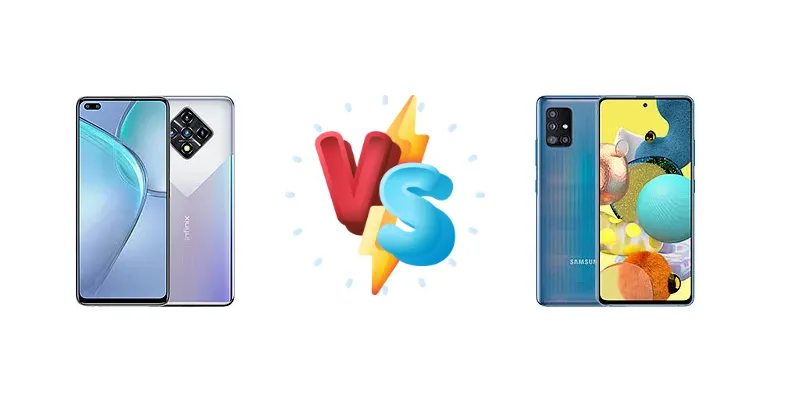
The Infinix Zero 8 and Samsung Galaxy A51 5G UW represent distinct approaches to the mid-range smartphone market. The Zero 8 aggressively targets gamers with its powerful MediaTek Helio G90T chipset, while the A51 5G UW prioritizes 5G connectivity and broader usability with the Qualcomm Snapdragon 765G. This comparison dissects their strengths and weaknesses to determine which device delivers the best value for your needs.
🏆 Quick Verdict
For users prioritizing raw gaming performance and fast charging, the Infinix Zero 8 is the clear winner. However, the Samsung Galaxy A51 5G UW offers a more balanced experience with 5G support and a more efficient processor, making it ideal for everyday users and those heavily invested in the 5G ecosystem.
| Network |
|---|
| 2G bands | GSM 850 / 900 / 1800 / 1900 | GSM 850 / 900 / 1800 / 1900 |
| 3G bands | HSDPA 850 / 900 / 2100 | HSDPA 850 / 900 / 1900 / 2100 |
| 4G bands | 1, 3, 5, 7, 8, 20, 28, 38, 40, 41 | 2, 4, 5, 13, 66 |
| 5G bands | - | 260, 261 mmWave |
| Speed | HSPA, LTE | HSPA, LTE, 5G |
| Technology | GSM / HSPA / LTE | GSM / HSPA / LTE / 5G |
| Launch |
|---|
| Announced | 2020, August 27. Released 2020, August 31 | 2020, August 14 |
| Status | Discontinued | Available. Released 2020, August 14 |
| Body |
|---|
| Build | - | Glass front (Gorilla Glass 3), plastic back, aluminum frame |
| Dimensions | 168.7 x 76.1 x 9.1 mm (6.64 x 3.00 x 0.36 in) | 158.8 x 73.4 x 8.6 mm (6.25 x 2.89 x 0.34 in) |
| SIM | Nano-SIM + Nano-SIM | Nano-SIM (pre-installed) |
| Weight | 205 g (7.23 oz) | 188.8 g (6.67 oz) |
| Display |
|---|
| Protection | Corning Gorilla Glass | Corning Gorilla Glass 3 |
| Resolution | 1080 x 2460 pixels (~392 ppi density) | 1080 x 2400 pixels, 20:9 ratio (~405 ppi density) |
| Size | 6.85 inches, 111.4 cm2 (~86.8% screen-to-body ratio) | 6.5 inches, 102.0 cm2 (~87.5% screen-to-body ratio) |
| Type | IPS LCD, 90Hz | Super AMOLED |
| Platform |
|---|
| CPU | Octa-core (2x2.05 GHz Cortex-A76 & 6x2.0 GHz Cortex-A55) | Octa-core (1x2.4 GHz Kryo 475 Prime & 1x2.2 GHz Kryo 475 Gold & 6x1.8 GHz Kryo 475 Silver) |
| Chipset | Mediatek MT6785 Helio G90T (12 nm) | Qualcomm SM7250 Snapdragon 765G 5G (7 nm) |
| GPU | Mali-G76 MC4 | Adreno 620 |
| OS | Android 10 | Android 10, One UI 2 |
| Memory |
|---|
| Card slot | microSDXC (dedicated slot) | microSDXC (uses shared SIM slot) |
| Internal | 128GB 8GB RAM | 128GB 6GB RAM |
| | - | UFS 2.1 |
| Main Camera |
|---|
| Features | Quad-LED flash, HDR, panorama | LED flash, panorama, HDR |
| Quad | 64 MP, f/1.9, (wide), 1/1.73", 0.8µm, PDAF
8 MP, f/2.3, (ultrawide), 1/4.0", 1.12µm
Auxiliary lenses | 48 MP, f/2.0, 26mm (wide), 1/2.0", 0.8µm, PDAF
12 MP, f/2.2, 123˚ (ultrawide)
5 MP (macro)
Auxiliary lens |
| Single | 5 MP, f/2.8, AF | 5 MP, AF |
| Video | 4K@30fps, 1080p@30fps, gyro-EIS | 4K@30fps, 1080p@30/120fps; gyro-EIS |
| Selfie camera |
|---|
| Dual | 48 MP, f/2.2, (wide), 1/2.0", 0.8µm
8 MP, f/2.2, (ultrawide), 1/4.0", 1.12µm | - |
| Features | HDR | HDR |
| Single | VGA | 32 MP, f/2.2, 26mm (wide), 1/2.8", 0.8µm |
| Video | 1080p@30fps | 4K@30fps, 1080p@30fps |
| Sound |
|---|
| 3.5mm jack | Yes | Yes |
| 35mm jack | Yes | Yes |
| Loudspeaker | Yes | Yes |
| Comms |
|---|
| Bluetooth | 5.0, A2DP, LE | 5.0, A2DP, LE |
| NFC | No | Yes |
| Positioning | GPS | GPS, GLONASS, GALILEO, BDS |
| Radio | FM radio | FM radio, RDS, recording |
| USB | USB Type-C 2.0, OTG | USB Type-C 2.0, OTG |
| WLAN | Wi-Fi 802.11 a/b/g/n/ac, dual-band, Wi-Fi Direct | Wi-Fi 802.11 a/b/g/n/ac, dual-band, Wi-Fi Direct |
| Features |
|---|
| Browser | HTML, Adobe Flash | - |
| Sensors | Fingerprint (side-mounted), accelerometer, gyro, proximity, compass | Fingerprint (under display, optical), accelerometer, gyro, proximity, compass |
| | - | ANT+ |
| Battery |
|---|
| Charging | 33W wired | 15W wired |
| Stand-by | Up to 400 h | Up to 672 h |
| Talk time | Up to 9 h 48 min | Up to 5 h |
| Type | 4500 mAh | Li-Po 4500 mAh |
| Misc |
|---|
| Colors | Silver Diamond, Black Diamond, Green Diamond | Prism Bricks Blue |
| Models | X687 | SM-A516V |
| Price | About 210 EUR | About 470 EUR |
| SAR | - | 0.70 W/kg (head) 1.25 W/kg (body) |
| SAR EU | - | 0.59 W/kg (head) 1.32 W/kg (body) |
| Tests |
|---|
| Audio quality |
Noise -84.7dB / Crosstalk -82.5dB | - |
| Battery life |
Endurance rating 116h
| - |
| Camera |
Photo / Video | - |
| Display |
Contrast ratio: 2184:1 (nominal) | - |
| Loudspeaker |
-28.4 LUFS (Average)
| - |
| Performance |
AnTuTu: 282348 (v8)
GeekBench: 6640 (v4.4), 1663 (v5.1)
GFXBench: 15fps (ES 3.1 onscreen) | - |
Infinix Zero 8
- Faster 33W charging for quick power-ups
- Potentially higher peak gaming performance with Helio G90T
- Strong contrast ratio (2184:1) for a vibrant display
- Less power-efficient chipset leading to potential throttling
- Lacks 5G connectivity
- Camera performance likely less refined than Samsung
Samsung Galaxy A51 5G UW
- Integrated 5G modem for faster data speeds
- More efficient Snapdragon 765G processor for better battery life
- Likely superior camera image processing and software features
- Slower 15W charging
- Potentially lower peak gaming performance compared to Zero 8
- May lack the Zero 8's display contrast
Display Comparison
Both phones lack detailed display specifications beyond the Infinix Zero 8's reported 2184:1 contrast ratio. Given the A51 5G UW's market positioning, it likely utilizes a Super AMOLED panel, known for vibrant colors and deep blacks, while the Zero 8 likely uses an IPS LCD. The absence of refresh rate data is a significant omission; however, the Zero 8's contrast ratio suggests a well-tuned display, though likely not as visually striking as a high-quality AMOLED. Bezels are expected to be comparable, typical of phones in this price bracket.
Camera Comparison
Both phones are listed with 'Photo / Video' capabilities, offering minimal insight. The A51 5G UW, given Samsung's camera expertise, likely features more sophisticated image processing algorithms. Sensor size and aperture data are crucial but missing. The Zero 8's focus on gaming suggests camera performance may be a secondary consideration. The presence of a 2MP macro lens on either device is largely inconsequential; image quality from such sensors is typically poor. The A51 5G UW likely benefits from Samsung's scene optimization and software features.
Performance
The core difference lies in the chipsets. The Infinix Zero 8's MediaTek Helio G90T (12nm) boasts an octa-core CPU with two high-performance Cortex-A76 cores clocked at 2.05 GHz, geared towards gaming. The Samsung Galaxy A51 5G UW's Snapdragon 765G (7nm) employs a more balanced CPU configuration with Kryo cores, prioritizing efficiency alongside performance. The 7nm process node of the Snapdragon 765G provides a significant advantage in thermal management and power efficiency, meaning less throttling during sustained loads. While the G90T offers peak performance, the 765G delivers smoother, more consistent performance over extended periods. The A51 5G UW also benefits from integrated 5G modem, a feature absent in the Zero 8.
Battery Life
The Infinix Zero 8 claims an endurance rating of 116 hours, suggesting a respectable battery life. However, the Helio G90T's power consumption is higher than the Snapdragon 765G. The A51 5G UW lacks a specific endurance rating, but the 7nm process and more efficient CPU should translate to comparable or better real-world battery life despite a potentially smaller battery capacity. Crucially, the Zero 8's 33W wired charging is significantly faster than the A51 5G UW's 15W charging, allowing for quicker top-ups.
Buying Guide
Buy the Infinix Zero 8 if you need a phone primarily for mobile gaming, demanding multitasking, and appreciate exceptionally fast 33W charging. You'll benefit from the G90T's raw power. Buy the Samsung Galaxy A51 5G UW if you prefer a phone with 5G connectivity, a more refined software experience, and better overall power efficiency for all-day use. It's the better choice for streaming, browsing, and casual gaming.
Frequently Asked Questions
❓ Does the MediaTek Helio G90T in the Infinix Zero 8 overheat during prolonged gaming sessions?
The Helio G90T is known to generate more heat than the Snapdragon 765G. While the Zero 8 likely has thermal management features, extended gaming at high settings may lead to noticeable throttling, reducing sustained performance. The 7nm process of the Snapdragon 765G in the A51 5G UW offers better thermal efficiency.
❓ How much faster is the 5G connectivity on the Samsung Galaxy A51 5G UW compared to 4G?
5G speeds on the A51 5G UW can be significantly faster than 4G, potentially reaching several gigabits per second depending on network conditions and carrier support. This translates to faster download and upload speeds, lower latency for online gaming, and smoother streaming of high-resolution video. However, 5G availability varies greatly by location.
❓ Is the 33W charging on the Infinix Zero 8 compatible with Power Delivery (PD) chargers?
While the Zero 8 supports 33W charging, compatibility with Power Delivery (PD) chargers isn't explicitly stated. It's likely to utilize MediaTek's Pump Express technology, which may not be fully compatible with all PD chargers. Using the included charger is recommended for optimal charging speeds.
❓ Will the Samsung Galaxy A51 5G UW receive future Android updates?
Samsung typically provides several years of software updates for its A-series devices. The A51 5G UW is likely to receive at least one major Android version update (potentially two) and several security patches. However, the exact update schedule is subject to change.