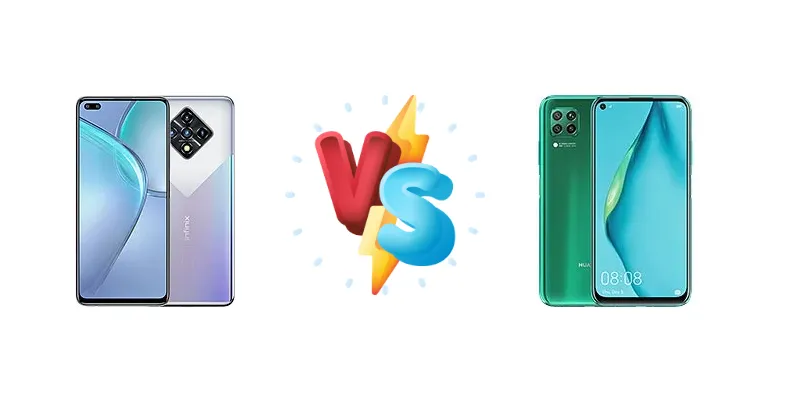
The mid-range smartphone market is fiercely competitive, and the Huawei nova 7i and Infinix Zero 8 represent compelling options for budget-conscious buyers. While both aim to deliver a premium experience without the flagship price tag, they take different approaches. The nova 7i leverages Huawei’s Kirin chipset and rapid charging, while the Zero 8 focuses on gaming performance with its MediaTek Helio G90T. This comparison dissects their strengths and weaknesses to determine which device best suits your needs.
🏆 Quick Verdict
For the average user prioritizing fast charging and a refined software experience, the Huawei nova 7i emerges as the winner. Its 40W charging significantly reduces downtime, and the Kirin 810 offers a balanced performance profile. However, gamers and those seeking maximum sustained performance may find the Infinix Zero 8’s Helio G90T more appealing.
| Network |
|---|
| 2G bands | GSM 850 / 900 / 1800 / 1900 | GSM 850 / 900 / 1800 / 1900 |
| 3G bands | HSDPA 850 / 900 / 2100 | HSDPA 800 / 850 / 900 / 1700(AWS) / 2100 |
| 4G bands | 1, 3, 5, 7, 8, 20, 28, 38, 40, 41 | 1, 2, 3, 4, 5, 7, 8, 18, 19, 20, 28, 34, 38, 39, 40, 41 - JNY-L21A, JNY-L01A, JNY-L21B |
| Speed | HSPA, LTE | HSPA 42.2/5.76 Mbps, LTE (2CA) Cat13 400/75 Mbps |
| Technology | GSM / HSPA / LTE | GSM / CDMA / HSPA / LTE |
| | - | 1, 2, 3, 4, 5, 7, 8, 18, 19, 28, 34, 38, 39, 40, 41 - JNY-L22A, JNY-L02A, JNY-L22B |
| Launch |
|---|
| Announced | 2020, August 27. Released 2020, August 31 | 2020, January 30. Released 2020, February 14 |
| Status | Discontinued | Discontinued |
| Body |
|---|
| Build | - | Glass front, plastic back, plastic frame |
| Dimensions | 168.7 x 76.1 x 9.1 mm (6.64 x 3.00 x 0.36 in) | 159.2 x 76.3 x 8.7 mm (6.27 x 3.00 x 0.34 in) |
| SIM | Nano-SIM + Nano-SIM | · Nano-SIM· Nano-SIM + Nano-SIM |
| Weight | 205 g (7.23 oz) | 183 g (6.46 oz) |
| Display |
|---|
| Protection | Corning Gorilla Glass | - |
| Resolution | 1080 x 2460 pixels (~392 ppi density) | 1080 x 2310 pixels (~398 ppi density) |
| Size | 6.85 inches, 111.4 cm2 (~86.8% screen-to-body ratio) | 6.4 inches, 101.4 cm2 (~83.5% screen-to-body ratio) |
| Type | IPS LCD, 90Hz | IPS LCD |
| Platform |
|---|
| CPU | Octa-core (2x2.05 GHz Cortex-A76 & 6x2.0 GHz Cortex-A55) | Octa-core (2x2.27 GHz Cortex-A76 & 6x1.88 GHz Cortex-A55) |
| Chipset | Mediatek MT6785 Helio G90T (12 nm) | Kirin 810 (7 nm) |
| GPU | Mali-G76 MC4 | Mali-G52 MP6 |
| OS | Android 10 | Android 10, EMUI 10, no Google Play Services |
| Memory |
|---|
| Card slot | microSDXC (dedicated slot) | Nano Memory (uses shared SIM slot) |
| Internal | 128GB 8GB RAM | 128GB 8GB RAM |
| | - | UFS 2.1 |
| Main Camera |
|---|
| Features | Quad-LED flash, HDR, panorama | LED flash, HDR, panorama |
| Quad | 64 MP, f/1.9, (wide), 1/1.73", 0.8µm, PDAF
8 MP, f/2.3, (ultrawide), 1/4.0", 1.12µm
Auxiliary lenses | 48 MP, f/1.8, 26mm (wide), 1/2.0", 0.8µm, PDAF
8 MP, f/2.4, (ultrawide)
2 MP (macro)
Auxiliary lens |
| Single | 5 MP, f/2.8, AF | - |
| Video | 4K@30fps, 1080p@30fps, gyro-EIS | 1080p@30fps |
| Selfie camera |
|---|
| Dual | 48 MP, f/2.2, (wide), 1/2.0", 0.8µm
8 MP, f/2.2, (ultrawide), 1/4.0", 1.12µm | - |
| Features | HDR | HDR |
| Single | VGA | 16 MP, f/2.0, (wide), 1/3.06", 1.0µm |
| Video | 1080p@30fps | 1080p@30fps |
| Sound |
|---|
| 3.5mm jack | Yes | Yes |
| 35mm jack | Yes | Yes |
| Loudspeaker | Yes | Yes |
| Comms |
|---|
| Bluetooth | 5.0, A2DP, LE | 5.1, A2DP, LE |
| NFC | No | No |
| Positioning | GPS | GPS, GLONASS, GALILEO, BDS, QZSS |
| Radio | FM radio | FM radio (market/region dependent) |
| USB | USB Type-C 2.0, OTG | USB Type-C 2.0, OTG |
| WLAN | Wi-Fi 802.11 a/b/g/n/ac, dual-band, Wi-Fi Direct | Wi-Fi 802.11 a/b/g/n/ac, dual-band, Wi-Fi Direct |
| Features |
|---|
| Browser | HTML, Adobe Flash | - |
| Sensors | Fingerprint (side-mounted), accelerometer, gyro, proximity, compass | Fingerprint (side-mounted), accelerometer, proximity, compass |
| Battery |
|---|
| Charging | 33W wired | 40W wired, 70% in 30 min |
| Stand-by | Up to 400 h | - |
| Talk time | Up to 9 h 48 min | - |
| Type | 4500 mAh | Li-Po 4200 mAh |
| Misc |
|---|
| Colors | Silver Diamond, Black Diamond, Green Diamond | Midnight Black, Crush Green, Sakura Pink |
| Models | X687 | JNY-L22B, JNY-L21A, JNY-L01A, JNY-L21B, JNY-L22A, JNY-L02A, JNY-LX2 |
| Price | About 210 EUR | About 240 EUR |
| Tests |
|---|
| Audio quality |
Noise -84.7dB / Crosstalk -82.5dB | - |
| Battery life |
Endurance rating 116h
| - |
| Camera |
Photo / Video | - |
| Display |
Contrast ratio: 2184:1 (nominal) | - |
| Loudspeaker |
-28.4 LUFS (Average)
| - |
| Performance |
AnTuTu: 282348 (v8)
GeekBench: 6640 (v4.4), 1663 (v5.1)
GFXBench: 15fps (ES 3.1 onscreen) | - |
Infinix Zero 8
- Strong gaming performance with Helio G90T
- Good contrast ratio for immersive viewing
- Respectable battery endurance
- Less efficient chipset compared to Kirin 810
- Slower charging speed than the nova 7i
- Limited display details available
Huawei nova 7i
- Faster 40W charging for minimal downtime
- More power-efficient Kirin 810 chipset
- Potentially better image processing
- Gaming performance may be slightly lower than Zero 8
- Display specifications are limited
- Software experience can be polarizing
Display Comparison
Both devices lack detailed display specifications beyond the Infinix Zero 8’s reported 2184:1 contrast ratio. However, given their price points, it’s safe to assume both utilize IPS LCD panels. The absence of high refresh rate information suggests both are likely capped at 60Hz. The contrast ratio on the Zero 8 indicates good black levels, potentially offering a more immersive viewing experience, but without detailed brightness measurements, a definitive winner is difficult to declare. Bezels are likely comparable, typical of mid-range devices.
Camera Comparison
Both phones list 'Photo / Video' capabilities, offering little concrete detail. Without megapixel counts or sensor sizes, a direct comparison is challenging. However, Huawei’s image processing algorithms are generally more refined, potentially leading to better dynamic range and color accuracy in the nova 7i. The prevalence of 2MP macro lenses in this segment suggests both devices likely include one, but these are often of limited practical use. The absence of OIS information suggests neither phone features optical image stabilization, relying instead on software stabilization.
Performance
The core difference lies in the chipsets. The Huawei nova 7i’s Kirin 810, fabricated on a 7nm process, generally offers better power efficiency than the Infinix Zero 8’s 12nm MediaTek Helio G90T. While the G90T boasts a slightly higher clock speed on its prime Cortex-A76 cores (2.05 GHz vs 2.27 GHz), the Kirin 810’s more advanced manufacturing process and architectural optimizations translate to superior sustained performance and thermal management. This means the nova 7i is less likely to throttle under prolonged load. The CPU configuration is similar – both feature a 2+6 core setup – but the Kirin 810’s GPU is generally more capable.
Battery Life
The Infinix Zero 8 boasts an endurance rating of 116 hours, indicating respectable battery life. However, the Huawei nova 7i’s 40W wired charging is a game-changer. It can reportedly reach 70% charge in just 30 minutes, significantly reducing downtime. While the Zero 8’s 33W charging is respectable, it doesn’t match the speed of the nova 7i. The actual battery capacity of both devices is unknown, but the faster charging of the nova 7i effectively mitigates any potential capacity disadvantage.
Buying Guide
Buy the Infinix Zero 8 if you need a phone primarily for gaming and demand sustained performance over extended sessions. Its Helio G90T chipset, while older, is optimized for gaming workloads. Buy the Huawei nova 7i if you prioritize fast charging, a more polished user interface, and a balanced everyday experience. The 40W charging is a significant advantage for users who are constantly on the go.
Frequently Asked Questions
❓ Does the Kirin 810 in the Huawei nova 7i suffer from overheating during extended gaming sessions?
The Kirin 810’s 7nm process and efficient thermal design generally prevent significant overheating. While it may get warm during prolonged gaming, it’s less prone to throttling compared to the Infinix Zero 8’s Helio G90T, ensuring more consistent performance.
❓ Is the 33W charging on the Infinix Zero 8 fast enough for daily use?
33W charging is respectable, but the Huawei nova 7i’s 40W charging is noticeably faster. While the Zero 8 will still charge adequately, the nova 7i’s quicker top-up times are a significant convenience for users who frequently need to recharge.
❓ How does the software experience differ between the two phones?
The Huawei nova 7i runs EMUI, which offers a feature-rich but sometimes heavily customized experience. The Infinix Zero 8 typically runs XOS, which is lighter but may lack the polish of EMUI. Software preference is subjective, but EMUI is known for its extensive customization options.
❓ Are the camera apps on both phones easy to use for casual photographers?
Both phones offer user-friendly camera apps with various shooting modes. Huawei’s app is generally more intuitive, while Infinix’s app provides more manual control options. Both are suitable for casual photography, but Huawei’s automatic modes are often more reliable.