
Infinix Zero 5G vs Samsung Galaxy A53 5G: A Detailed Comparison
| Phones Images | |||||
|---|---|---|---|---|---|
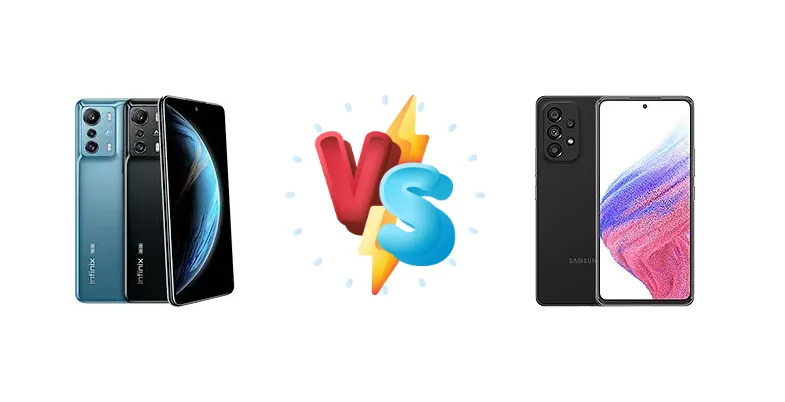
|
🏆 Quick Verdict
For the average user prioritizing display brightness and brand recognition, the Samsung Galaxy A53 5G is the better choice. However, the Infinix Zero 5G offers a compelling value proposition with its slightly more efficient chipset and longer endurance rating, making it ideal for users focused on maximizing battery life.
| PHONES | ||
|---|---|---|
| Phone Names | Infinix Zero 5G | Samsung Galaxy A53 5G |
| Network | ||
|---|---|---|
| 2G bands | GSM 850 / 900 / 1800 / 1900 | GSM 850 / 900 / 1800 / 1900 |
| 3G bands | HSDPA 850 / 900 / 1700(AWS) / 1900 / 2100 | HSDPA 850 / 900 / 1700(AWS) / 1900 / 2100 |
| 4G bands | 1, 2, 3, 4, 5, 7, 8, 17, 20, 28, 38, 40, 41, 66 - X6815 | 1, 2, 3, 4, 5, 7, 12, 14, 20, 29, 30, 38, 39, 40, 41, 46, 48, 66 - SM-A536U |
| 5G bands | 1, 3, 5, 7, 8, 20, 28, 38, 40, 41, 77, 78, 79 SA/NSA/Sub6 - X6815 | 2, 5, 41, 66, 77, 78 SA/NSA/Sub6/mmWave - SM-A536U |
| Speed | HSPA, LTE, 5G | HSPA, LTE, 5G |
| Technology | GSM / HSPA / LTE / 5G | GSM / HSPA / LTE / 5G |
| 1, 28, 38, 41, 77, 78, 79 SA/NSA/Sub6 - X6815B | 2, 5, 48, 66, 77, 78, 260, 261 SA/NSA/Sub6/mmWave - SM-A536V | |
| Launch | ||
|---|---|---|
| Announced | 2022, February 08 | 2022, March 17 |
| Status | Available. Released 2022, March 03 | Available. Released 2022, March 24 |
| Body | ||
|---|---|---|
| Build | Glass front, plastic frame, plastic back | Glass front (Gorilla Glass 5), plastic frame, plastic back |
| Dimensions | 168.7 x 76.5 x 8.8 mm (6.64 x 3.01 x 0.35 in) | 159.6 x 74.8 x 8.1 mm (6.28 x 2.94 x 0.32 in) |
| SIM | Nano-SIM + Nano-SIM | · Nano-SIM· Nano-SIM + Nano-SIM |
| Weight | 199 g (7.05 oz) | 189 g (6.67 oz) |
| - | IP67 dust/water resistant (up to 1m for 30 min) | |
| Display | ||
|---|---|---|
| Protection | - | Corning Gorilla Glass 5 |
| Resolution | 1080 x 2460 pixels (~388 ppi density) | 1080 x 2400 pixels, 20:9 ratio (~405 ppi density) |
| Size | 6.78 inches, 113.7 cm2 (~88.1% screen-to-body ratio) | 6.5 inches, 102.0 cm2 (~85.4% screen-to-body ratio) |
| Type | IPS LCD, 120Hz, 500 nits (peak) | Super AMOLED, 120Hz, 800 nits (HBM) |
| Platform | ||
|---|---|---|
| CPU | Octa-core (2x2.4 GHz Cortex-A78 & 6x2.0 GHz Cortex-A55) | Octa-core (2x2.4 GHz Cortex-A78 & 6x2.0 GHz Cortex-A55) |
| Chipset | Mediatek Dimensity 900 (6 nm) | Exynos 1280 (5 nm) |
| GPU | Mali-G68 MC4 | Mali-G68 |
| OS | Android 11, upgradable to Android 12, XOS 10.6 | Android 12, up to 4 major Android upgrades, One UI 8 |
| Memory | ||
|---|---|---|
| Card slot | microSDXC (dedicated slot) | microSDXC (uses shared SIM slot) |
| Internal | 128GB 8GB RAM | 128GB 4GB RAM, 128GB 6GB RAM, 128GB 8GB RAM, 256GB 6GB RAM, 256GB 8GB RAM |
| UFS 3.1 | - | |
| Main Camera | ||
|---|---|---|
| Features | Quad-LED flash, HDR, panorama | LED flash, panorama, HDR |
| Quad | - | 64 MP, f/1.8, 26mm (wide), 1/1.7X", 0.8µm, PDAF, OIS 12 MP, f/2.2, 123˚ (ultrawide), 1.12µm 5 MP (macro) Auxiliary lens |
| Single | 16 MP, f/2.0, (wide), 1/2.76", 1.12µm | 32 MP, f/2.2, 26mm (wide), 1/2.8", 0.8µm |
| Triple | 48 MP, f/1.8, 26mm (wide), 1/2.0", 0.8µm, PDAF 13 MP, f/2.5, 50mm (telephoto), 1/3.1", 1.12µm, PDAF, 2x optical zoom 2 MP | - |
| Video | 4K@30fps, 1080p@30/60fps | 4K@30fps, 1080p@30/60fps; gyro-EIS |
| Selfie camera | ||
|---|---|---|
| Features | Dual-LED flash | HDR |
| Single | 16 MP, f/2.0, (wide), 1/2.76", 1.12µm | 32 MP, f/2.2, 26mm (wide), 1/2.8", 0.8µm |
| Video | 1080p@30fps | 4K@30fps, 1080p@30fps |
| Sound | ||
|---|---|---|
| 3.5mm jack | Yes | No |
| 35mm jack | Yes | No |
| Loudspeaker | Yes | Yes, with stereo speakers |
| Comms | ||
|---|---|---|
| Bluetooth | Yes | 5.1, A2DP, LE |
| NFC | No | Yes (market/region dependent) |
| Positioning | GPS | GPS, GLONASS, GALILEO, BDS |
| Radio | FM radio | No |
| USB | USB Type-C 2.0, OTG | USB Type-C 2.0, OTG |
| WLAN | Wi-Fi 802.11 a/b/g/n/ac/6, dual-band, Wi-Fi Direct | Wi-Fi 802.11 a/b/g/n/ac, dual-band, Wi-Fi Direct |
| Features | ||
|---|---|---|
| Sensors | Fingerprint (side-mounted), accelerometer, gyro, proximity, compass | Fingerprint (under display, optical), accelerometer, gyro, compass, barometer (market/region dependent) |
| - | Virtual proximity sensing | |
| Battery | ||
|---|---|---|
| Charging | 33W wired | 25W wired |
| Type | 5000 mAh | Li-Po 5000 mAh |
| Misc | ||
|---|---|---|
| Colors | Cosmic Black, Skylight Orange, Horizon Blue | Black, White, Blue, Peach |
| Models | X6815, X6815B | SM-A536B, SM-A536B/DS, SM-A536U, SM-A536U1, SM-A5360, SM-A536E, SM-A536E/DS, SM-A536V, SM-A536W, SM-A536N, SM-S536DL |
| Price | About 250 EUR | $ 151.42 / £ 185.00 / € 169.14 |
| SAR | - | 0.75 W/kg (head) 1.58 W/kg (body) |
| SAR EU | - | 0.89 W/kg (head) 1.60 W/kg (body) |
| Tests | ||
|---|---|---|
| Battery life | Endurance rating 140h | Endurance rating 113h |
| Camera | Photo / Video | Photo / Video |
| Display | Contrast ratio: 1610:1 (nominal) | Contrast ratio: Infinite (nominal) |
| Loudspeaker | -27.6 LUFS (Good) | -26.5 LUFS (Good) |
| Performance | AnTuTu: 419083 (v8), 487639 (v9) GeekBench: 2169 (v5.1) GFXBench: 19fps (ES 3.1 onscreen) | AnTuTu: 329802 (v8), 379313 (v9) GeekBench: 1891 (v5.1) GFXBench: 19fps (ES 3.1 onscreen) |
Infinix Zero 5G
- Longer battery endurance (140h)
- Faster 33W charging
- Potentially better value for money
- Less bright display
- Less established brand reputation
- Camera performance is unknown
Samsung Galaxy A53 5G
- Brighter display (830 nits)
- More refined camera processing
- Established brand and software support
- Shorter battery endurance (113h)
- Slower 25W charging
- Potential for Exynos 1280 throttling
Display Comparison
The Samsung Galaxy A53 5G boasts a significantly brighter display, reaching a measured peak of 830 nits compared to the Infinix Zero 5G’s 499 nits. This difference is immediately noticeable in outdoor visibility. While the Infinix Zero 5G offers a respectable 1610:1 contrast ratio, Samsung’s ‘Infinite’ contrast ratio (likely a marketing term for a high-quality AMOLED panel) suggests deeper blacks and more vivid colors. The lack of information regarding panel technology for the Infinix Zero 5G suggests it utilizes an IPS LCD, which, while color accurate, won’t match the vibrancy of Samsung’s AMOLED.
Camera Comparison
Both phones feature photo and video capabilities, but detailed sensor information is missing. Without specifics, it’s difficult to make a definitive judgment. However, Samsung’s image processing is generally more refined and consistent, offering a more polished final product. The inclusion of Optical Image Stabilization (OIS) on the A53 (based on typical Samsung A-series features) would provide a significant advantage in low-light photography and video recording. The absence of details regarding the Infinix Zero 5G’s camera system makes it difficult to assess its capabilities beyond basic functionality.
Performance
Both devices utilize an octa-core CPU configuration with 2x2.4 GHz Cortex-A78 cores and 6x2.0 GHz Cortex-A55 cores, indicating similar CPU performance. However, the chipset differs: the Infinix Zero 5G employs the Mediatek Dimensity 900 (6nm), while the Samsung Galaxy A53 5G uses the Exynos 1280 (5nm). The 5nm process node of the Exynos 1280 *should* translate to better power efficiency and potentially less thermal throttling under sustained load, despite the similar core configuration. However, real-world performance will depend on Samsung’s software optimization. The lack of LPDDR5x RAM specification for either device suggests they likely use LPDDR5, which is still fast but not the latest standard.
Battery Life
The Infinix Zero 5G demonstrates a clear advantage in battery endurance, achieving a measured 140 hours compared to the Samsung Galaxy A53 5G’s 113 hours. This suggests more efficient power management or a larger battery capacity (though the exact mAh is not specified). While the Samsung Galaxy A53 5G supports 25W wired charging, the Infinix Zero 5G offers 33W wired charging, promising faster top-up times. The combination of longer endurance and faster charging makes the Infinix Zero 5G a more convenient option for users who prioritize battery life.
Buying Guide
Buy the Infinix Zero 5G if you need exceptional battery endurance and are comfortable with a less-established brand. Its 140-hour endurance rating and Dimensity 900 chipset provide a solid foundation for all-day use. Buy the Samsung Galaxy A53 5G if you prioritize a brighter, more vibrant display, a well-known brand with established software support, and a potentially smoother camera experience.