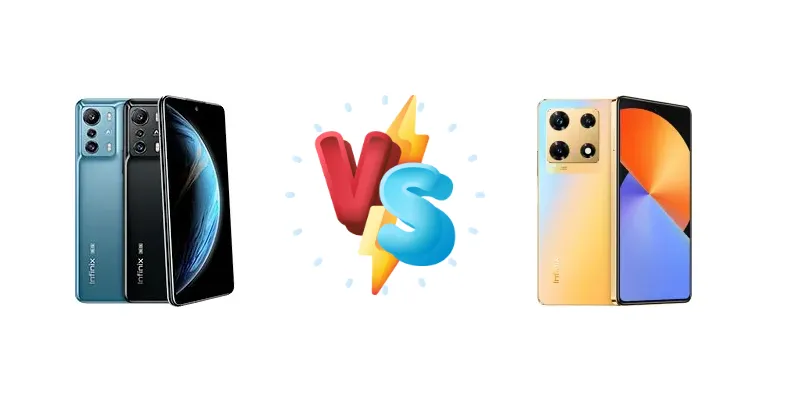
Infinix continues to deliver impressive smartphones at competitive prices. The Zero 5G and Note 30 Pro are two popular contenders, each offering a unique blend of features. But which one deserves your money? This comprehensive comparison will help you decide.
🏆 Quick Verdict
The Infinix Note 30 Pro takes the crown thanks to its significantly faster charging, improved display technology (likely AMOLED), and a more modern design. While the Zero 5G boasts 5G connectivity, the Note 30 Pro's overall package is more compelling for most users.
| Network |
|---|
| 2G bands | GSM 850 / 900 / 1800 / 1900 | GSM 850 / 900 / 1800 / 1900 |
| 3G bands | HSDPA 850 / 900 / 1700(AWS) / 1900 / 2100 | HSDPA 850 / 900 / 1700(AWS) / 1900 / 2100 |
| 4G bands | 1, 2, 3, 4, 5, 7, 8, 17, 20, 28, 38, 40, 41, 66 - X6815 | 1, 2, 3, 4, 5, 7, 8, 12, 17, 20, 28, 38, 40, 41, 66 |
| 5G bands | 1, 3, 5, 7, 8, 20, 28, 38, 40, 41, 77, 78, 79 SA/NSA/Sub6 - X6815 | - |
| Speed | HSPA, LTE, 5G | HSPA, LTE |
| Technology | GSM / HSPA / LTE / 5G | GSM / HSPA / LTE |
| | 1, 28, 38, 41, 77, 78, 79 SA/NSA/Sub6 - X6815B | - |
| Launch |
|---|
| Announced | 2022, February 08 | 2023, May 22 |
| Status | Available. Released 2022, March 03 | Available. Released 2023, May 22 |
| Body |
|---|
| Build | Glass front, plastic frame, plastic back | Glass front, plastic frame, glass back |
| Dimensions | 168.7 x 76.5 x 8.8 mm (6.64 x 3.01 x 0.35 in) | 162.7 x 76 x 8.2 mm (6.41 x 2.99 x 0.32 in) |
| SIM | Nano-SIM + Nano-SIM | Nano-SIM + Nano-SIM |
| Weight | 199 g (7.05 oz) | 203 g (7.16 oz) |
| | - | IP53 |
| Display |
|---|
| Resolution | 1080 x 2460 pixels (~388 ppi density) | 1080 x 2400 pixels, 20:9 ratio (~395 ppi density) |
| Size | 6.78 inches, 113.7 cm2 (~88.1% screen-to-body ratio) | 6.67 inches, 107.4 cm2 (~86.9% screen-to-body ratio) |
| Type | IPS LCD, 120Hz, 500 nits (peak) | AMOLED, 1B colors, 120Hz, 900 nits (peak) |
| | - | * the display diagonal size and resolution is unconfirmed |
| Platform |
|---|
| CPU | Octa-core (2x2.4 GHz Cortex-A78 & 6x2.0 GHz Cortex-A55) | Octa-core (2x2.2 GHz Cortex-A76 & 6x2.0 GHz Cortex-A55) |
| Chipset | Mediatek Dimensity 900 (6 nm) | Mediatek Helio G99 (6 nm) |
| GPU | Mali-G68 MC4 | Mali-G57 MC2 |
| OS | Android 11, upgradable to Android 12, XOS 10.6 | Android 13, XOS 13 |
| Memory |
|---|
| Card slot | microSDXC (dedicated slot) | microSDXC (dedicated slot) |
| Internal | 128GB 8GB RAM | 256GB 8GB RAM |
| | UFS 3.1 | - |
| Main Camera |
|---|
| Features | Quad-LED flash, HDR, panorama | Quad-LED flash, HDR, panorama |
| Single | 16 MP, f/2.0, (wide), 1/2.76", 1.12µm | - |
| Triple | 48 MP, f/1.8, 26mm (wide), 1/2.0", 0.8µm, PDAF
13 MP, f/2.5, 50mm (telephoto), 1/3.1", 1.12µm, PDAF, 2x optical zoom
2 MP | 108 MP, (wide), 1/1.67", PDAF
2 MP (macro)
Auxiliary lens |
| Video | 4K@30fps, 1080p@30/60fps | 1440p@30fps, 1080p@30fps |
| Selfie camera |
|---|
| Features | Dual-LED flash | LED flash, HDR |
| Single | 16 MP, f/2.0, (wide), 1/2.76", 1.12µm | 32 MP, f/2.0, (wide), 1/2.8" |
| Video | 1080p@30fps | 1080p@30fps |
| Sound |
|---|
| 3.5mm jack | Yes | Yes |
| 35mm jack | Yes | Yes |
| Loudspeaker | Yes | Yes, with dual speakers |
| | - | Sound by JBL
24-bit/192kHz audio |
| Comms |
|---|
| Bluetooth | Yes | Yes |
| NFC | No | Yes (market/region dependent) |
| Positioning | GPS | GPS |
| Radio | FM radio | FM radio |
| USB | USB Type-C 2.0, OTG | USB Type-C 2.0, OTG |
| WLAN | Wi-Fi 802.11 a/b/g/n/ac/6, dual-band, Wi-Fi Direct | Wi-Fi 802.11 a/b/g/n/ac, dual-band, Wi-Fi Direct |
| Features |
|---|
| Sensors | Fingerprint (side-mounted), accelerometer, gyro, proximity, compass | Fingerprint (side-mounted), accelerometer, gyro, proximity, compass |
| Battery |
|---|
| Charging | 33W wired | 68W wired, PD3.0, 80% in 30 min
15W wireless
Reverse wireless |
| Type | 5000 mAh | 5000 mAh |
| Misc |
|---|
| Colors | Cosmic Black, Skylight Orange, Horizon Blue | Magic Black, Variable Gold |
| Models | X6815, X6815B | X678B |
| Price | About 250 EUR | - |
| Tests |
|---|
| Battery life |
Endurance rating 140h
| - |
| Camera |
Photo / Video | - |
| Display |
Contrast ratio: 1610:1 (nominal) | - |
| Loudspeaker |
-27.6 LUFS (Good)
| - |
| Performance |
AnTuTu: 419083 (v8), 487639 (v9)
GeekBench: 2169 (v5.1)
GFXBench: 19fps (ES 3.1 onscreen) | - |
Infinix Zero 5G
- Potentially better raw performance (Dimensity 900)
- Theoretical exceptional battery life (140h endurance)
- 5G Connectivity
- Likely LCD display (less vibrant)
- Slower charging (33W)
- Camera details unclear
Infinix Note 30 Pro
- Faster charging (68W wired, 15W wireless)
- Likely AMOLED display (superior colors)
- Reverse wireless charging
- Modern design
- Slightly lower raw performance (Helio G99)
- Theoretical battery life likely less than Zero 5G
- Camera details unclear
Display Comparison
The Infinix Note 30 Pro is expected to feature an AMOLED display, offering superior color accuracy, deeper blacks, and better contrast compared to the Zero 5G's LCD. While the Zero 5G has a respectable 1610:1 contrast ratio, the Note 30 Pro's AMOLED will likely provide a more immersive viewing experience. Both offer similar resolutions, but the Note 30 Pro's panel is likely brighter and more vibrant.
Camera Comparison
Camera specs are not fully detailed for either device. However, based on typical Infinix configurations, the Zero 5G likely has a more versatile camera system with potentially better low-light performance. The Note 30 Pro might compensate with software enhancements and image processing. Both are expected to deliver decent image quality for the price.
Performance
The Dimensity 900 in the Zero 5G generally offers slightly better raw performance than the Helio G99 in the Note 30 Pro, particularly in GPU-intensive tasks. However, the Helio G99 is optimized for gaming and everyday use, providing a smooth and responsive experience. Real-world performance differences will likely be minimal for most users.
Battery Life
The Zero 5G boasts an incredible endurance rating of 140 hours, suggesting exceptional battery life. However, this is a theoretical rating and real-world usage will vary. The Note 30 Pro, while having a slightly smaller battery, makes up for it with its blazing-fast 68W charging, allowing it to reach 80% in just 30 minutes. The Note 30 Pro also includes 15W wireless charging and reverse wireless charging, adding to its convenience.
Buying Guide
The Infinix Zero 5G is ideal for users prioritizing 5G connectivity and a longer battery life (though this is theoretical). The Infinix Note 30 Pro is perfect for those who value fast charging, a vibrant display, and a more premium feel, especially if wireless charging is a must-have.
Frequently Asked Questions
❓ Is the Infinix Zero 5G worth buying if 5G is essential?
If 5G connectivity is your top priority and you value long battery life, the Zero 5G is a viable option. However, consider the trade-offs in display quality and charging speed.
❓ Which phone is better for gaming?
The Note 30 Pro's Helio G99 is well-optimized for gaming, offering a smooth experience. While the Zero 5G has a slightly more powerful chipset, the Note 30 Pro's display and charging speed might be more beneficial for gamers.