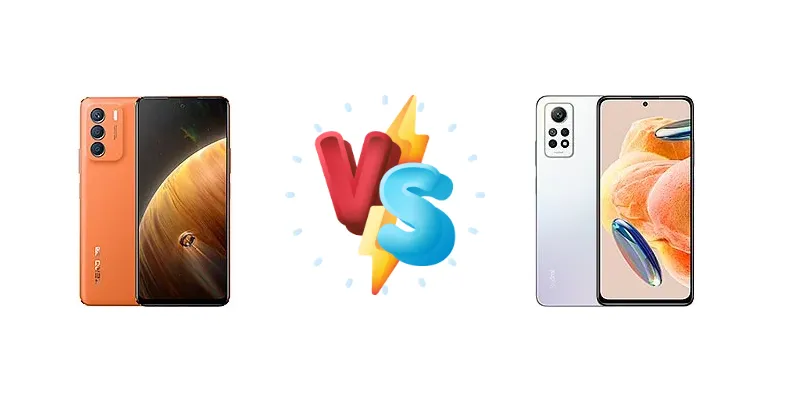
The mid-range smartphone market is fiercely competitive, and the Infinix Zero 5G 2023 and Xiaomi Redmi Note 12 Pro 4G are two strong contenders. Both offer compelling features at attractive price points, but cater to slightly different needs. Let's dive into a detailed comparison to help you decide which one deserves your money.
🏆 Quick Verdict
The Redmi Note 12 Pro 4G takes the lead with its significantly faster charging and generally smoother 4G experience. However, the Infinix Zero 5G 2023 offers 5G connectivity and a potentially more powerful chipset for future-proofing, making it a worthwhile consideration for those prioritizing 5G.
| Network |
|---|
| 2G bands | GSM 850 / 900 / 1800 / 1900 | GSM 850 / 900 / 1800 / 1900 |
| 3G bands | HSDPA 850 / 900 / 1700(AWS) / 1900 / 2100 | HSDPA 850 / 900 / 1700(AWS) / 1900 / 2100 |
| 4G bands | 1, 2, 3, 4, 5, 7, 8, 20, 28, 38, 40, 41, 66 | 1, 2, 3, 4, 5, 7, 8, 20, 28, 38, 40, 41, 66 |
| 5G bands | 1, 3, 5, 7, 8, 20, 28, 38, 40, 41, 66, 71, 77, 78 SA/NSA/Sub6 | - |
| Speed | HSPA, LTE, 5G | HSPA, LTE |
| Technology | GSM / HSPA / LTE / 5G | GSM / HSPA / LTE |
| Launch |
|---|
| Announced | 2022, November 08 | 2023, March 03 |
| Status | Available. Released 2022, December 01 | Available. Released 2023, April 11 |
| Body |
|---|
| Build | Glass front, plastic frame, plastic back | - |
| Dimensions | 168.7 x 76.5 x 8.9 mm (6.64 x 3.01 x 0.35 in) | 164.2 x 76.1 x 8.1 mm (6.46 x 3.00 x 0.32 in) |
| SIM | Nano-SIM + Nano-SIM | Nano-SIM + Nano-SIM |
| Weight | 201 g (7.09 oz) | 201.8 g (7.13 oz) |
| Display |
|---|
| Resolution | 1080 x 2460 pixels (~396 ppi density) | 1080 x 2400 pixels, 20:9 ratio (~395 ppi density) |
| Size | 6.78 inches, 109.2 cm2 (~84.6% screen-to-body ratio) | 6.67 inches, 107.4 cm2 (~86.0% screen-to-body ratio) |
| Type | IPS LCD, 120Hz, 500 nits (peak) | AMOLED, 120Hz, Dolby Vision, 700 nits (HBM), 1100 nits (peak) |
| Platform |
|---|
| CPU | Octa-core (2x2.6 GHz Cortex-A78 & 6x2.0 GHz Cortex-A55)Octa-core (2x2.5 GHz Cortex-A78 & 6x2.0 GHz Cortex-A55) - X6815D | Octa-core (2x2.2 GHz Kryo 470 Gold & 6x1.8 GHz Kryo 470 Silver) |
| Chipset | Mediatek Dimensity 1080Mediatek Dimensity 920 (6 nm) - X6815D | Qualcomm SM7150 Snapdragon 732G (8 nm) |
| GPU | Mali-G68 MC4 | Adreno 618 |
| OS | Android 12, upgradable to Android 13, XOS 13 | Android 11, MIUI 13 |
| Memory |
|---|
| Card slot | microSDXC (dedicated slot) | microSDXC (uses shared SIM slot) |
| Internal | 256GB 8GB RAM | 128GB 6GB RAM, 128GB 8GB RAM, 256GB 8GB RAM |
| | - | UFS 2.2 |
| Main Camera |
|---|
| Features | Quad-LED flash, HDR, panorama | LED flash, HDR, panorama |
| Quad | - | 108 MP, f/1.9, (wide), 1/1.52", 0.7µm, PDAF
8 MP, 120˚, (ultrawide)
2 MP (macro)
Auxiliary lens |
| Single | 16 MP, f/2.0, (wide), 1/3", 1.0µm | - |
| Triple | 50 MP, f/1.6, (wide), PDAF
2 MP (macro)
Auxiliary lens | - |
| Video | 4K@30fps, 1080p@30/60fps | 4K@30fps, 1080p@30/60fps |
| Selfie camera |
|---|
| Features | Dual-LED flash | - |
| Single | 16 MP, f/2.0, (wide), 1/3", 1.0µm | 16 MP, f/2.4, (wide) |
| Video | 1080p@30fps | 1080p@30fps |
| Sound |
|---|
| 3.5mm jack | Yes | Yes |
| 35mm jack | Yes | Yes |
| Loudspeaker | Yes | Yes, with stereo speakers |
| | 24-bit/192kHz audio | - |
| Comms |
|---|
| Bluetooth | Yes | 5.0, A2DP, LE |
| Infrared port | - | Yes |
| NFC | Yes | Yes (market/region dependent) |
| Positioning | GPS | GPS, GLONASS, GALILEO, BDS |
| Radio | FM radio | Unspecified |
| USB | USB Type-C 2.0, OTG | USB Type-C 2.0, OTG |
| WLAN | Wi-Fi 802.11 a/b/g/n/ac/6, dual-band | Wi-Fi 802.11 a/b/g/n/ac, dual-band |
| Features |
|---|
| Sensors | Fingerprint (side-mounted), accelerometer, gyro, proximity, compass | Fingerprint (side-mounted), accelerometer, gyro, compass |
| Battery |
|---|
| Charging | 33W wired | 67W wired |
| Type | 5000 mAh | Li-Po 5000 mAh |
| Misc |
|---|
| Colors | Pearly White, Coral Orange, Submarine Black | Star Blue, Graphite Gray, Polar White, Ice blue |
| Models | X6815C, X6815D | 2209116AG, 2209116AG |
| Price | About 250 EUR | About 150 EUR |
Infinix Zero 5G 2023
- 5G Connectivity
- Potentially more powerful chipset (Dimensity 1080)
- Competitive price
- Decent display
- Slower charging (33W)
- Camera performance slightly behind Redmi Note 12 Pro
- Software optimization could be improved
Xiaomi Redmi Note 12 Pro 4G
- 67W Fast Charging
- Excellent MIUI software optimization
- Versatile and capable camera system
- Smooth 120Hz display (typically)
- No 5G connectivity
- Snapdragon 732G chipset is less powerful than Dimensity 1080
- Design may be less striking than Infinix
Display Comparison
Both phones feature vibrant AMOLED displays, but the Redmi Note 12 Pro 4G often boasts a slightly higher refresh rate (typically 120Hz) for smoother scrolling and animations. The Zero 5G 2023's display is generally well-regarded, but the Redmi Note 12 Pro 4G's display often edges it out in terms of fluidity.
Camera Comparison
The Redmi Note 12 Pro 4G typically features a more versatile camera system, often including a higher resolution main sensor and improved image processing. While the Infinix Zero 5G 2023's camera is capable, the Redmi Note 12 Pro 4G generally produces more consistent and detailed photos, particularly in challenging lighting conditions.
Performance
The Dimensity 1080 in the Infinix Zero 5G 2023 generally offers better raw performance than the Snapdragon 732G in the Redmi Note 12 Pro 4G, especially in graphics-intensive tasks. However, Xiaomi's MIUI optimization often results in a more fluid and responsive daily experience. The 5G capabilities of the Infinix are a significant advantage for future-proofing.
Battery Life
The Redmi Note 12 Pro 4G's 67W fast charging is a major advantage, allowing for incredibly quick top-ups. The Infinix Zero 5G 2023's 33W charging is decent, but significantly slower. Battery capacity is generally comparable between the two devices.
Buying Guide
The Infinix Zero 5G 2023 is ideal for users who want 5G connectivity and are comfortable with a slightly less refined overall experience. The Xiaomi Redmi Note 12 Pro 4G is a better choice for those prioritizing fast charging, a polished user experience, and reliable 4G performance.
Frequently Asked Questions
❓ Is the Infinix Zero 5G 2023 worth buying if I don't need 5G?
If you don't need 5G, the Xiaomi Redmi Note 12 Pro 4G is likely a better choice due to its faster charging and generally more refined software experience.
❓ Which phone has better gaming performance?
The Infinix Zero 5G 2023 generally offers slightly better gaming performance thanks to its more powerful Dimensity 1080 chipset.