
Infinix Zero 40 vs Xiaomi 13T Pro: A Deep Dive into Mid-Range Power
| Phones Images | |||||
|---|---|---|---|---|---|
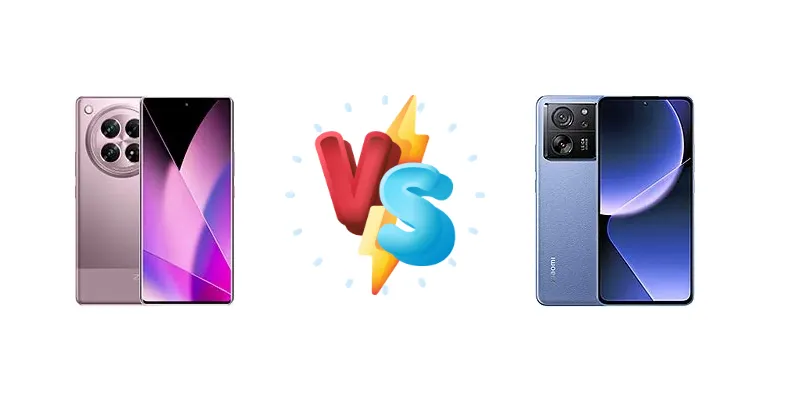
|
🏆 Quick Verdict
For the average user prioritizing speed and convenience, the Xiaomi 13T Pro is the clear winner. Its Dimensity 9200+ chipset offers a noticeable performance edge, and the 120W charging is a game-changer, fully charging the device in just 19 minutes. However, the Infinix Zero 40 provides a strong alternative for those seeking a more balanced package with wireless charging.
| PHONES | ||
|---|---|---|
| Phone Names | Infinix Zero 40 | Xiaomi 13T Pro |
| Network | ||
|---|---|---|
| 2G bands | GSM 850 / 900 / 1800 / 1900 | GSM 850 / 900 / 1800 / 1900 |
| 3G bands | HSDPA 850 / 900 / 1700(AWS) / 1900 / 2100 | HSDPA 800 / 850 / 900 / 1700(AWS) / 1900 / 2100 |
| 4G bands | 1, 2, 3, 4, 5, 7, 8, 12, 17, 20, 28, 38, 40, 41, 42, 66 | 1, 2, 3, 4, 5, 7, 8, 12, 13, 17, 18, 19, 20, 25, 26, 28, 32, 38, 39, 40, 41, 42, 48, 66 |
| 5G bands | 1, 3, 5, 7, 8, 12, 20, 28, 38, 40, 41, 66, 77, 78 SA/NSA/Sub6 | 1, 3, 5, 7, 8, 20, 28, 38, 40, 41, 66, 75, 77, 78 SA/NSA |
| Speed | HSPA, LTE, 5G | HSPA, LTE, 5G |
| Technology | GSM / HSPA / LTE / 5G | GSM / HSPA / LTE / 5G |
| Launch | ||
|---|---|---|
| Announced | 2024, August 29 | 2023, September 26 |
| Status | Available. Released 2024, September 08 | Available. Released 2023, September 26 |
| Body | ||
|---|---|---|
| Build | - | Glass front (Gorilla Glass 5), glass back or silicone polymer back, plastic frame |
| Dimensions | 164.3 x 74.8 x 7.9 mm (6.47 x 2.94 x 0.31 in) | 162.2 x 75.7 x 8.5 mm (6.39 x 2.98 x 0.33 in) |
| SIM | Nano-SIM + Nano-SIM | · Nano-SIM + eSIM· Nano-SIM + Nano-SIM |
| Weight | 195 g (6.88 oz) | 200 g or 206 g (7.05 oz) |
| Display | ||
|---|---|---|
| Protection | Corning Gorilla Glass 5 | Corning Gorilla Glass 5 |
| Resolution | 1080 x 2436 pixels (~393 ppi density) | 1220 x 2712 pixels, 20:9 ratio (~446 ppi density) |
| Size | 6.78 inches, 109.9 cm2 (~89.4% screen-to-body ratio) | 6.67 inches, 107.4 cm2 (~87.5% screen-to-body ratio) |
| Type | AMOLED, 1B colors, HDR, 144Hz, 1300 nits (HBM) | AMOLED, 68B colors, 144Hz, Dolby Vision, HDR10+, 1200 nits (HBM), 2600 nits (peak) |
| Platform | ||
|---|---|---|
| CPU | Octa-core (1x3.1 GHz Cortex-A78 & 3x3.0 GHz Cortex-A78 & 4x2.0 GHz Cortex-A55) | Octa-core (1x3.35 GHz Cortex-X3 & 3x3.0 GHz Cortex-A715 & 4x2.0 GHz Cortex-A510) |
| Chipset | Mediatek Dimensity 8200 Ultimate (4 nm) | Mediatek Dimensity 9200+ (4 nm) |
| GPU | Mali-G610 MC6 | Immortalis-G715 MC11 |
| OS | Android 14, up to 2 major Android upgrades, XOS 14.5 | Android 13, up to 4 major Android upgrades, HyperOS |
| Memory | ||
|---|---|---|
| Card slot | No | No |
| Internal | 256GB 12GB RAM, 512GB 12GB RAM | 256GB 12GB RAM, 512GB 12GB RAM, 1TB 16GB RAM |
| Main Camera | ||
|---|---|---|
| Features | Triple-LED flash, HDR, panorama | Leica lens, color spectrum sensor, LED flash, HDR, panorama |
| Triple | 108 MP, f/1.8, (wide), 1/1.67", PDAF, OIS 50 MP, f/2.0, 120˚, (ultrawide), 1/2.76", PDAF Auxiliary lens | 50 MP, f/1.9, 24mm (wide), 1/1.28", 1.22µm, PDAF, OIS 50 MP, f/1.9, 50mm (telephoto), 1/2.88", 0.61µm, PDAF, 2x optical zoom 12 MP, f/2.2, 15mm (ultrawide), 1/3.06", 1.12µm |
| Video | 4K@30/60fps, 1080p@30/60/120/240fps, gyro-EIS, OIS | 8K@24fps, 4K@24/30/60fps, 4K/1080p@30fps HDR10+, 1080p@30/60/120/240fps; 10-bit LOG, gyro-EIS |
| Selfie camera | ||
|---|---|---|
| Features | Dual-LED flash | HDR |
| Single | 50 MP, f/2.5, 21mm (wide), 1/2.76", PDAF | 20 MP, f/2.2, (wide), 0.8µm |
| Video | 4K@30/60fps, 1080p@30/60fps | 1080p@30fps, HDR10+ |
| Sound | ||
|---|---|---|
| 35mm jack | No | No |
| Loudspeaker | Yes, with dual speakers | Yes, with stereo speakers |
| Comms | ||
|---|---|---|
| Bluetooth | Yes | 5.4, A2DP, LE |
| Infrared port | Yes | Yes |
| NFC | Yes | Yes |
| Positioning | GPS | GPS (L1+L5), GLONASS (G1), GALILEO (E1+E5a), NavIC (L5), BDS |
| Radio | FM radio | No |
| USB | USB Type-C 2.0, OTG | USB Type-C 2.0, OTG |
| WLAN | Wi-Fi 802.11 a/b/g/n/ac/6e, dual-band | Wi-Fi 802.11 a/b/g/n/ac/6e/7, dual/tri-band (market/region dependent), Wi-Fi Direct |
| Features | ||
|---|---|---|
| Sensors | Fingerprint (under display, optical), accelerometer, gyro, proximity, compass | Fingerprint (under display, optical), accelerometer, gyro, proximity, compass |
| Battery | ||
|---|---|---|
| Charging | 45W wired, 60% in 25 min 20W wireless 10W reverse wired Bypass Charging 2.0 | 120W wired, PD3.0, QC4, 100% in 19 min |
| Type | 5000 mAh | Li-Po 5000 mAh |
| Misc | ||
|---|---|---|
| Colors | Rock Black, Violet Garden, Moving Titanium | Alpine Blue, Meadow Green, Black |
| Models | X6861 | 23078PND5G |
| Price | ₹ 27,999 | $ 370.00 / £ 482.55 / € 301.99 |
| SAR EU | - | 1.00 W/kg (head) 0.99 W/kg (body) |
Infinix Zero 40
- Wireless charging support
- Reverse wired charging
- Bypass Charging 2.0 for battery health
- Slower wired charging (45W)
- Less powerful chipset (Dimensity 8200 Ultimate)
Xiaomi 13T Pro
- Ultra-fast 120W wired charging
- More powerful chipset (Dimensity 9200+)
- Brighter display (1094 nits)
- No wireless charging
- Potentially more aggressive software features
Display Comparison
The Xiaomi 13T Pro boasts a significantly brighter display, reaching a measured peak of 1094 nits. While the Infinix Zero 40’s display specifications aren’t provided, this brightness difference will be immediately noticeable in outdoor conditions. The 13T Pro’s higher brightness also suggests a more robust panel capable of better HDR content reproduction. Without knowing the Zero 40’s panel type, it’s difficult to assess color accuracy or refresh rate capabilities, but the 13T Pro’s brightness gives it a clear advantage for visual clarity.
Camera Comparison
Detailed camera specifications for both devices are limited. However, the focus should be on the main sensors and image processing. Without knowing sensor sizes or apertures, it’s difficult to make a definitive judgment. The Xiaomi 13T Pro’s camera is listed as capable of both Photo and Video, suggesting a well-rounded approach. The Infinix Zero 40’s camera capabilities are unknown. It’s crucial to avoid placing weight on the presence of 2MP macro lenses, as these typically offer limited real-world benefit.
Performance
The core difference lies in the chipsets: the Xiaomi 13T Pro utilizes the Mediatek Dimensity 9200+, while the Infinix Zero 40 features the Dimensity 8200 Ultimate. Both are 4nm chips, but the 9200+ incorporates the Cortex-X3 prime core clocked at 3.35 GHz, a significant upgrade over the Zero 40’s Cortex-A78 core at 3.1 GHz. This translates to faster single-core performance on the 13T Pro, beneficial for app launch speeds and responsiveness. The 13T Pro’s CPU configuration (3x A715 vs 3x A78) also offers improved efficiency. While both phones likely utilize LPDDR5x RAM, the 13T Pro’s superior chipset will deliver a smoother experience in demanding games and multitasking scenarios.
Battery Life
The Xiaomi 13T Pro’s 120W wired charging is its standout feature, achieving a full charge in just 19 minutes. This is dramatically faster than the Infinix Zero 40’s 45W charging, which takes 25 minutes to reach 60%. The 13T Pro also supports PD3.0 and QC4, enhancing compatibility. The Zero 40 compensates with 20W wireless charging and 10W reverse wired charging, features absent on the 13T Pro. The 13T Pro’s active use score of 11:50h suggests excellent battery life, while the Zero 40’s battery capacity is not specified. The 13T Pro’s faster charging effectively mitigates any potential capacity disadvantage.
Buying Guide
Buy the Infinix Zero 40 if you need a phone with wireless charging capabilities, appreciate a more streamlined software experience, and prioritize a balanced feature set. Buy the Xiaomi 13T Pro if you prefer maximum performance for gaming and demanding tasks, value incredibly fast wired charging, and don't mind a potentially more feature-rich (and sometimes cluttered) software experience.