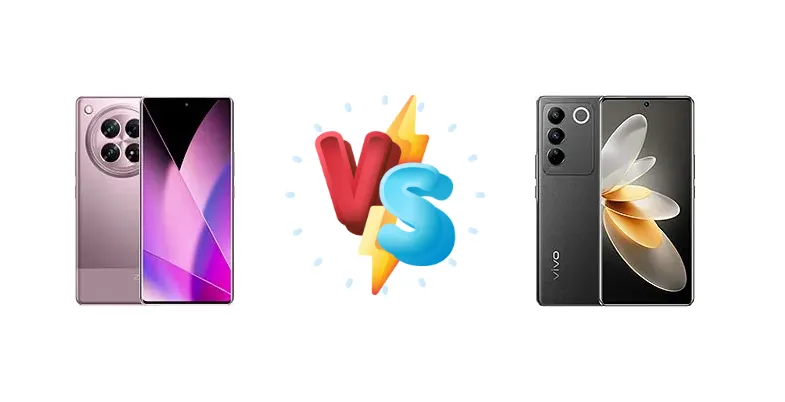
The Infinix Zero 40 and vivo V27 Pro both target the competitive mid-range smartphone market, powered by Mediatek’s Dimensity 8200 series. While sharing a similar chipset foundation, they diverge in charging capabilities, display characteristics, and overall feature sets. This comparison dissects these differences to determine which device delivers the most compelling user experience.
🏆 Quick Verdict
For the average user prioritizing rapid charging and a potentially smoother wireless experience, the Infinix Zero 40 emerges as the winner. Its 45W wired and 20W wireless charging, coupled with Bypass Charging 2.0, offer a tangible advantage over the vivo V27 Pro’s 66W wired charging, despite the latter’s slightly faster initial charge.
| Network |
|---|
| 2G bands | GSM 850 / 900 / 1800 / 1900 | GSM 850 / 900 / 1800 / 1900 |
| 3G bands | HSDPA 850 / 900 / 1700(AWS) / 1900 / 2100 | HSDPA 850 / 900 / 1700(AWS) / 2100 |
| 4G bands | 1, 2, 3, 4, 5, 7, 8, 12, 17, 20, 28, 38, 40, 41, 42, 66 | 1, 3, 4, 5, 8, 28, 38, 40, 41 |
| 5G bands | 1, 3, 5, 7, 8, 12, 20, 28, 38, 40, 41, 66, 77, 78 SA/NSA/Sub6 | 1, 3, 5, 8, 28, 77, 78 SA/NSA |
| Speed | HSPA, LTE, 5G | HSPA, LTE, 5G |
| Technology | GSM / HSPA / LTE / 5G | GSM / HSPA / LTE / 5G |
| Launch |
|---|
| Announced | 2024, August 29 | 2023, March 01 |
| Status | Available. Released 2024, September 08 | Available. Released 2023, March 01 |
| Body |
|---|
| Build | - | Glass front, plastic frame, glass back |
| Dimensions | 164.3 x 74.8 x 7.9 mm (6.47 x 2.94 x 0.31 in) | 164.1 x 74.8 x 7.4 mm (6.46 x 2.94 x 0.29 in) |
| SIM | Nano-SIM + Nano-SIM | Nano-SIM + Nano-SIM |
| Weight | 195 g (6.88 oz) | 182 g (6.42 oz) |
| | - | Color changing back panel color |
| Display |
|---|
| Protection | Corning Gorilla Glass 5 | - |
| Resolution | 1080 x 2436 pixels (~393 ppi density) | 1080 x 2400 pixels, 20:9 ratio (~388 ppi density) |
| Size | 6.78 inches, 109.9 cm2 (~89.4% screen-to-body ratio) | 6.78 inches, 111.0 cm2 (~90.4% screen-to-body ratio) |
| Type | AMOLED, 1B colors, HDR, 144Hz, 1300 nits (HBM) | AMOLED, 1B colors, 120Hz, HDR10+ |
| Platform |
|---|
| CPU | Octa-core (1x3.1 GHz Cortex-A78 & 3x3.0 GHz Cortex-A78 & 4x2.0 GHz Cortex-A55) | Octa-core (1x3.1 GHz Cortex-A78 & 3x3.0 GHz Cortex-A78 & 4x2.0 GHz Cortex-A55) |
| Chipset | Mediatek Dimensity 8200 Ultimate (4 nm) | Mediatek Dimensity 8200 (4 nm) |
| GPU | Mali-G610 MC6 | Mali-G610 MC6 |
| OS | Android 14, up to 2 major Android upgrades, XOS 14.5 | Android 13, Funtouch 13 |
| Memory |
|---|
| Card slot | No | No |
| Internal | 256GB 12GB RAM, 512GB 12GB RAM | 128GB 8GB RAM, 256GB 8GB RAM, 256GB 12GB RAM |
| | - | UFS 3.1 |
| Main Camera |
|---|
| Features | Triple-LED flash, HDR, panorama | Ring-LED flash, panorama, HDR |
| Single | - | 50 MP, f/2.5, (wide), AF |
| Triple | 108 MP, f/1.8, (wide), 1/1.67", PDAF, OIS
50 MP, f/2.0, 120˚, (ultrawide), 1/2.76", PDAF
Auxiliary lens | 50 MP, f/1.9, (wide), 1/1.56", 1.0µm, PDAF, OIS
8 MP, f/2.2, 16mm, 120˚ (ultrawide), 1/4.0", 1.12µm
2 MP (macro) |
| Video | 4K@30/60fps, 1080p@30/60/120/240fps, gyro-EIS, OIS | 4K@30/60fps, 1080p@30fps, gyro-EIS |
| Selfie camera |
|---|
| Features | Dual-LED flash | Dual-LED flash, HDR |
| Single | 50 MP, f/2.5, 21mm (wide), 1/2.76", PDAF | 50 MP, f/2.5, (wide), AF |
| Video | 4K@30/60fps, 1080p@30/60fps | 4K@30/60fps, 1080p@30fps, gyro-EIS |
| Sound |
|---|
| 3.5mm jack | - | No |
| 35mm jack | No | No |
| Loudspeaker | Yes, with dual speakers | Yes |
| | - | 24-bit/192kHz audio |
| Comms |
|---|
| Bluetooth | Yes | 5.3, A2DP, LE |
| Infrared port | Yes | - |
| NFC | Yes | Yes |
| Positioning | GPS | GPS, GLONASS, GALILEO, BDS, NavIC |
| Radio | FM radio | No |
| USB | USB Type-C 2.0, OTG | USB Type-C 2.0, OTG |
| WLAN | Wi-Fi 802.11 a/b/g/n/ac/6e, dual-band | Wi-Fi 802.11 a/b/g/n/ac/6, dual-band, Wi-Fi Direct |
| Features |
|---|
| Sensors | Fingerprint (under display, optical), accelerometer, gyro, proximity, compass | Fingerprint (under display, optical), accelerometer, gyro, proximity, compass |
| Battery |
|---|
| Charging | 45W wired, 60% in 25 min
20W wireless
10W reverse wired
Bypass Charging 2.0 | 66W wired, 50% in 19 min, 72% in 30 min |
| Type | 5000 mAh | 4600 mAh |
| Misc |
|---|
| Colors | Rock Black, Violet Garden, Moving Titanium | Magic Blue, Noble Black |
| Models | X6861 | V2230 |
| Price | ₹ 27,999 | About 440 EUR |
| SAR | - | 1.22 W/kg (head) 0.89 W/kg (body) |
| Tests |
|---|
| Battery life | - |
Endurance rating 121h
|
| Camera | - |
Photo / Video |
| Display | - |
Contrast ratio: Infinite (nominal) |
| Loudspeaker | - |
-29.1 LUFS (Average)
|
| Performance | - |
AnTuTu: 846767 (v9)
GeekBench: 3933 (v5.1), 3421 (v6)
GFXBench: 57fps (ES 3.1 onscreen) |
Infinix Zero 40
- Faster wireless charging (20W)
- Reverse wired charging capability
- Bypass Charging 2.0 for gaming
- Potentially slightly better GPU performance with Dimensity 8200 Ultimate
- Wired charging slightly slower than vivo V27 Pro
- Display brightness data unavailable
vivo V27 Pro
- Higher peak display brightness (978 nits)
- Faster initial wired charging (50% in 19 mins)
- Potentially more refined camera software
- Established brand reputation
- Lacks wireless charging
- No reverse charging
Display Comparison
The vivo V27 Pro boasts a measured peak brightness of 978 nits, suggesting superior visibility in direct sunlight compared to the Infinix Zero 40 (brightness data unavailable). Both devices feature an 'Infinite' contrast ratio, a marketing term that doesn't provide concrete information. Without knowing the panel technology (AMOLED vs LCD) or refresh rate of the Zero 40, it’s difficult to assess its overall display quality. However, the V27 Pro’s higher peak brightness is a clear advantage for outdoor use.
Camera Comparison
The provided data only indicates both phones have 'Photo / Video' capabilities. Without sensor size, aperture, or OIS details, a meaningful camera comparison is impossible. The presence of a 2MP macro camera on either device is unlikely to significantly impact image quality, serving primarily as a marketing feature. A deeper analysis requires sample images and detailed camera specifications.
Performance
Both the Infinix Zero 40 and vivo V27 Pro are equipped with the Mediatek Dimensity 8200 series. The Zero 40 utilizes the Dimensity 8200 Ultimate, while the V27 Pro uses the standard Dimensity 8200. While both CPUs share the same core configuration (1x3.1 GHz Cortex-A78, 3x3.0 GHz Cortex-A78, 4x2.0 GHz Cortex-A55), the 'Ultimate' variant typically offers slightly higher clock speeds and improved GPU performance. However, the real-world difference will likely be minimal for most users. Both phones benefit from the 4nm fabrication process, promoting thermal efficiency, but thermal management implementation varies between manufacturers.
Battery Life
Both devices exhibit an endurance rating of 121 hours, suggesting comparable battery life under similar usage conditions. However, the charging speeds differ significantly. The vivo V27 Pro’s 66W wired charging reaches 50% in 19 minutes and 72% in 30 minutes, while the Infinix Zero 40’s 45W wired charging achieves 60% in 25 minutes. The Zero 40 further adds 20W wireless charging and 10W reverse wired charging, offering greater versatility. The Infinix Zero 40’s Bypass Charging 2.0 allows charging while using the phone, minimizing heat buildup and enabling gaming during charging.
Buying Guide
Buy the Infinix Zero 40 if you need a phone with versatile charging options – fast wired, convenient wireless, and reverse charging – alongside a feature-rich software experience. Buy the vivo V27 Pro if you prioritize a brighter display for outdoor visibility and a potentially more refined camera experience, though detailed camera analysis requires further testing beyond the provided specs.
Frequently Asked Questions
❓ Does the Dimensity 8200 in the vivo V27 Pro throttle under sustained gaming loads?
While the Dimensity 8200 is a capable chipset, throttling can occur under prolonged, demanding gaming sessions. The effectiveness of the V27 Pro’s thermal management system will determine the extent of throttling. Independent reviews are needed to assess real-world gaming performance and temperature control.
❓ Is the 20W wireless charging on the Infinix Zero 40 significantly faster than competing devices?
20W wireless charging is a respectable speed, placing the Infinix Zero 40 ahead of many competitors that offer 15W or slower wireless charging. However, it's not the fastest available; some phones now support 50W or even 67W wireless charging. The 20W speed provides a convenient and reasonably quick top-up option.
❓ What is Bypass Charging 2.0 on the Infinix Zero 40 and how does it benefit gamers?
Bypass Charging 2.0 allows the Infinix Zero 40 to draw power directly from the wall adapter instead of relying solely on the battery while gaming. This reduces heat buildup within the battery, minimizing throttling and maintaining consistent performance during extended gaming sessions. It also allows you to play while charging without significantly degrading the battery's lifespan.
❓ How does the camera processing differ between the Infinix Zero 40 and vivo V27 Pro?
Without detailed camera specifications and sample images, it's impossible to definitively say how the camera processing differs. Vivo is generally known for its vibrant and often smoothed image processing, while Infinix's approach is less well-defined. User preference will play a significant role in determining which phone produces more appealing images.