
Infinix Zero 40 vs Samsung Galaxy A54: A Detailed Comparison
| Phones Images | |||||
|---|---|---|---|---|---|
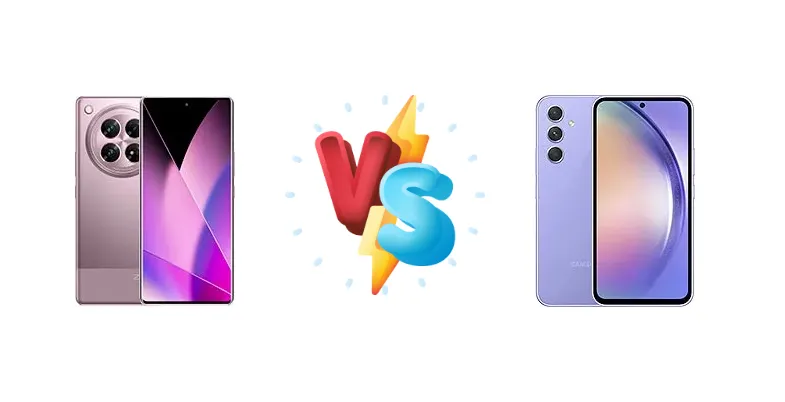
|
🏆 Quick Verdict
For the average user prioritizing performance and charging speed, the Infinix Zero 40 is the clear winner. Its Mediatek Dimensity 8200 Ultimate chipset delivers a noticeable performance boost over the Samsung Galaxy A54’s Exynos 1380, and the 45W charging is substantially faster than the A54’s 25W. However, Samsung’s software and established reputation remain strong considerations.
| PHONES | ||
|---|---|---|
| Phone Names | Infinix Zero 40 | Samsung Galaxy A54 |
| Network | ||
|---|---|---|
| 2G bands | GSM 850 / 900 / 1800 / 1900 | GSM 850 / 900 / 1800 / 1900 |
| 3G bands | HSDPA 850 / 900 / 1700(AWS) / 1900 / 2100 | HSDPA 850 / 900 / 1700(AWS) / 1900 / 2100 |
| 4G bands | 1, 2, 3, 4, 5, 7, 8, 12, 17, 20, 28, 38, 40, 41, 42, 66 | 1, 2, 3, 4, 5, 7, 8, 12, 17, 20, 26, 28, 32, 38, 40, 41, 66 - International |
| 5G bands | 1, 3, 5, 7, 8, 12, 20, 28, 38, 40, 41, 66, 77, 78 SA/NSA/Sub6 | 1, 3, 7, 8, 20, 28, 38, 40, 41, 77, 78 SA/NSA/Sub6 - International |
| Speed | HSPA, LTE, 5G | HSPA, LTE, 5G |
| Technology | GSM / HSPA / LTE / 5G | GSM / HSPA / LTE / 5G |
| - | 25, 41, 66, 71 SA/NSA/Sub6/mmWave - USA | |
| Launch | ||
|---|---|---|
| Announced | 2024, August 29 | 2023, March 15 |
| Status | Available. Released 2024, September 08 | Available. Released 2023, March 24 |
| Body | ||
|---|---|---|
| Build | - | Glass front (Gorilla Glass 5), glass back (Gorilla Glass 5), plastic frame |
| Dimensions | 164.3 x 74.8 x 7.9 mm (6.47 x 2.94 x 0.31 in) | 158.2 x 76.7 x 8.2 mm (6.23 x 3.02 x 0.32 in) |
| SIM | Nano-SIM + Nano-SIM | · Nano-SIM + eSIM· Nano-SIM + Nano-SIM |
| Weight | 195 g (6.88 oz) | 202 g (7.13 oz) |
| - | IP67 dust/water resistant (up to 1m for 30 min) | |
| Display | ||
|---|---|---|
| Protection | Corning Gorilla Glass 5 | Corning Gorilla Glass 5 |
| Resolution | 1080 x 2436 pixels (~393 ppi density) | 1080 x 2340 pixels, 19.5:9 ratio (~403 ppi density) |
| Size | 6.78 inches, 109.9 cm2 (~89.4% screen-to-body ratio) | 6.4 inches, 100.5 cm2 (~82.9% screen-to-body ratio) |
| Type | AMOLED, 1B colors, HDR, 144Hz, 1300 nits (HBM) | Super AMOLED, 120Hz, HDR10+, 1000 nits (HBM) |
| Platform | ||
|---|---|---|
| CPU | Octa-core (1x3.1 GHz Cortex-A78 & 3x3.0 GHz Cortex-A78 & 4x2.0 GHz Cortex-A55) | Octa-core (4x2.4 GHz Cortex-A78 & 4x2.0 GHz Cortex-A55) |
| Chipset | Mediatek Dimensity 8200 Ultimate (4 nm) | Exynos 1380 (5 nm) |
| GPU | Mali-G610 MC6 | Mali-G68 MP5 |
| OS | Android 14, up to 2 major Android upgrades, XOS 14.5 | Android 13, up to 4 major Android upgrades, One UI 7 |
| Memory | ||
|---|---|---|
| Card slot | No | microSDXC (uses shared SIM slot) |
| Internal | 256GB 12GB RAM, 512GB 12GB RAM | 128GB 4GB RAM, 128GB 6GB RAM, 128GB 8GB RAM, 256GB 6GB RAM, 256GB 8GB RAM |
| Main Camera | ||
|---|---|---|
| Features | Triple-LED flash, HDR, panorama | LED flash, panorama, HDR |
| Single | - | 32 MP, f/2.2, 26mm (wide), 1/2.8", 0.8µm |
| Triple | 108 MP, f/1.8, (wide), 1/1.67", PDAF, OIS 50 MP, f/2.0, 120˚, (ultrawide), 1/2.76", PDAF Auxiliary lens | 50 MP, f/1.8, 23mm (wide), 1/1.56", 1.0µm, PDAF, OIS 12 MP, f/2.2, 13mm, 123˚ (ultrawide), 1/3.X", 1.12µm 5 MP (macro) |
| Video | 4K@30/60fps, 1080p@30/60/120/240fps, gyro-EIS, OIS | 4K@30fps, 1080p@30/60fps, 720p@480fps, gyro-EIS |
| Selfie camera | ||
|---|---|---|
| Features | Dual-LED flash | - |
| Single | 50 MP, f/2.5, 21mm (wide), 1/2.76", PDAF | 32 MP, f/2.2, 26mm (wide), 1/2.8", 0.8µm |
| Video | 4K@30/60fps, 1080p@30/60fps | 4K@30fps, 1080p@30/60fps |
| Sound | ||
|---|---|---|
| 3.5mm jack | - | No |
| 35mm jack | No | No |
| Loudspeaker | Yes, with dual speakers | Yes, with stereo speakers |
| Comms | ||
|---|---|---|
| Bluetooth | Yes | 5.3, A2DP, LE |
| Infrared port | Yes | - |
| NFC | Yes | Yes (market/region dependent) |
| Positioning | GPS | GPS, GLONASS, GALILEO, BDS |
| Radio | FM radio | No |
| USB | USB Type-C 2.0, OTG | USB Type-C 2.0, OTG |
| WLAN | Wi-Fi 802.11 a/b/g/n/ac/6e, dual-band | Wi-Fi 802.11 a/b/g/n/ac/6, dual-band, Wi-Fi Direct |
| Features | ||
|---|---|---|
| Sensors | Fingerprint (under display, optical), accelerometer, gyro, proximity, compass | Fingerprint (under display, optical), accelerometer, gyro, compass, barometer (USA only) |
| - | Virtual proximity sensing | |
| Battery | ||
|---|---|---|
| Charging | 45W wired, 60% in 25 min 20W wireless 10W reverse wired Bypass Charging 2.0 | 25W wired |
| Type | 5000 mAh | 5000 mAh |
| Misc | ||
|---|---|---|
| Colors | Rock Black, Violet Garden, Moving Titanium | Lime, Graphite, Violet, White |
| Models | X6861 | SM-A546V, SM-A546U, SM-A546U1, SM-A546B, SM-A546B/DS, SM-A546E, SM-A546E/DS, SM-A5460, SM-A546M, SM-A546M/DS, SM-A546W |
| Price | ₹ 27,999 | € 210.00 / $ 119.11 / £ 169.95 / ₹ 28,999 |
| SAR | - | 0.81 W/kg (head) 0.67 W/kg (body) |
| SAR EU | - | 0.69 W/kg (head) 1.34 W/kg (body) |
| Tests | ||
|---|---|---|
| Battery life | - | Endurance rating 119h |
| Camera | - | Photo / Video |
| Display | - | Contrast ratio: Infinite (nominal) |
| Loudspeaker | - | -26.6 LUFS (Good) |
| Performance | - | AnTuTu: 506678 (v9) GeekBench: 2703 (v5.1), 2797 (v6) GFXBench: 25fps (ES 3.1 onscreen) |
Infinix Zero 40
- Significantly faster 45W wired charging
- More powerful Mediatek Dimensity 8200 Ultimate chipset
- Includes 20W wireless and 10W reverse wired charging
- Brand recognition is lower than Samsung
- Software support may not be as extensive as Samsung
Samsung Galaxy A54
- Established brand reputation and software ecosystem
- Excellent display brightness (980 nits)
- Solid battery life with 119h endurance rating
- Slower 25W charging
- Less powerful Exynos 1380 chipset
Display Comparison
The Samsung Galaxy A54 boasts a peak brightness of 980 nits, ensuring excellent visibility outdoors. While the Infinix Zero 40’s display specifications aren’t provided, it’s likely to be competitive in brightness. However, the A54’s ‘Infinite’ contrast ratio (nominal) suggests a strong AMOLED panel. The absence of LTPO technology in either phone means refresh rate scaling isn’t as efficient as on flagship devices, potentially impacting battery life during dynamic content viewing. Bezels are likely comparable, given both phones target a similar price bracket.
Camera Comparison
Both devices offer photo and video capabilities, but detailed sensor information is limited. The absence of specific details necessitates a focus on processing. Samsung’s image processing is known for its vibrant, often saturated colors, while Infinix typically aims for a more natural look. Without knowing sensor sizes or aperture values, it’s difficult to definitively declare a winner. The presence of OIS on either device would be a significant advantage for low-light photography and video stabilization, but this information isn’t provided. The usefulness of a 2MP macro camera (often found in this segment) is questionable, as image quality is typically subpar.
Performance
The core difference lies in the chipsets. The Infinix Zero 40’s Mediatek Dimensity 8200 Ultimate, fabricated on a 4nm process, offers a significant advantage over the Samsung Galaxy A54’s 5nm Exynos 1380. The Dimensity 8200 Ultimate features a more powerful CPU configuration – a 3.1 GHz Cortex-A78 prime core versus the A54’s 2.4 GHz Cortex-A78. This translates to faster app loading times, smoother multitasking, and improved gaming performance. The 4nm node also contributes to better thermal efficiency, potentially reducing throttling during sustained workloads. While both phones utilize an octa-core configuration, the architectural differences and clock speeds favor the Infinix.
Battery Life
The Samsung Galaxy A54 has an endurance rating of 119 hours and achieves 11:15h of active use, indicating solid battery life. The Infinix Zero 40’s battery capacity isn’t specified, but its 45W wired charging is a major advantage over the A54’s 25W. The Zero 40 can reach 60% charge in just 25 minutes, while the A54 will take considerably longer. Furthermore, the Zero 40 includes 20W wireless charging and 10W reverse wired charging, features absent on the A54. Bypass Charging 2.0 on the Zero 40 allows for charging while the phone is in use, minimizing heat buildup and extending battery lifespan.
Buying Guide
Buy the Infinix Zero 40 if you need a phone that can handle demanding tasks like gaming and video editing without compromise, and if you value rapid charging to minimize downtime. Buy the Samsung Galaxy A54 if you prioritize a polished software experience, a well-established brand with strong resale value, and consistently good (though not class-leading) all-around performance. The A54 is the safer, more predictable choice.