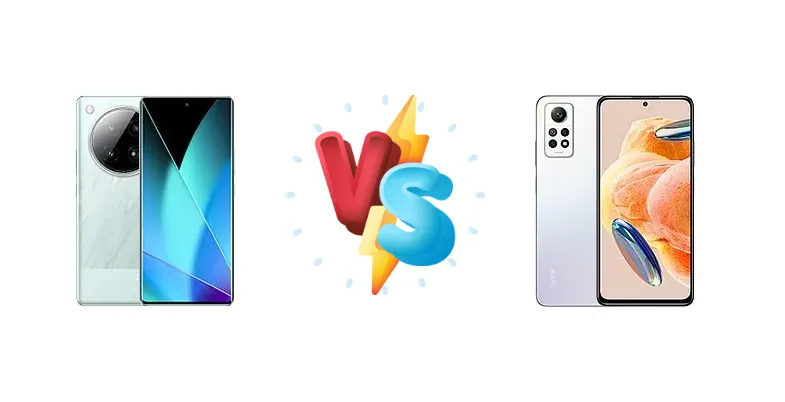
The Infinix Zero 40 4G and Xiaomi Redmi Note 12 Pro 4G represent compelling options in the increasingly competitive mid-range 4G smartphone market. While both aim to deliver a balanced experience, they take different approaches to chipset choice and charging technology, creating a clear distinction for potential buyers. This comparison dives deep into the specifics to determine which device offers the best overall package.
🏆 Quick Verdict
For the average user prioritizing fast charging and a slightly more refined software experience, the Xiaomi Redmi Note 12 Pro 4G emerges as the winner. Its 67W charging significantly reduces downtime, offsetting the Helio G100's potential performance edge in the Infinix Zero 40 4G.
| Network |
|---|
| 2G bands | GSM 850 / 900 / 1800 / 1900 | GSM 850 / 900 / 1800 / 1900 |
| 3G bands | HSDPA 850 / 900 / 1700(AWS) / 1900 / 2100 | HSDPA 850 / 900 / 1700(AWS) / 1900 / 2100 |
| 4G bands | 1, 2, 3, 4, 5, 7, 8, 20, 28, 38, 40, 41 | 1, 2, 3, 4, 5, 7, 8, 20, 28, 38, 40, 41, 66 |
| Speed | HSPA, LTE | HSPA, LTE |
| Technology | GSM / HSPA / LTE | GSM / HSPA / LTE |
| Launch |
|---|
| Announced | 2024, August 29 | 2023, March 03 |
| Status | Available. Released 2024, September 08 | Available. Released 2023, April 11 |
| Body |
|---|
| Dimensions | 164.3 x 74.6 x 7.7 mm (6.47 x 2.94 x 0.30 in) | 164.2 x 76.1 x 8.1 mm (6.46 x 3.00 x 0.32 in) |
| SIM | Nano-SIM + Nano-SIM | Nano-SIM + Nano-SIM |
| Weight | 180 g (6.35 oz) | 201.8 g (7.13 oz) |
| Display |
|---|
| Protection | Corning Gorilla Glass 5 | - |
| Resolution | 1080 x 2436 pixels (~393 ppi density) | 1080 x 2400 pixels, 20:9 ratio (~395 ppi density) |
| Size | 6.78 inches, 109.9 cm2 (~89.7% screen-to-body ratio) | 6.67 inches, 107.4 cm2 (~86.0% screen-to-body ratio) |
| Type | AMOLED, 1B colors, 120Hz, 1300 nits (HBM) | AMOLED, 120Hz, Dolby Vision, 700 nits (HBM), 1100 nits (peak) |
| Platform |
|---|
| CPU | Octa-core (2x2.2 GHz Cortex-A76 & 6x2.0 GHz Cortex-A55) | Octa-core (2x2.2 GHz Kryo 470 Gold & 6x1.8 GHz Kryo 470 Silver) |
| Chipset | Mediatek Helio G100 (6 nm) | Qualcomm SM7150 Snapdragon 732G (8 nm) |
| GPU | Mali-G57 MC2 | Adreno 618 |
| OS | Android 14, up to 2 major Android upgrades, XOS 14.5 | Android 11, MIUI 13 |
| Memory |
|---|
| Card slot | No | microSDXC (uses shared SIM slot) |
| Internal | 256GB 8GB RAM, 512GB 8GB RAM | 128GB 6GB RAM, 128GB 8GB RAM, 256GB 8GB RAM |
| | - | UFS 2.2 |
| Main Camera |
|---|
| Features | Dual-LED flash, HDR, panorama | LED flash, HDR, panorama |
| Quad | - | 108 MP, f/1.9, (wide), 1/1.52", 0.7µm, PDAF
8 MP, 120˚, (ultrawide)
2 MP (macro)
Auxiliary lens |
| Triple | 108 MP, f/1.8, (wide), 1/1.67", PDAF, OIS
50 MP, f/2.0, 120˚, (ultrawide), 1/2.76", PDAF
Auxiliary lens | - |
| Video | 1440p@30fps, 1080p@30/60fps, gyro-EIS, OIS | 4K@30fps, 1080p@30/60fps |
| Selfie camera |
|---|
| Features | Dual-LED flash | - |
| Single | 50 MP, f/2.5, 21mm (wide), 1/2.76", PDAF | 16 MP, f/2.4, (wide) |
| Video | 1440p@30fps, 1080p@30/60fps | 1080p@30fps |
| Sound |
|---|
| 3.5mm jack | - | Yes |
| 35mm jack | No | Yes |
| Loudspeaker | Yes, with dual speakers | Yes, with stereo speakers |
| Comms |
|---|
| Bluetooth | Yes | 5.0, A2DP, LE |
| Infrared port | Yes | Yes |
| NFC | Yes | Yes (market/region dependent) |
| Positioning | GPS | GPS, GLONASS, GALILEO, BDS |
| Radio | FM radio | Unspecified |
| USB | USB Type-C 2.0, OTG | USB Type-C 2.0, OTG |
| WLAN | Wi-Fi 802.11 a/b/g/n/ac, dual-band | Wi-Fi 802.11 a/b/g/n/ac, dual-band |
| Features |
|---|
| Sensors | Fingerprint (under display, optical), accelerometer, gyro, proximity, compass | Fingerprint (side-mounted), accelerometer, gyro, compass |
| Battery |
|---|
| Charging | 45W wired, 50% in 25 min
10W reverse wired
Bypass Charging 2.0 | 67W wired |
| Type | 5000 mAh | Li-Po 5000 mAh |
| Misc |
|---|
| Colors | Misty Aqua, Rock Black, Blossom Glow | Star Blue, Graphite Gray, Polar White, Ice blue |
| Models | X6860 | 2209116AG, 2209116AG |
| Price | About 250 EUR | About 150 EUR |
Infinix Zero 40 4G
- Potentially higher CPU performance with Helio G100
- Reverse wireless charging for accessory top-ups
- Bypass Charging 2.0 for optimized battery health
- Slower 45W charging compared to the Redmi Note 12 Pro 4G
- Less established brand reputation
Xiaomi Redmi Note 12 Pro 4G
- Faster 67W wired charging for quicker top-ups
- More power-efficient Snapdragon 732G chipset
- Established brand with a wider support network
- Potentially lower CPU performance in demanding tasks
- No reverse wireless charging
Display Comparison
Neither device boasts a cutting-edge display, but subtle differences exist. While both likely feature LCD panels (based on market segment), the focus shifts to optimization. We lack specific display specs, but the Redmi Note 12 Pro 4G's brand history suggests a well-calibrated panel. The Infinix Zero 40 4G's display performance will depend heavily on software tuning. Bezels are likely comparable, and without data on peak brightness or color gamut coverage, it's difficult to declare a clear winner.
Camera Comparison
Without detailed camera specs, a direct comparison is challenging. However, the Redmi Note 12 Pro 4G's lineage suggests a focus on versatile camera systems. The Infinix Zero 40 4G may prioritize software enhancements to compensate for potentially less advanced hardware. The absence of information regarding sensor sizes and OIS makes it difficult to assess image quality. We can assume both devices will include standard wide, ultrawide, and macro lenses, but the quality of these lenses will vary significantly. Ignoring the likely low-resolution macro sensors on both devices, the main sensor and image processing algorithms will be the key differentiators.
Performance
The core of the difference lies in the chipsets. The Infinix Zero 40 4G utilizes the Mediatek Helio G100 (6nm), featuring a Cortex-A76 based CPU, while the Redmi Note 12 Pro 4G employs the Qualcomm Snapdragon 732G (8nm). The 8nm process of the Snapdragon 732G generally translates to better power efficiency, potentially leading to longer battery life under sustained loads. However, the Helio G100's Cortex-A76 cores offer a theoretical performance advantage in CPU-intensive tasks. The Snapdragon 732G's Kryo 470 cores are optimized for sustained performance, which could be more beneficial for gaming. The lack of LPDDR5x RAM specification for either device suggests both likely use LPDDR4x, limiting memory bandwidth.
Battery Life
The Xiaomi Redmi Note 12 Pro 4G’s 67W wired charging is a significant advantage. This allows for a much faster recharge compared to the Infinix Zero 40 4G’s 45W charging. While the Infinix Zero 40 4G offers 10W reverse wired charging – a useful feature for topping up accessories – the Redmi Note 12 Pro 4G’s faster charging is more impactful for daily use. Without knowing the battery capacity of either device, the faster charging speed of the Redmi Note 12 Pro 4G is the more compelling feature for most users.
Buying Guide
Buy the Infinix Zero 40 4G if you prioritize raw processing power for demanding apps and occasional gaming, and appreciate the convenience of reverse wireless charging. Buy the Xiaomi Redmi Note 12 Pro 4G if you value faster charging speeds, a more established brand reputation, and a generally smoother user experience focused on efficiency.
Frequently Asked Questions
❓ Does the Mediatek Helio G100 in the Infinix Zero 40 4G get noticeably hot during extended gaming sessions?
The Helio G100, while capable, is a 6nm chip and may exhibit more thermal throttling than the 8nm Snapdragon 732G under sustained heavy loads like gaming. While not necessarily overheating, users might experience some performance dips after prolonged gaming. The effectiveness of Infinix's thermal management will be crucial.
❓ How much faster is the 67W charging on the Redmi Note 12 Pro 4G compared to the 45W charging on the Infinix Zero 40 4G?
The 67W charging on the Redmi Note 12 Pro 4G can realistically reduce charging times by 20-30% compared to the 45W charging on the Infinix Zero 40 4G. This translates to significantly less downtime and a more convenient charging experience.
❓ Is the reverse charging feature on the Infinix Zero 40 4G useful in real-world scenarios?
The 10W reverse charging is primarily useful for topping up accessories like wireless earbuds or smartwatches in a pinch. It's not a replacement for a dedicated power bank, but it can be a convenient feature for users who frequently use Bluetooth accessories.