
Xiaomi 13T Pro vs. Infinix Zero 30: A Deep Dive into Performance, Charging, and Value
| Phones Images | |||||
|---|---|---|---|---|---|
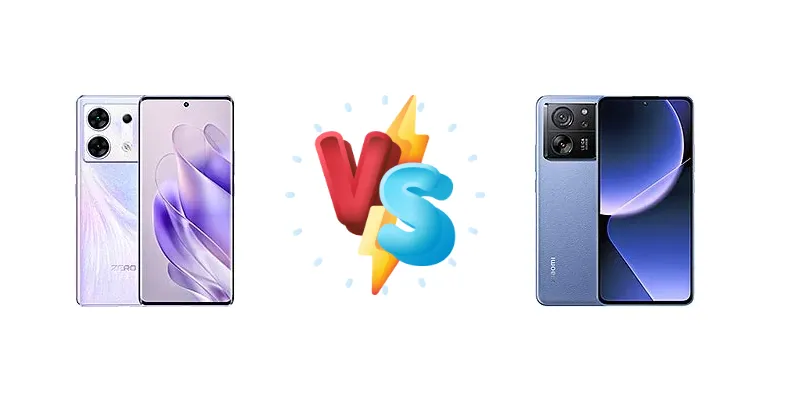
|
🏆 Quick Verdict
For most users, the Xiaomi 13T Pro is the superior choice. Its Dimensity 9200+ chipset provides a substantial performance uplift, and the 120W charging is a game-changer, fully charging the device in just 19 minutes. While the Infinix Zero 30 is a capable phone, it can't match the 13T Pro's raw power.
| PHONES | ||
|---|---|---|
| Phone Names | Infinix Zero 30 | Xiaomi 13T Pro |
| Network | ||
|---|---|---|
| 2G bands | GSM 850 / 900 / 1800 / 1900 | GSM 850 / 900 / 1800 / 1900 |
| 3G bands | HSDPA 850 / 900 / 1700(AWS) / 1900 / 2100 | HSDPA 800 / 850 / 900 / 1700(AWS) / 1900 / 2100 |
| 4G bands | 1, 2, 3, 4, 5, 7, 8, 12, 20, 28, 38, 40, 41, 66 | 1, 2, 3, 4, 5, 7, 8, 12, 13, 17, 18, 19, 20, 25, 26, 28, 32, 38, 39, 40, 41, 42, 48, 66 |
| 5G bands | 1, 3, 5, 7, 8, 12, 20, 28, 38, 40, 41, 66, 77, 78 SA/NSA/Sub6 | 1, 3, 5, 7, 8, 20, 28, 38, 40, 41, 66, 75, 77, 78 SA/NSA |
| Speed | HSPA, LTE, 5G | HSPA, LTE, 5G |
| Technology | GSM / HSPA / LTE / 5G | GSM / HSPA / LTE / 5G |
| Launch | ||
|---|---|---|
| Announced | 2023, September 01 | 2023, September 26 |
| Status | Available. Released 2023, September | Available. Released 2023, September 26 |
| Body | ||
|---|---|---|
| Build | Glass front (Gorilla Glass 5), glass back (Gorilla Glass 5) or eco leather back, plastic frame | Glass front (Gorilla Glass 5), glass back or silicone polymer back, plastic frame |
| Dimensions | 164.5 x 75 x 7.9 mm (6.48 x 2.95 x 0.31 in) | 162.2 x 75.7 x 8.5 mm (6.39 x 2.98 x 0.33 in) |
| SIM | Nano-SIM + Nano-SIM | · Nano-SIM + eSIM· Nano-SIM + Nano-SIM |
| Weight | 185 g (6.53 oz) | 200 g or 206 g (7.05 oz) |
| Display | ||
|---|---|---|
| Protection | Corning Gorilla Glass 5 | Corning Gorilla Glass 5 |
| Resolution | 1080 x 2400 pixels, 20:9 ratio (~388 ppi density) | 1220 x 2712 pixels, 20:9 ratio (~446 ppi density) |
| Size | 6.78 inches, 111.0 cm2 (~90.0% screen-to-body ratio) | 6.67 inches, 107.4 cm2 (~87.5% screen-to-body ratio) |
| Type | AMOLED, 1B colors, 144Hz, 950 nits (peak) | AMOLED, 68B colors, 144Hz, Dolby Vision, HDR10+, 1200 nits (HBM), 2600 nits (peak) |
| Platform | ||
|---|---|---|
| CPU | Octa-core (4x2.6 GHz Cortex-A78 & 4x2.0 GHz Cortex-A55) | Octa-core (1x3.35 GHz Cortex-X3 & 3x3.0 GHz Cortex-A715 & 4x2.0 GHz Cortex-A510) |
| Chipset | Mediatek Dimensity 8020 (6 nm) | Mediatek Dimensity 9200+ (4 nm) |
| GPU | Mali-G77 MC9 | Immortalis-G715 MC11 |
| OS | Android 13, XOS 13 | Android 13, up to 4 major Android upgrades, HyperOS |
| Memory | ||
|---|---|---|
| Card slot | No | No |
| Internal | 256GB 8GB RAM, 256GB 12GB RAM | 256GB 12GB RAM, 512GB 12GB RAM, 1TB 16GB RAM |
| Main Camera | ||
|---|---|---|
| Features | LED flash, HDR, panorama | Leica lens, color spectrum sensor, LED flash, HDR, panorama |
| Triple | 108 MP, f/1.7, (wide), 1/1.67", PDAF, OIS 13 MP, f/2.2, 120˚ (ultrawide) 2 MP, f/2.4 | 50 MP, f/1.9, 24mm (wide), 1/1.28", 1.22µm, PDAF, OIS 50 MP, f/1.9, 50mm (telephoto), 1/2.88", 0.61µm, PDAF, 2x optical zoom 12 MP, f/2.2, 15mm (ultrawide), 1/3.06", 1.12µm |
| Video | 4K@30/60fps, 1080p@30/60fps | 8K@24fps, 4K@24/30/60fps, 4K/1080p@30fps HDR10+, 1080p@30/60/120/240fps; 10-bit LOG, gyro-EIS |
| Selfie camera | ||
|---|---|---|
| Features | LED flash | HDR |
| Single | 50 MP, f/2.5, (wide), 1/2.76", PDAF | 20 MP, f/2.2, (wide), 0.8µm |
| Video | 4K@30/60fps, 1080p@30fps | 1080p@30fps, HDR10+ |
| Sound | ||
|---|---|---|
| 35mm jack | No | No |
| Loudspeaker | Yes, with dual speakers | Yes, with stereo speakers |
| Comms | ||
|---|---|---|
| Bluetooth | Yes | 5.4, A2DP, LE |
| Infrared port | - | Yes |
| NFC | Yes | Yes |
| Positioning | GPS | GPS (L1+L5), GLONASS (G1), GALILEO (E1+E5a), NavIC (L5), BDS |
| Radio | FM radio | No |
| USB | USB Type-C 2.0, OTG | USB Type-C 2.0, OTG |
| WLAN | Wi-Fi 802.11 a/b/g/n/ac/6, dual-band | Wi-Fi 802.11 a/b/g/n/ac/6e/7, dual/tri-band (market/region dependent), Wi-Fi Direct |
| Features | ||
|---|---|---|
| Sensors | Fingerprint (under display, optical), accelerometer, gyro, proximity, compass | Fingerprint (under display, optical), accelerometer, gyro, proximity, compass |
| Battery | ||
|---|---|---|
| Charging | 68W wired, 80% in 30 min | 120W wired, PD3.0, QC4, 100% in 19 min |
| Type | 5000 mAh | Li-Po 5000 mAh |
| Misc | ||
|---|---|---|
| Colors | Rome Green, Golden Hour, Fantasy Purple | Alpine Blue, Meadow Green, Black |
| Models | X6731 | 23078PND5G |
| Price | - | $ 370.00 / £ 482.55 / € 301.99 |
| SAR EU | - | 1.00 W/kg (head) 0.99 W/kg (body) |
Infinix Zero 30
- Sleek and stylish design
- Good battery endurance
- Competitive price point
- Less powerful processor
- Slower charging speed
- Potentially less refined camera processing
Xiaomi 13T Pro
- Exceptional performance with Dimensity 9200+
- Ultra-fast 120W charging
- Brighter display for outdoor visibility
- May run slightly warmer under heavy load
- Potentially higher price
Display Comparison
The Xiaomi 13T Pro boasts a brighter display, reaching 1094 nits compared to the Infinix Zero 30’s 764 nits. This translates to better visibility outdoors under direct sunlight. While both devices likely utilize AMOLED panels, the higher peak brightness of the 13T Pro provides a more vibrant and engaging viewing experience. The absence of LTPO technology in either device suggests both will rely on adaptive refresh rate switching rather than variable refresh rates for power saving. Bezels appear comparable based on available imagery, and color accuracy is likely similar given both brands' focus on display quality.
Camera Comparison
Both phones feature capable camera systems, but detailed sensor information is limited. Assuming both offer similar video capabilities, the photographic performance will likely hinge on the main sensor and image processing. Without specific sensor size details, it’s difficult to definitively declare a winner. However, the Xiaomi 13T Pro’s more powerful ISP (Image Signal Processor) within the Dimensity 9200+ chipset will likely provide superior image processing, particularly in low-light conditions. The inclusion of Optical Image Stabilization (OIS) on the 13T Pro, if present, would further enhance image quality and video stabilization.
Performance
The core difference lies in the chipsets. The Xiaomi 13T Pro’s Mediatek Dimensity 9200+ (4nm) is a significant step up from the Infinix Zero 30’s Dimensity 8020 (6nm). The 9200+ features a Cortex-X3 prime core clocked at 3.35 GHz, offering substantially higher single-core performance. The 8020’s Cortex-A78 cores, while capable, are older architecture and clocked lower at 2.6 GHz. The 4nm process node of the 9200+ also contributes to better thermal efficiency, reducing the likelihood of throttling during sustained workloads. The 13T Pro will demonstrably outperform the Zero 30 in demanding tasks like gaming and video editing.
Battery Life
Both phones share an endurance rating of 102 hours, suggesting similar overall battery life. However, the charging speeds are drastically different. The Xiaomi 13T Pro’s 120W wired charging can fully charge the device in just 19 minutes, a massive advantage over the Infinix Zero 30’s 68W charging, which takes 30 minutes to reach 80%. This difference in charging speed significantly impacts usability, allowing the 13T Pro to quickly top up its battery during short breaks. While the Infinix Zero 30 offers respectable endurance, the 13T Pro’s charging speed is a compelling feature for users who are always on the go.
Buying Guide
Buy the Infinix Zero 30 if you prioritize a sleek design and a balanced experience with good battery endurance, and are less concerned with absolute performance. It's ideal for everyday users who enjoy social media, streaming, and casual gaming. Buy the Xiaomi 13T Pro if you demand top-tier performance for gaming, content creation, or multitasking, and value incredibly fast charging. This phone is for power users who want a near-flagship experience without the flagship price.