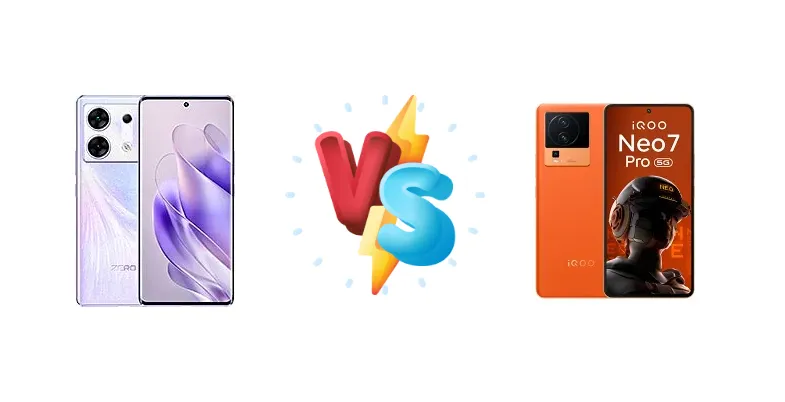
The Infinix Zero 30 and vivo iQOO Neo 7 Pro represent compelling options in the increasingly competitive mid-range smartphone market. The Zero 30 aims for a balanced experience, while the iQOO Neo 7 Pro prioritizes raw performance and incredibly fast charging. This comparison dissects their key differences to determine which device best suits your needs.
🏆 Quick Verdict
For the average user prioritizing gaming and rapid charging, the vivo iQOO Neo 7 Pro is the clear winner. Its Snapdragon 8+ Gen 1 chipset delivers significantly more processing power. However, the Infinix Zero 30 provides a strong alternative for those valuing a more balanced feature set and potentially better efficiency.
| Network |
|---|
| 2G bands | GSM 850 / 900 / 1800 / 1900 | GSM 850 / 900 / 1800 / 1900 |
| 3G bands | HSDPA 850 / 900 / 1700(AWS) / 1900 / 2100 | HSDPA 800 / 850 / 900 / 1700(AWS) / 1900 / 2100 |
| 4G bands | 1, 2, 3, 4, 5, 7, 8, 12, 20, 28, 38, 40, 41, 66 | 1, 2, 3, 4, 5, 8, 28, 34, 38, 39, 40, 41 |
| 5G bands | 1, 3, 5, 7, 8, 12, 20, 28, 38, 40, 41, 66, 77, 78 SA/NSA/Sub6 | 1, 3, 5, 8, 28, 40, 77, 78 SA/NSA |
| Speed | HSPA, LTE, 5G | HSPA, LTE, 5G |
| Technology | GSM / HSPA / LTE / 5G | GSM / HSPA / LTE / 5G |
| Launch |
|---|
| Announced | 2023, September 01 | 2023, July 04 |
| Status | Available. Released 2023, September | Available. Released 2023, July 15 |
| Body |
|---|
| Build | Glass front (Gorilla Glass 5), glass back (Gorilla Glass 5) or eco leather back, plastic frame | Glass front, plastic frame, glass or leather back |
| Dimensions | 164.5 x 75 x 7.9 mm (6.48 x 2.95 x 0.31 in) | 164.8 x 76.9 x 8.5 mm or 8.9 mm |
| SIM | Nano-SIM + Nano-SIM | Nano-SIM + Nano-SIM |
| Weight | 185 g (6.53 oz) | 197 g or 202 g (6.95 oz) |
| Display |
|---|
| Protection | Corning Gorilla Glass 5 | - |
| Resolution | 1080 x 2400 pixels, 20:9 ratio (~388 ppi density) | 1080 x 2400 pixels, 20:9 ratio (~388 ppi density) |
| Size | 6.78 inches, 111.0 cm2 (~90.0% screen-to-body ratio) | 6.78 inches, 111.0 cm2 (~87.6% screen-to-body ratio) |
| Type | AMOLED, 1B colors, 144Hz, 950 nits (peak) | AMOLED, 1B colors, 120Hz, HDR10+, 1300 nits (peak) |
| Platform |
|---|
| CPU | Octa-core (4x2.6 GHz Cortex-A78 & 4x2.0 GHz Cortex-A55) | Octa-core (1x3.19 GHz Cortex-X2 & 3x2.75 GHz Cortex-A710 & 4x2.0 GHz Cortex-A510) |
| Chipset | Mediatek Dimensity 8020 (6 nm) | Qualcomm SM8475 Snapdragon 8+ Gen 1 (4 nm) |
| GPU | Mali-G77 MC9 | Adreno 730 |
| OS | Android 13, XOS 13 | Android 13, Funtouch 13 |
| Memory |
|---|
| Card slot | No | No |
| Internal | 256GB 8GB RAM, 256GB 12GB RAM | 128GB 8GB RAM, 256GB 12GB RAM |
| Main Camera |
|---|
| Features | LED flash, HDR, panorama | LED flash, HDR, panorama |
| Triple | 108 MP, f/1.7, (wide), 1/1.67", PDAF, OIS
13 MP, f/2.2, 120˚ (ultrawide)
2 MP, f/2.4 | 50 MP, f/1.9, 24mm (wide), 1/1.57", 1.0µm, PDAF, OIS
8 MP, f/2.2, 16mm (ultrawide), 1/4.0", 1.12µm
2 MP (macro) |
| Video | 4K@30/60fps, 1080p@30/60fps | 4K@30fps, 1080p@30fps |
| Selfie camera |
|---|
| Features | LED flash | HDR |
| Single | 50 MP, f/2.5, (wide), 1/2.76", PDAF | 16 MP, f/2.5, (wide), 1/3.1", 1.0µm |
| Video | 4K@30/60fps, 1080p@30fps | 1080p@30fps |
| Sound |
|---|
| 35mm jack | No | No |
| Loudspeaker | Yes, with dual speakers | Yes, with stereo speakers |
| Comms |
|---|
| Bluetooth | Yes | 5.3, A2DP, LE, aptX HD, aptX Adaptive |
| Infrared port | - | Yes |
| NFC | Yes | No |
| Positioning | GPS | GPS, GLONASS, GALILEO, BDS, QZSS, NavIC |
| Radio | FM radio | No |
| USB | USB Type-C 2.0, OTG | USB Type-C 2.0, OTG |
| WLAN | Wi-Fi 802.11 a/b/g/n/ac/6, dual-band | Wi-Fi 802.11 a/b/g/n/ac/6, dual-band, Wi-Fi Direct |
| Features |
|---|
| Sensors | Fingerprint (under display, optical), accelerometer, gyro, proximity, compass | Fingerprint (under display, optical), accelerometer, gyro, proximity, compass |
| Battery |
|---|
| Charging | 68W wired, 80% in 30 min | 120W wired, 50% in 8 min |
| Type | 5000 mAh | 5000 mAh |
| Misc |
|---|
| Colors | Rome Green, Golden Hour, Fantasy Purple | Fearless Flame, Dark Storm |
| Models | X6731 | I2217 |
| Price | - | About 380 EUR |
Infinix Zero 30
- Good display brightness (764 nits)
- Potentially better battery endurance
- Balanced feature set
- Less powerful chipset than the iQOO Neo 7 Pro
- Slower charging speed
vivo iQOO Neo 7 Pro
- Significantly faster charging (120W)
- More powerful Snapdragon 8+ Gen 1 chipset
- Superior gaming performance
- Potentially lower battery endurance
- May run hotter under sustained load
Display Comparison
The Infinix Zero 30 boasts a display capable of reaching 764 nits of peak brightness, providing good visibility outdoors. While the iQOO Neo 7 Pro’s display specs aren’t provided, vivo typically equips its Neo series with high refresh rate AMOLED panels. The Zero 30’s brightness is a key advantage, especially for users who frequently consume content in bright environments. Without knowing the iQOO Neo 7 Pro’s panel technology, it’s difficult to assess features like LTPO for variable refresh rate, which would impact battery life. Bezels are likely comparable given the market segment, but color accuracy testing would be needed to determine which display offers more faithful reproduction.
Camera Comparison
Both phones feature 'Photo / Video' capabilities, but detailed sensor information is lacking for the Infinix Zero 30. The iQOO Neo 7 Pro’s camera specs are also unavailable, but iQOO typically focuses on delivering a versatile camera system. Without knowing sensor sizes, apertures, or the presence of Optical Image Stabilization (OIS), a direct comparison is difficult. However, the emphasis on processing power in the iQOO Neo 7 Pro suggests it may have more advanced computational photography capabilities. We can safely assume both phones will include standard features like portrait mode and night mode, but image quality will depend heavily on the underlying hardware.
Performance
This is where the iQOO Neo 7 Pro truly shines. Its Qualcomm Snapdragon 8+ Gen 1 (4nm) is a significant step up from the Infinix Zero 30’s MediaTek Dimensity 8020 (6nm). The 4nm process node of the Snapdragon offers superior thermal efficiency, meaning sustained performance under load will be higher, and throttling will be less pronounced during extended gaming sessions. The Snapdragon 8+ Gen 1’s Cortex-X2 prime core, clocked at 3.19 GHz, provides a substantial single-core performance boost compared to the Dimensity 8020’s Cortex-A78 cores at 2.6 GHz. While the Dimensity 8020 is no slouch, the iQOO Neo 7 Pro is the clear choice for power users and mobile gamers.
Battery Life
The Infinix Zero 30 has an endurance rating of 102 hours, suggesting reasonable battery life. However, the iQOO Neo 7 Pro’s 120W wired charging is a game-changer. Reaching 50% charge in just 8 minutes is significantly faster than the Zero 30’s 68W charging, which takes 30 minutes to reach 80%. While the Zero 30’s endurance rating implies a potentially larger battery capacity, the iQOO Neo 7 Pro’s charging speed mitigates concerns about battery life, allowing for quick top-ups throughout the day. The Snapdragon 8+ Gen 1’s efficiency also plays a role, potentially offsetting a smaller battery capacity.
Buying Guide
Buy the Infinix Zero 30 if you need a phone with a good all-around experience, prioritizing a balanced feature set and potentially longer battery life due to the more efficient Dimensity 8020. Buy the vivo iQOO Neo 7 Pro if you prefer uncompromising performance for gaming and demanding tasks, and absolutely require the fastest possible charging speeds – 50% in just 8 minutes.
Frequently Asked Questions
❓ Will the Snapdragon 8+ Gen 1 in the iQOO Neo 7 Pro overheat during prolonged gaming sessions?
While the Snapdragon 8+ Gen 1 is a powerful chip, its 4nm process node and vivo’s thermal management solutions (typically including vapor chamber cooling) are designed to mitigate overheating. However, some throttling is still possible during extremely demanding games over extended periods. The iQOO Neo 7 Pro is generally well-regarded for its thermal performance, but it will likely get warmer than the Infinix Zero 30 under the same load.
❓ How does the 68W charging on the Infinix Zero 30 compare to the 120W charging on the iQOO Neo 7 Pro in real-world usage?
The difference is substantial. The iQOO Neo 7 Pro can reach 50% charge in just 8 minutes, while the Infinix Zero 30 takes 30 minutes to reach 80%. This means you can add a significant amount of charge to the iQOO Neo 7 Pro during a quick coffee break, whereas the Zero 30 requires a more substantial charging period. For users who frequently find themselves with low battery, the iQOO Neo 7 Pro’s charging speed is a major advantage.
❓ Is the Dimensity 8020 in the Infinix Zero 30 capable of running demanding games like Genshin Impact at high settings?
Yes, the Dimensity 8020 is a capable chipset and can run Genshin Impact. However, you may need to make some compromises on graphics settings to maintain a stable frame rate. The iQOO Neo 7 Pro’s Snapdragon 8+ Gen 1 will deliver a smoother and more consistent experience at higher settings.