
Infinix Zero 30 vs Google Pixel 7a: A Detailed Comparison of Mid-Range Powerhouses
| Phones Images | |||||
|---|---|---|---|---|---|
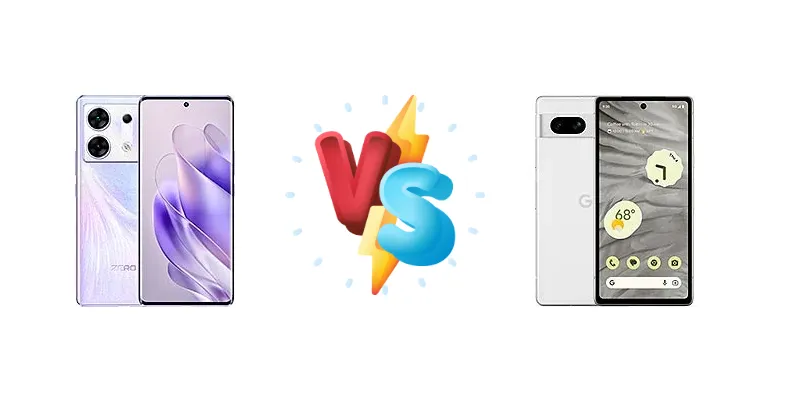
|
🏆 Quick Verdict
For the average user prioritizing camera quality and software experience, the Google Pixel 7a is the better choice. However, the Infinix Zero 30 offers significantly faster charging and a brighter display, making it ideal for power users and those who frequently consume media on the go.
| PHONES | ||
|---|---|---|
| Phone Names | Infinix Zero 30 | Google Pixel 7a |
| Network | ||
|---|---|---|
| 2G bands | GSM 850 / 900 / 1800 / 1900 | GSM 850 / 900 / 1800 / 1900 |
| 3G bands | HSDPA 850 / 900 / 1700(AWS) / 1900 / 2100 | HSDPA 800 / 850 / 900 / 1700(AWS) / 1900 / 2100 |
| 4G bands | 1, 2, 3, 4, 5, 7, 8, 12, 20, 28, 38, 40, 41, 66 | 1, 2, 3, 4, 5, 7, 8, 12, 13, 14, 17, 20, 25, 26, 28, 29, 30, 38, 40, 41, 48, 66, 71 - GWKK3, G0DZQ |
| 5G bands | 1, 3, 5, 7, 8, 12, 20, 28, 38, 40, 41, 66, 77, 78 SA/NSA/Sub6 | 1, 2, 3, 5, 7, 8, 12, 14, 20, 25, 28, 30, 38, 41, 48, 66, 71, 77, 78 SA/NSA/Sub6 - GWKK3 |
| Speed | HSPA, LTE, 5G | HSPA, LTE, 5G |
| Technology | GSM / HSPA / LTE / 5G | GSM / HSPA / LTE / 5G |
| - | 1, 2, 3, 5, 7, 8, 12, 20, 25, 28, 38, 40, 41, 66, 75, 76, 77, 78, 79 SA/NSA/Sub6 - GHL1X, G82U8 | |
| Launch | ||
|---|---|---|
| Announced | 2023, September 01 | 2023, May 10 |
| Status | Available. Released 2023, September | Available. Released 2023, May 10 |
| Body | ||
|---|---|---|
| Build | Glass front (Gorilla Glass 5), glass back (Gorilla Glass 5) or eco leather back, plastic frame | Glass front (Gorilla Glass 3), aluminum frame, plastic back |
| Dimensions | 164.5 x 75 x 7.9 mm (6.48 x 2.95 x 0.31 in) | 152 x 72.9 x 9 mm (5.98 x 2.87 x 0.35 in) |
| SIM | Nano-SIM + Nano-SIM | Nano-SIM + eSIM |
| Weight | 185 g (6.53 oz) | 193.5 g (6.84 oz) |
| - | IP67 dust/water resistant (up to 1m for 30 min) | |
| Display | ||
|---|---|---|
| Protection | Corning Gorilla Glass 5 | Corning Gorilla Glass 3 |
| Resolution | 1080 x 2400 pixels, 20:9 ratio (~388 ppi density) | 1080 x 2400 pixels, 20:9 ratio (~429 ppi density) |
| Size | 6.78 inches, 111.0 cm2 (~90.0% screen-to-body ratio) | 6.1 inches, 90.7 cm2 (~81.8% screen-to-body ratio) |
| Type | AMOLED, 1B colors, 144Hz, 950 nits (peak) | OLED, HDR, 90Hz |
| - | Always-on display | |
| Platform | ||
|---|---|---|
| CPU | Octa-core (4x2.6 GHz Cortex-A78 & 4x2.0 GHz Cortex-A55) | Octa-core (2x2.85 GHz Cortex-X1 & 2x2.35 GHz Cortex-A78 & 4x1.80 GHz Cortex-A55) |
| Chipset | Mediatek Dimensity 8020 (6 nm) | Google Tensor G2 (5 nm) |
| GPU | Mali-G77 MC9 | Mali-G710 MP7 |
| OS | Android 13, XOS 13 | Android 13, upgradable to Android 15, up to 5 major Android upgrades |
| Memory | ||
|---|---|---|
| Card slot | No | No |
| Internal | 256GB 8GB RAM, 256GB 12GB RAM | 128GB 8GB RAM |
| - | UFS 3.1 | |
| Main Camera | ||
|---|---|---|
| Dual | - | 64 MP, f/1.9, 26mm (wide), 1/1.73", 0.8µm, dual pixel PDAF, OIS 13 MP, f/2.2, 120˚ (ultrawide), 1.12µm |
| Features | LED flash, HDR, panorama | Dual-LED flash, Pixel Shift, Auto-HDR, panorama |
| Triple | 108 MP, f/1.7, (wide), 1/1.67", PDAF, OIS 13 MP, f/2.2, 120˚ (ultrawide) 2 MP, f/2.4 | - |
| Video | 4K@30/60fps, 1080p@30/60fps | 4K@30/60fps, 1080p@30/60/120/240fps, OIS |
| Selfie camera | ||
|---|---|---|
| Features | LED flash | HDR, panorama |
| Single | 50 MP, f/2.5, (wide), 1/2.76", PDAF | 13 MP, f/2.2, 20mm (ultrawide), 1.12µm |
| Video | 4K@30/60fps, 1080p@30fps | 4K@30fps, 1080p@30fps |
| Sound | ||
|---|---|---|
| 3.5mm jack | - | No |
| 35mm jack | No | No |
| Loudspeaker | Yes, with dual speakers | Yes, with stereo speakers |
| Comms | ||
|---|---|---|
| Bluetooth | Yes | 5.3, A2DP, LE |
| NFC | Yes | Yes |
| Positioning | GPS | GPS, GLONASS, GALILEO, BDS, QZSS, NavIC |
| Radio | FM radio | No |
| USB | USB Type-C 2.0, OTG | USB Type-C 3.2 |
| WLAN | Wi-Fi 802.11 a/b/g/n/ac/6, dual-band | Wi-Fi 802.11 a/b/g/n/ac/6e, tri-band |
| Features | ||
|---|---|---|
| Sensors | Fingerprint (under display, optical), accelerometer, gyro, proximity, compass | Fingerprint (under display, optical), accelerometer, gyro, proximity, compass, barometer |
| Battery | ||
|---|---|---|
| Charging | 68W wired, 80% in 30 min | 18W wired, PD3.0 7.5W wireless |
| Type | 5000 mAh | Li-Po 4385 mAh |
| Misc | ||
|---|---|---|
| Colors | Rome Green, Golden Hour, Fantasy Purple | Charcoal, Snow, Sea, Coral |
| Models | X6731 | GWKK3, GHL1X, G0DZQ, G82U8 |
| Price | - | € 179.90 / $ 150.00 / £ 170.00 / ₹ 25,980 |
Infinix Zero 30
- Significantly faster 68W charging
- Longer battery endurance (102h rating)
- Brighter display (764 nits)
- Potentially higher raw processing power with Dimensity 8020
- Less refined software experience
- Camera likely lags behind Pixel 7a
Google Pixel 7a
- Superior camera quality and image processing
- Clean Android experience with guaranteed updates
- Brighter display for outdoor visibility (1070 nits)
- More efficient Tensor G2 chip
- Slower 18W charging
- Shorter battery endurance (76h rating)
Display Comparison
The Pixel 7a boasts a brighter display, reaching 1070 nits compared to the Zero 30’s 764 nits. This translates to better visibility under direct sunlight. While both utilize OLED panels, the Pixel 7a’s higher peak brightness is a clear advantage for outdoor use. The Zero 30, however, doesn’t specify refresh rate, while the Pixel 7a is known to have a 90Hz panel, offering smoother scrolling and animations. Bezels appear comparable based on available imagery, but the Pixel 7a’s smaller overall size may feel more comfortable for one-handed use.
Camera Comparison
Both phones are capable video and photo devices, but Google’s computational photography gives the Pixel 7a a distinct edge. While sensor sizes aren’t specified, Google’s image processing algorithms excel at dynamic range, noise reduction, and detail preservation. The Pixel 7a’s software features, like Magic Eraser and Photo Unblur, are also significant advantages. The Zero 30’s camera performance will likely rely more on hardware capabilities, and without detailed sensor information, it’s difficult to assess its low-light performance relative to the Pixel 7a. The absence of detailed camera specs on the Zero 30 suggests Google has a clear advantage in this area.
Performance
The chipset is where these phones diverge significantly. The Google Pixel 7a’s Tensor G2, fabricated on a 5nm process, prioritizes AI and machine learning tasks, enhancing features like voice recognition and image processing. The Infinix Zero 30 utilizes the MediaTek Dimensity 8020 (6nm). While the Dimensity 8020 features a higher clock speed on its prime Cortex-A78 cores (2.6 GHz vs 2.85 GHz on the Pixel), the Tensor G2’s architecture and 5nm fabrication offer potential advantages in sustained performance and efficiency. The Pixel 7a’s CPU configuration (2x Cortex-X1) is also geared towards peak performance, while the Zero 30 relies on a more traditional Cortex-A78 setup. The impact of this will be most noticeable in demanding applications and gaming.
Battery Life
The Pixel 7a’s endurance rating of 76 hours is lower than the Infinix Zero 30’s 102 hours, suggesting the Zero 30 offers better battery life under typical usage. However, the charging speeds are drastically different. The Zero 30 supports 68W wired charging, capable of reaching 80% charge in just 30 minutes. The Pixel 7a is limited to 18W wired charging, a significantly slower pace. The Pixel 7a also offers 7.5W wireless charging, a feature absent on the Zero 30. This means while the Pixel 7a may require more frequent charging, it offers the convenience of wireless top-ups.
Buying Guide
Buy the Infinix Zero 30 if you need blazing-fast 68W charging, a brighter display for outdoor visibility, and prioritize raw processing power for demanding tasks. Buy the Google Pixel 7a if you prefer a superior camera experience with Google’s image processing, a cleaner Android experience with guaranteed updates, and a more compact form factor.