
Infinix Zero 30 4G vs Xiaomi Redmi Note 13 Pro 4G: A Deep Dive Comparison
| Phones Images | |||||
|---|---|---|---|---|---|
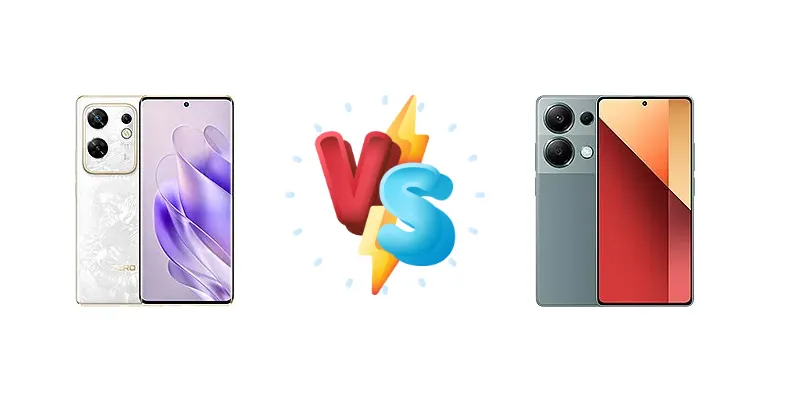
|
🏆 Quick Verdict
For the average user prioritizing rapid charging and a brighter display, the Xiaomi Redmi Note 13 Pro 4G emerges as the winner. Its 67W charging significantly reduces downtime, and the measured 1047 nits brightness provides excellent outdoor visibility. However, the Infinix Zero 30 4G remains a viable option for those less concerned with these features.
| PHONES | ||
|---|---|---|
| Phone Names | Infinix Zero 30 4G | Xiaomi Redmi Note 13 Pro 4G |
| Network | ||
|---|---|---|
| 2G bands | GSM 850 / 900 / 1800 / 1900 | GSM 850 / 900 / 1800 / 1900 |
| 3G bands | HSDPA 850 / 900 / 1700(AWS) / 1900 / 2100 | HSDPA 850 / 900 / 1700(AWS) / 1900 / 2100 |
| 4G bands | 1, 2, 3, 4, 5, 7, 8, 20, 28, 38, 41, 40 | 1, 2, 3, 4, 5, 7, 8, 12, 13, 17, 18, 19, 20, 26, 28, 38, 40, 41, 66 |
| Speed | HSPA, LTE | HSPA, LTE |
| Technology | GSM / HSPA / LTE | GSM / HSPA / LTE |
| Launch | ||
|---|---|---|
| Announced | 2023, October 26 | 2024, January 15 |
| Status | Available. Released 2023, October 26 | Available. Released 2024, January 15 |
| Body | ||
|---|---|---|
| Build | - | Glass front (Gorilla Glass 5), plastic frame, plastic back |
| Dimensions | 164.5 x 75 x 7.9 mm (6.48 x 2.95 x 0.31 in) | 161.1 x 75 x 8 mm (6.34 x 2.95 x 0.31 in) |
| SIM | Nano-SIM + Nano-SIM | Nano-SIM + Nano-SIM |
| Weight | 182 g (6.42 oz) | 188 g (6.63 oz) |
| Display | ||
|---|---|---|
| Protection | Corning Gorilla Glass 5 | Corning Gorilla Glass 5 |
| Resolution | 1080 x 2400 pixels, 20:9 ratio (~388 ppi density) | 1080 x 2400 pixels, 20:9 ratio (~395 ppi density) |
| Size | 6.78 inches, 111.0 cm2 (~90.0% screen-to-body ratio) | 6.67 inches, 107.4 cm2 (~88.9% screen-to-body ratio) |
| Type | AMOLED, 1B colors, 120Hz, 950 nits (peak) | AMOLED, 1B colors, 120Hz, 500 nits (typ), 1000 nits (HBM), 1300 nits (peak) |
| Platform | ||
|---|---|---|
| CPU | Octa-core (2x2.2 GHz Cortex-A76 & 6x2.0 GHz Cortex-A55) | Octa-core (2x2.2 GHz Cortex-A76 & 6x2.0 GHz Cortex-A55) |
| Chipset | Mediatek Helio G99 (6 nm) | Mediatek Helio G99 Ultra |
| GPU | Mali-G57 MC2 | Mali-G57 MC2 |
| OS | Android 13, XOS 13 | Android 13, up to 3 major Android upgrades, HyperOS |
| Memory | ||
|---|---|---|
| Card slot | No | microSDXC (uses shared SIM slot) |
| Internal | 256GB 8GB RAM | 128GB 8GB RAM, 256GB 8GB RAM, 256GB 12GB RAM, 512GB 8GB RAM, 512GB 12GB RAM |
| Main Camera | ||
|---|---|---|
| Features | Quad-LED flash, HDR, panorama | LED flash, HDR, panorama |
| Triple | 108 MP, f/1.7, (wide), 1/1.67", PDAF 2 MP, f/2.4 2 MP, f/2.4 | 200 MP, f/1.7, 23mm (wide), 1/1.4", 0.56µm, multi-directional PDAF, OIS 8 MP, f/2.2, 15mm, 120˚ (ultrawide), 1/4.4", 1.0µm 2 MP (macro) |
| Video | 1440p@30fps, 1080p@30/60fps | 1080p@30/60fps |
| Selfie camera | ||
|---|---|---|
| Features | Dual-LED flash | - |
| Single | 50 MP, f/2.5, (wide), 1/2.76", PDAF | 16 MP, f/2.4, (wide), 1/3.0", 1.0µm |
| Video | 1440p@30fps, 1080p@30/60fps | 1080p@30/60fps |
| Sound | ||
|---|---|---|
| 35mm jack | No | Yes |
| Loudspeaker | Yes, with dual speakers | Yes, with dual speakers |
| Comms | ||
|---|---|---|
| Bluetooth | Yes | 5.2, A2DP, LE |
| Infrared port | - | Yes |
| NFC | Yes | Yes (market/region dependent) |
| Positioning | GPS | GPS, GLONASS, GALILEO, BDS |
| Radio | FM radio | FM radio |
| USB | USB Type-C 2.0, OTG | USB Type-C 2.0, OTG |
| WLAN | Wi-Fi 802.11 a/b/g/n/ac, dual-band | Wi-Fi 802.11 a/b/g/n/ac, dual-band |
| Features | ||
|---|---|---|
| Sensors | Fingerprint (under display, optical), accelerometer, gyro, proximity, compass | Fingerprint (under display, optical), accelerometer, gyro, compass |
| Battery | ||
|---|---|---|
| Charging | 45W wired, PD3.0, 75% in 30 min | 67W wired, 50% in 16 min, 100% in 46 min |
| Type | 5000 mAh | 5000 mAh |
| Misc | ||
|---|---|---|
| Colors | Sunset Gold, Misty Green, Pearly White | Midnight Black, Lavender Purple, Forest Green |
| Models | X6731B | 23117RA68G, 2312FPCA6G |
| Price | About 180 EUR | € 92.00 / $ 269.99 / £ 299.99 |
| SAR | - | 1.09 W/kg (head) 1.09 W/kg (body) |
| SAR EU | - | 0.99 W/kg (head) 0.99 W/kg (body) |
Infinix Zero 30 4G
- Sleek and modern design (assumed based on brand aesthetic)
- Competitive pricing (likely)
- 45W fast charging with PD3.0 support
- Slower charging compared to Redmi Note 13 Pro 4G
- Display brightness likely lower than Redmi Note 13 Pro 4G
Xiaomi Redmi Note 13 Pro 4G
- 67W ultra-fast charging
- High peak display brightness (1047 nits)
- Potentially better sustained performance with Helio G99 Ultra
- May have a less premium design (subjective)
- Xiaomi’s MIUI software can be polarizing
Display Comparison
The Xiaomi Redmi Note 13 Pro 4G boasts a significant advantage in display brightness, achieving a measured 1047 nits. This is crucial for usability in direct sunlight, a scenario where the Infinix Zero 30 4G’s display specifications are not provided, suggesting it will likely fall short. While both likely utilize AMOLED panels (common in this price bracket), the Redmi Note 13 Pro’s higher peak brightness translates to a more vibrant and readable experience outdoors. The absence of refresh rate data for both devices makes it difficult to assess smoothness, but the brightness difference is a clear win for Xiaomi.
Camera Comparison
Detailed camera specifications are limited, but both phones likely feature multi-camera setups. The Redmi Note 13 Pro 4G’s camera is described as having 'Photo / Video' capabilities, implying a focus on overall image and video quality. Without sensor size or aperture information for either device, it’s difficult to make a definitive judgment. However, the Redmi Note 13 Pro 4G’s marketing often emphasizes camera capabilities, suggesting a potentially more refined camera experience. The inclusion of a 2MP macro camera on many phones in this segment is largely a marketing tactic, offering limited real-world benefit.
Performance
Both devices are powered by the MediaTek Helio G99, featuring an octa-core CPU configuration with the same core arrangement (2x2.2 GHz Cortex-A76 & 6x2.0 GHz Cortex-A55). However, the Redmi Note 13 Pro 4G utilizes the 'Ultra' variant of the G99. While the core architecture remains identical, the 'Ultra' designation often indicates higher clock speeds or optimizations for sustained performance. This suggests the Redmi Note 13 Pro 4G may exhibit less thermal throttling during extended gaming sessions or demanding tasks. The lack of RAM and storage specifications for the Infinix Zero 30 4G hinders a complete performance assessment, but the chipset difference leans in favor of the Xiaomi.
Battery Life
The Xiaomi Redmi Note 13 Pro 4G excels in charging speed, offering 67W wired charging, capable of reaching 50% in 16 minutes and 100% in 46 minutes. This is a substantial improvement over the Infinix Zero 30 4G’s 45W charging, which reaches 75% in 30 minutes. While the Redmi Note 13 Pro 4G’s battery capacity isn’t specified, its active use score of 11:36h demonstrates strong battery life. The faster charging speed mitigates any potential disadvantage from a slightly smaller battery capacity, providing a more convenient user experience.
Buying Guide
Buy the Infinix Zero 30 4G if you prioritize a sleek design and are comfortable with a slower charging experience. It’s a good fit for users who primarily use their phone for social media, communication, and light tasks. Buy the Xiaomi Redmi Note 13 Pro 4G if you need a phone that can keep up with a busy lifestyle, offering faster charging, a brighter screen for outdoor use, and potentially better sustained performance due to improved thermal management implied by the 'Ultra' designation of its chipset.