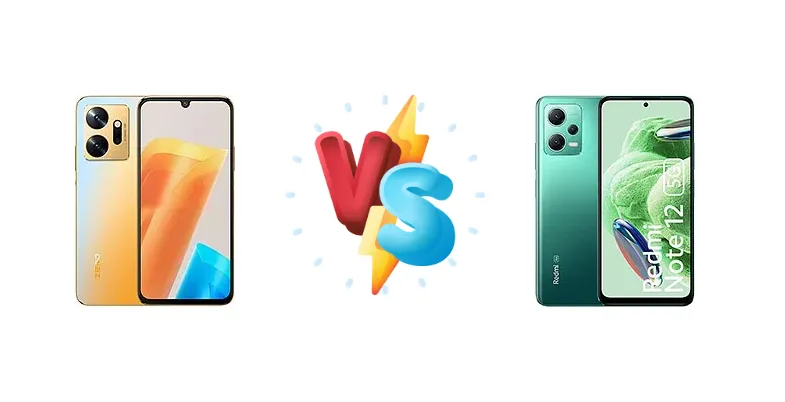
The mid-range smartphone market is fiercely competitive, and the Infinix Zero 20 and Xiaomi Redmi Note 12 are two strong contenders. Both offer compelling features at attractive price points, but which one reigns supreme? This comprehensive comparison will break down every aspect, helping you make an informed decision.
🏆 Quick Verdict
The Redmi Note 12 takes the crown for overall value, boasting exceptional battery life and a bright display. While the Zero 20 offers faster charging and a potentially more powerful chipset, the Redmi Note 12's endurance and screen quality make it a more practical choice for most users.
| Network |
|---|
| 2G bands | GSM 850 / 900 / 1800 / 1900 | GSM 850 / 900 / 1800 / 1900 |
| 3G bands | HSDPA 850 / 900 / 1700(AWS) / 1900 / 2100 | HSDPA 850 / 900 / 2100 |
| 4G bands | 1, 2, 3, 4, 5, 7, 8, 20, 28, 38, 40, 41 | 1, 3, 5, 8, 40, 41 |
| 5G bands | - | 1, 3, 5, 8, 28, 40, 78 SA/NSA |
| Speed | HSPA 42.2/11.5 Mbps, LTE Cat4 150/75 Mbps | HSPA, LTE, 5G |
| Technology | GSM / HSPA / LTE | GSM / HSPA / LTE / 5G |
| Launch |
|---|
| Announced | 2022, October 05 | 2022, October 27 |
| Status | Available. Released 2023, January 02 | Available. Released 2023, January 11 |
| Body |
|---|
| Build | Glass front, aluminum frame | - |
| Dimensions | 164.4 x 76.7 x 8 mm (6.47 x 3.02 x 0.31 in) | 165.9 x 76.2 x 8 mm (6.53 x 3.00 x 0.31 in) |
| SIM | Nano-SIM + Nano-SIM | Nano-SIM + Nano-SIM |
| Weight | 196 g (6.91 oz) | 188 g (6.63 oz) |
| | - | IP53, dust and splash resistant |
| Display |
|---|
| Protection | - | Corning Gorilla Glass 3 |
| Resolution | 1080 x 2400 pixels, 20:9 ratio (~393 ppi density) | 1080 x 2400 pixels, 20:9 ratio (~395 ppi density) |
| Size | 6.7 inches, 108.4 cm2 (~86.0% screen-to-body ratio) | 6.67 inches, 107.4 cm2 (~85.0% screen-to-body ratio) |
| Type | AMOLED, 90Hz | AMOLED, 120Hz, 1200 nits (peak) |
| Platform |
|---|
| CPU | Octa-core (2x2.2 GHz Cortex-A76 & 6x2.0 GHz Cortex-A55) | Octa-core (2x2.0 GHz Cortex-A78 & 6x1.8 GHz Cortex-A55) |
| Chipset | Mediatek Helio G99 (6 nm) | Qualcomm SM4375 Snapdragon 4 Gen 1 (6 nm) |
| GPU | Mali-G57 MC2 | Adreno 619 |
| OS | Android 12, XOS 12 | Android 12, MIUI 14 (International), MIUI 13 (India) |
| Memory |
|---|
| Card slot | microSDXC (dedicated slot) | microSDXC (uses shared SIM slot) |
| Internal | 128GB 8GB RAM, 256GB 8GB RAM | 128GB 4GB RAM, 128GB 6GB RAM, 256GB 8GB RAM |
| | - | UFS 2.2 |
| Main Camera |
|---|
| Features | Quad-LED flash, HDR, panorama | Dual-LED dual-tone flash, HDR, panorama |
| Single | 60 MP, (wide), AF, OIS | - |
| Triple | 108 MP, (wide), PDAF
13 MP, AF
2 MP | 48 MP, f/1.8, (wide), PDAF
8 MP, f/2.2, 120˚ (ultrawide), 1/4.0", 1.12µm
2 MP (macro) |
| Video | 1440p@30fps | 1080p@30fps |
| Selfie camera |
|---|
| Features | Dual-LED flash, HDR | HDR |
| Single | 60 MP, (wide), AF, OIS | 13 MP, f/2.5, (wide), 1/3.0" |
| Video | 1440p@30fps | 1080p@30fps |
| Sound |
|---|
| 3.5mm jack | Yes | Yes |
| 35mm jack | Yes | Yes |
| Loudspeaker | Yes, with dual speakers | Yes |
| | - | 24-bit/192kHz audio |
| Comms |
|---|
| Bluetooth | Yes | 5.1, A2DP, LE |
| Infrared port | - | Yes |
| NFC | Yes | Yes (market/region dependent) |
| Positioning | GPS | GPS, GLONASS |
| Radio | FM radio | Unspecified |
| USB | USB Type-C 2.0, OTG | USB Type-C 2.0, OTG |
| WLAN | Wi-Fi 802.11 a/b/g/n/ac, dual-band | Wi-Fi 802.11 a/b/g/n/ac, dual-band |
| Features |
|---|
| Sensors | Fingerprint (side-mounted), accelerometer, gyro, proximity, compass | Fingerprint (side-mounted), accelerometer, gyro, proximity, compass |
| Battery |
|---|
| Charging | 45W wired, 75% in 30 min | 33W wired, 50% in 22 min |
| Type | 4500 mAh | Li-Po 5000 mAh |
| Misc |
|---|
| Colors | Space Gray, Glitter Gold, Green Fantasy | Frosted Green, Matte Black, Mystique Blue |
| Models | X6821 | 22111317I, 22111317G |
| Price | About 200 EUR | € 151.99 / $ 219.99 / ₹ 11,999 |
| SAR | - | 1.09 W/kg (head) 1.05 W/kg (body) |
| SAR EU | - | 0.68 W/kg (head) 0.91 W/kg (body) |
| Tests |
|---|
| Battery life | - |
Endurance rating 101h
|
| Camera | - |
Photo / Video |
| Display | - |
Contrast ratio: Infinite (nominal) |
| Loudspeaker | - |
-28.0 LUFS (Good)
|
| Performance | - |
AnTuTu: 360745 (v9)
GeekBench: 1998 (v5.1), 2017 (v6) |
Infinix Zero 20
- Faster Charging (45W)
- Potentially better gaming performance
- Good selfie camera
- Sleek design
- Shorter battery life
- Less bright display
- Software experience can be inconsistent
Xiaomi Redmi Note 12
- Exceptional battery life (101h endurance)
- Bright and vibrant display
- Smooth performance for everyday tasks
- Excellent value for money
- Slightly less powerful chipset
- Charging speed is slower (33W)
- Design is more generic
Display Comparison
The Redmi Note 12's 706 nits max brightness and infinite contrast ratio provide a noticeably better viewing experience, especially outdoors. While the Zero 20's display is adequate, it lacks the same level of vibrancy and clarity. The Redmi Note 12's display is a clear winner here.
Camera Comparison
Both phones feature capable camera systems, but the Zero 20 often gets praised for its selfie camera. The Redmi Note 12 excels in capturing well-balanced photos in various lighting conditions. Detailed camera tests are needed to determine a definitive winner, but both offer good value for their price range.
Performance
The Infinix Zero 20's Mediatek Helio G99 chipset generally offers slightly better raw performance than the Redmi Note 12's Snapdragon 4 Gen 1, particularly in gaming scenarios. However, the difference isn't massive, and the Redmi Note 12 handles everyday tasks smoothly. The G99's 6nm process is also more efficient.
Battery Life
The Redmi Note 12 absolutely dominates in battery life. Its endurance rating of 101h is exceptional, providing multiple days of use on a single charge. The Zero 20's battery life is respectable, but falls significantly short of the Redmi Note 12's longevity.
Buying Guide
The Infinix Zero 20 is ideal for users prioritizing fast charging and a slightly more powerful processor for gaming. The Xiaomi Redmi Note 12 is perfect for those who need all-day (or multi-day) battery life and a vibrant display for media consumption.
Frequently Asked Questions
❓ Which phone has better gaming performance?
The Infinix Zero 20's Helio G99 chipset generally offers slightly better gaming performance, but the difference isn't substantial.
❓ Is the Redmi Note 12 worth buying if I need long battery life?
Absolutely! The Redmi Note 12's battery life is a standout feature, easily lasting multiple days with moderate use.
❓ Which phone has a better camera for selfies?
The Infinix Zero 20 is often praised for its selfie camera quality.
❓ Which phone is more durable?
Neither phone is explicitly marketed for durability. Consider a case for either device to protect it from damage.