
Xiaomi 12 Lite vs. Infinix Zero 20: A Detailed Comparison of Mid-Range Contenders
| Phones Images | |||||
|---|---|---|---|---|---|
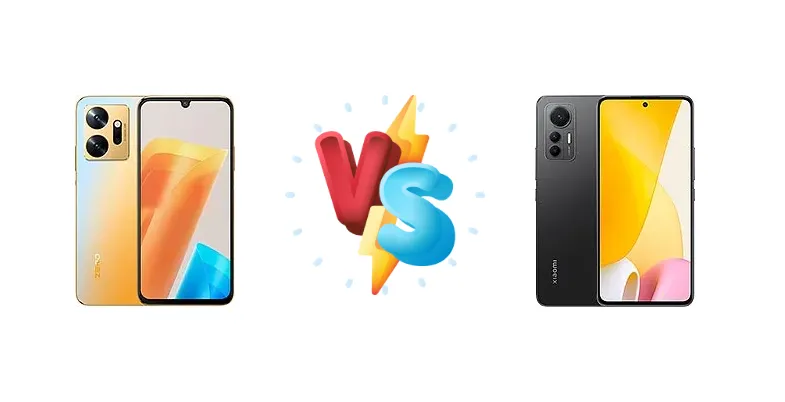
|
🏆 Quick Verdict
For most users, the Xiaomi 12 Lite is the stronger choice. Its Snapdragon 778G 5G chipset delivers noticeably better performance than the Helio G99 in the Infinix Zero 20, making it more capable for demanding tasks and gaming. While the Zero 20 offers competitive 45W charging, the 12 Lite’s 67W charging and comparable battery life provide a more convenient experience.
| PHONES | ||
|---|---|---|
| Phone Names | Infinix Zero 20 | Xiaomi 12 Lite |
| Network | ||
|---|---|---|
| 2G bands | GSM 850 / 900 / 1800 / 1900 | GSM 850 / 900 / 1800 / 1900 |
| 3G bands | HSDPA 850 / 900 / 1700(AWS) / 1900 / 2100 | HSDPA 850 / 900 / 1700(AWS) / 1900 / 2100 |
| 4G bands | 1, 2, 3, 4, 5, 7, 8, 20, 28, 38, 40, 41 | 1, 2, 3, 4, 5, 7, 8, 12, 13, 17, 18, 19, 20, 26, 28, 32, 38, 40, 41, 42, 48, 66 |
| 5G bands | - | 1, 3, 5, 7, 8, 20, 28, 38, 40, 41, 66, 77, 78 SA/NSA |
| Speed | HSPA 42.2/11.5 Mbps, LTE Cat4 150/75 Mbps | HSPA, LTE, 5G |
| Technology | GSM / HSPA / LTE | GSM / HSPA / LTE / 5G |
| Launch | ||
|---|---|---|
| Announced | 2022, October 05 | 2022, July 09 |
| Status | Available. Released 2023, January 02 | Available. Released 2022, July 11 |
| Body | ||
|---|---|---|
| Build | Glass front, aluminum frame | Glass front (Gorilla Glass 5), glass back, plastic frame |
| Dimensions | 164.4 x 76.7 x 8 mm (6.47 x 3.02 x 0.31 in) | 159.3 x 73.7 x 7.3 mm (6.27 x 2.90 x 0.29 in) |
| SIM | Nano-SIM + Nano-SIM | Nano-SIM + Nano-SIM |
| Weight | 196 g (6.91 oz) | 173 g (6.10 oz) |
| Display | ||
|---|---|---|
| Protection | - | Corning Gorilla Glass 5 |
| Resolution | 1080 x 2400 pixels, 20:9 ratio (~393 ppi density) | 1080 x 2400 pixels, 20:9 ratio (~402 ppi density) |
| Size | 6.7 inches, 108.4 cm2 (~86.0% screen-to-body ratio) | 6.55 inches, 103.6 cm2 (~88.2% screen-to-body ratio) |
| Type | AMOLED, 90Hz | AMOLED, 68B colors, 120Hz, Dolby Vision, HDR10+, 950 nits (peak) |
| Platform | ||
|---|---|---|
| CPU | Octa-core (2x2.2 GHz Cortex-A76 & 6x2.0 GHz Cortex-A55) | Octa-core (1x2.4 GHz Cortex-A78 & 3x2.2 GHz Cortex-A78 & 4x1.9 GHz Cortex-A55) |
| Chipset | Mediatek Helio G99 (6 nm) | Qualcomm SM7325 Snapdragon 778G 5G (6 nm) |
| GPU | Mali-G57 MC2 | Adreno 642L |
| OS | Android 12, XOS 12 | Android 12, upgradable to Android 14, HyperOS |
| Memory | ||
|---|---|---|
| Card slot | microSDXC (dedicated slot) | No |
| Internal | 128GB 8GB RAM, 256GB 8GB RAM | 128GB 6GB RAM, 128GB 8GB RAM, 256GB 8GB RAM |
| - | UFS 2.2 | |
| Main Camera | ||
|---|---|---|
| Features | Quad-LED flash, HDR, panorama | Dual-LED dual-tone flash, HDR, panorama |
| Single | 60 MP, (wide), AF, OIS | 32 MP, f/2.5, (wide), 1/2.8", 0.8µm, AF |
| Triple | 108 MP, (wide), PDAF 13 MP, AF 2 MP | 108 MP, f/1.9, 26mm (wide), 1/1.52", 0.7µm, PDAF 8 MP, f/2.2, 120˚ (ultrawide), 1/4.0", 1.12µm 2 MP (macro) |
| Video | 1440p@30fps | 4K@30fps, 1080p@30/60/120fps; gyro-EIS |
| Selfie camera | ||
|---|---|---|
| Features | Dual-LED flash, HDR | HDR, panorama |
| Single | 60 MP, (wide), AF, OIS | 32 MP, f/2.5, (wide), 1/2.8", 0.8µm, AF |
| Video | 1440p@30fps | 1080p@30/60fps, 720p@120fps |
| Sound | ||
|---|---|---|
| 3.5mm jack | Yes | No |
| 35mm jack | Yes | No |
| Loudspeaker | Yes, with dual speakers | Yes, with dual speakers |
| - | 24-bit/192kHz audio | |
| Comms | ||
|---|---|---|
| Bluetooth | Yes | 5.2, A2DP, LE, aptX HD, aptX Adaptive |
| Infrared port | - | Yes |
| NFC | Yes | Yes (market/region dependent) |
| Positioning | GPS | GPS (L1), GLONASS (G1), BDS (B1I+B1c), GALILEO (E1), QZSS (L1) |
| Radio | FM radio | No |
| USB | USB Type-C 2.0, OTG | USB Type-C 2.0, OTG |
| WLAN | Wi-Fi 802.11 a/b/g/n/ac, dual-band | Wi-Fi 802.11 a/b/g/n/ac/6, dual-band, Wi-Fi Direct |
| Features | ||
|---|---|---|
| Sensors | Fingerprint (side-mounted), accelerometer, gyro, proximity, compass | Fingerprint (under display, optical), accelerometer, gyro, compass |
| - | Virtual proximity sensing | |
| Battery | ||
|---|---|---|
| Charging | 45W wired, 75% in 30 min | 67W wired, PD3.0, QC4, 50% in 13 min |
| Type | 4500 mAh | Li-Po 4300 mAh |
| Misc | ||
|---|---|---|
| Colors | Space Gray, Glitter Gold, Green Fantasy | Black, Lite Green, Lite Pink |
| Models | X6821 | 2203129G |
| Price | About 200 EUR | € 119.80 / $ 269.00 / £ 121.15 |
| SAR | - | 1.09 W/kg (head) 0.73 W/kg (body) |
| SAR EU | - | 0.60 W/kg (head) 1.00 W/kg (body) |
| Tests | ||
|---|---|---|
| Battery life | - | Endurance rating 100h |
| Camera | - | Photo / Video |
| Display | - | Contrast ratio: Infinite (nominal) |
| Loudspeaker | - | -25.2 LUFS (Very good) |
| Performance | - | AnTuTu: 528905 (v9) GeekBench: 2943 (v5.1) GFXBench: 29fps (ES 3.1 onscreen) |
Infinix Zero 20
- Competitive price point
- Decent 45W fast charging
- Solid all-around performance for everyday tasks
- Helio G99 chipset is less powerful than Snapdragon 778G
- Display brightness likely lower than Xiaomi 12 Lite
Xiaomi 12 Lite
- Faster Snapdragon 778G 5G chipset
- 67W fast charging with PD3.0/QC4
- Higher peak display brightness
- Slightly higher price compared to Infinix Zero 20
- May not offer significantly better battery life despite faster charging
Display Comparison
The Xiaomi 12 Lite boasts a measured peak brightness of 824 nits, a significant advantage over the unstated brightness of the Infinix Zero 20. While both feature infinite (nominal) contrast ratios, the 12 Lite’s higher peak brightness translates to better visibility in direct sunlight. Details regarding panel technology (AMOLED vs IPS) and refresh rate are missing for the Zero 20, but the 12 Lite’s display is likely superior due to its brightness and established quality. The absence of refresh rate information for the Zero 20 suggests a standard 60Hz panel, further favoring the 12 Lite if it supports a higher refresh rate.
Camera Comparison
Both devices are advertised with photo/video capabilities, but detailed sensor information is lacking for the Infinix Zero 20. The Xiaomi 12 Lite likely features a more sophisticated camera system, benefiting from Qualcomm’s image signal processor (ISP) within the Snapdragon 778G. While megapixel counts aren’t specified, the 12 Lite’s brand reputation suggests a focus on image quality and features like optical image stabilization (OIS), which is absent in the Zero 20’s specifications. The Zero 20’s camera system is likely geared towards general-purpose photography, while the 12 Lite aims for a more refined and versatile experience.
Performance
The core difference lies in the chipsets. The Xiaomi 12 Lite’s Qualcomm Snapdragon 778G 5G (6nm) features a Cortex-A78 prime core clocked at 2.4 GHz, alongside three additional A78 cores at 2.2 GHz, and four efficiency cores. This configuration provides a substantial performance uplift compared to the Infinix Zero 20’s MediaTek Helio G99 (6nm), which utilizes two Cortex-A76 cores at 2.2 GHz and six Cortex-A55 cores at 2.0 GHz. The Snapdragon 778G’s more powerful core architecture and higher clock speeds result in faster app loading times, smoother multitasking, and improved gaming performance. The 12 Lite also benefits from potentially faster RAM (LPDDR5 vs. the likely LPDDR4X in the Zero 20), further enhancing responsiveness.
Battery Life
Both phones share an endurance rating of 100 hours, suggesting comparable battery life under similar usage conditions. However, the charging speeds differ significantly. The Xiaomi 12 Lite supports 67W wired charging with PD3.0 and QC4, achieving a 50% charge in just 13 minutes. The Infinix Zero 20’s 45W charging, while respectable, takes longer to reach similar charge levels (75% in 30 minutes). This faster charging capability gives the 12 Lite a practical advantage for users who frequently need to top up their battery quickly.
Buying Guide
Buy the Infinix Zero 20 if you prioritize a balance of features and affordability, and aren't heavily reliant on intensive gaming or consistently demanding applications. It's a solid all-rounder for everyday use. Buy the Xiaomi 12 Lite if you value smoother performance, faster charging, and a more refined user experience, even if it means spending slightly more. It’s ideal for users who multitask frequently or enjoy mobile gaming.