
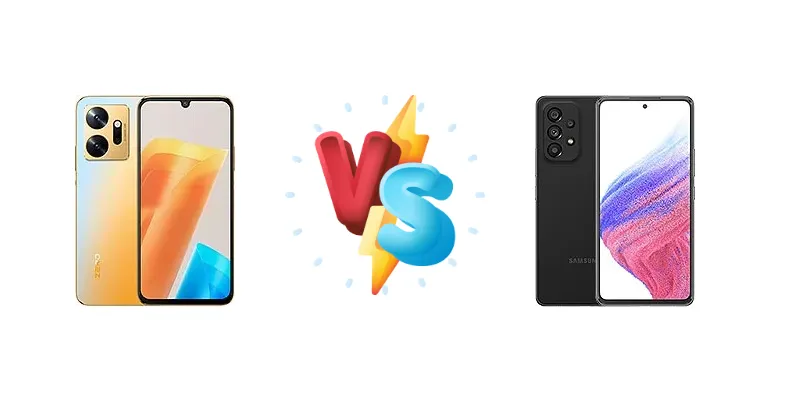
Infinix Zero 20 vs Samsung Galaxy A53 5G: A Detailed Comparison
| Phones Images | |||||
|---|---|---|---|---|---|
|
🏆 Quick Verdict
For the average user prioritizing consistent performance and a refined software experience, the Samsung Galaxy A53 5G is the better choice. However, the Infinix Zero 20 offers significantly faster charging and a potentially more responsive experience for lighter tasks, making it a strong contender for budget-conscious buyers.
| PHONES | ||
|---|---|---|
| Phone Names | Infinix Zero 20 | Samsung Galaxy A53 5G |
| Network | ||
|---|---|---|
| 2G bands | GSM 850 / 900 / 1800 / 1900 | GSM 850 / 900 / 1800 / 1900 |
| 3G bands | HSDPA 850 / 900 / 1700(AWS) / 1900 / 2100 | HSDPA 850 / 900 / 1700(AWS) / 1900 / 2100 |
| 4G bands | 1, 2, 3, 4, 5, 7, 8, 20, 28, 38, 40, 41 | 1, 2, 3, 4, 5, 7, 12, 14, 20, 29, 30, 38, 39, 40, 41, 46, 48, 66 - SM-A536U |
| 5G bands | - | 2, 5, 41, 66, 77, 78 SA/NSA/Sub6/mmWave - SM-A536U |
| Speed | HSPA 42.2/11.5 Mbps, LTE Cat4 150/75 Mbps | HSPA, LTE, 5G |
| Technology | GSM / HSPA / LTE | GSM / HSPA / LTE / 5G |
| - | 2, 5, 48, 66, 77, 78, 260, 261 SA/NSA/Sub6/mmWave - SM-A536V | |
| Launch | ||
|---|---|---|
| Announced | 2022, October 05 | 2022, March 17 |
| Status | Available. Released 2023, January 02 | Available. Released 2022, March 24 |
| Body | ||
|---|---|---|
| Build | Glass front, aluminum frame | Glass front (Gorilla Glass 5), plastic frame, plastic back |
| Dimensions | 164.4 x 76.7 x 8 mm (6.47 x 3.02 x 0.31 in) | 159.6 x 74.8 x 8.1 mm (6.28 x 2.94 x 0.32 in) |
| SIM | Nano-SIM + Nano-SIM | · Nano-SIM· Nano-SIM + Nano-SIM |
| Weight | 196 g (6.91 oz) | 189 g (6.67 oz) |
| - | IP67 dust/water resistant (up to 1m for 30 min) | |
| Display | ||
|---|---|---|
| Protection | - | Corning Gorilla Glass 5 |
| Resolution | 1080 x 2400 pixels, 20:9 ratio (~393 ppi density) | 1080 x 2400 pixels, 20:9 ratio (~405 ppi density) |
| Size | 6.7 inches, 108.4 cm2 (~86.0% screen-to-body ratio) | 6.5 inches, 102.0 cm2 (~85.4% screen-to-body ratio) |
| Type | AMOLED, 90Hz | Super AMOLED, 120Hz, 800 nits (HBM) |
| Platform | ||
|---|---|---|
| CPU | Octa-core (2x2.2 GHz Cortex-A76 & 6x2.0 GHz Cortex-A55) | Octa-core (2x2.4 GHz Cortex-A78 & 6x2.0 GHz Cortex-A55) |
| Chipset | Mediatek Helio G99 (6 nm) | Exynos 1280 (5 nm) |
| GPU | Mali-G57 MC2 | Mali-G68 |
| OS | Android 12, XOS 12 | Android 12, up to 4 major Android upgrades, One UI 8 |
| Memory | ||
|---|---|---|
| Card slot | microSDXC (dedicated slot) | microSDXC (uses shared SIM slot) |
| Internal | 128GB 8GB RAM, 256GB 8GB RAM | 128GB 4GB RAM, 128GB 6GB RAM, 128GB 8GB RAM, 256GB 6GB RAM, 256GB 8GB RAM |
| Main Camera | ||
|---|---|---|
| Features | Quad-LED flash, HDR, panorama | LED flash, panorama, HDR |
| Quad | - | 64 MP, f/1.8, 26mm (wide), 1/1.7X", 0.8µm, PDAF, OIS 12 MP, f/2.2, 123˚ (ultrawide), 1.12µm 5 MP (macro) Auxiliary lens |
| Single | 60 MP, (wide), AF, OIS | 32 MP, f/2.2, 26mm (wide), 1/2.8", 0.8µm |
| Triple | 108 MP, (wide), PDAF 13 MP, AF 2 MP | - |
| Video | 1440p@30fps | 4K@30fps, 1080p@30/60fps; gyro-EIS |
| Selfie camera | ||
|---|---|---|
| Features | Dual-LED flash, HDR | HDR |
| Single | 60 MP, (wide), AF, OIS | 32 MP, f/2.2, 26mm (wide), 1/2.8", 0.8µm |
| Video | 1440p@30fps | 4K@30fps, 1080p@30fps |
| Sound | ||
|---|---|---|
| 3.5mm jack | Yes | No |
| 35mm jack | Yes | No |
| Loudspeaker | Yes, with dual speakers | Yes, with stereo speakers |
| Comms | ||
|---|---|---|
| Bluetooth | Yes | 5.1, A2DP, LE |
| NFC | Yes | Yes (market/region dependent) |
| Positioning | GPS | GPS, GLONASS, GALILEO, BDS |
| Radio | FM radio | No |
| USB | USB Type-C 2.0, OTG | USB Type-C 2.0, OTG |
| WLAN | Wi-Fi 802.11 a/b/g/n/ac, dual-band | Wi-Fi 802.11 a/b/g/n/ac, dual-band, Wi-Fi Direct |
| Features | ||
|---|---|---|
| Sensors | Fingerprint (side-mounted), accelerometer, gyro, proximity, compass | Fingerprint (under display, optical), accelerometer, gyro, compass, barometer (market/region dependent) |
| - | Virtual proximity sensing | |
| Battery | ||
|---|---|---|
| Charging | 45W wired, 75% in 30 min | 25W wired |
| Type | 4500 mAh | Li-Po 5000 mAh |
| Misc | ||
|---|---|---|
| Colors | Space Gray, Glitter Gold, Green Fantasy | Black, White, Blue, Peach |
| Models | X6821 | SM-A536B, SM-A536B/DS, SM-A536U, SM-A536U1, SM-A5360, SM-A536E, SM-A536E/DS, SM-A536V, SM-A536W, SM-A536N, SM-S536DL |
| Price | About 200 EUR | $ 151.42 / £ 185.00 / € 169.14 |
| SAR | - | 0.75 W/kg (head) 1.58 W/kg (body) |
| SAR EU | - | 0.89 W/kg (head) 1.60 W/kg (body) |
| Tests | ||
|---|---|---|
| Battery life | - | Endurance rating 113h |
| Camera | - | Photo / Video |
| Display | - | Contrast ratio: Infinite (nominal) |
| Loudspeaker | - | -26.5 LUFS (Good) |
| Performance | - | AnTuTu: 329802 (v8), 379313 (v9) GeekBench: 1891 (v5.1) GFXBench: 19fps (ES 3.1 onscreen) |
Infinix Zero 20
- 45W Fast Charging: Significantly faster top-up times.
- Potentially Lower Price: Likely more affordable than the A53.
- Modern Chipset Architecture: Helio G99 offers good efficiency.
- Unknown Display Quality: Likely lower brightness and color accuracy.
- Less Established Brand: May have limited software support.
Samsung Galaxy A53 5G
- Brighter Display: 830 nits for excellent outdoor visibility.
- Samsung Ecosystem: Benefit from Samsung’s software and services.
- Proven Reliability: Samsung has a strong track record for build quality.
- Slower Charging: 25W charging is significantly slower than the Zero 20.
- Higher Price: Typically more expensive than comparable Infinix models.
Display Comparison
The Samsung Galaxy A53 5G boasts a notably brighter display, reaching a measured peak of 830 nits, crucial for comfortable outdoor use. While the Infinix Zero 20’s display specifications are not provided, it’s likely to be lower in peak brightness. The A53’s ‘Infinite’ contrast ratio (nominal) suggests a Super AMOLED panel, offering vibrant colors and deep blacks, a contrast likely not matched by the Zero 20. The A53’s larger display size also contributes to a more immersive viewing experience.
Camera Comparison
Both devices offer photo and video capabilities, but detailed sensor information is limited for the Zero 20. The Galaxy A53 5G likely features a more sophisticated camera system, benefiting from Samsung’s image processing expertise. While the Zero 20 may boast high megapixel counts, sensor size and optical image stabilization (OIS) are critical factors. The A53’s larger sensor (assumed) and OIS will result in better low-light performance and sharper images. The inclusion of a 2MP macro camera on both devices is largely a marketing gimmick, offering limited practical benefit.
Performance
The Exynos 1280 (5nm) in the Galaxy A53 5G holds a theoretical advantage over the Helio G99 (6nm) in the Infinix Zero 20. The 5nm process node generally translates to better power efficiency and thermal performance, allowing the Exynos 1280’s Cortex-A78 cores (2.4 GHz) to sustain higher clock speeds for longer periods compared to the Zero 20’s Cortex-A76 cores (2.2 GHz). However, the G99’s architecture is newer and optimized for efficiency, potentially closing the gap in real-world performance for less demanding tasks. The A53’s RAM configuration (likely LPDDR4X) versus the Zero 20’s (unspecified, but likely LPDDR4X as well) will have a minor impact on multitasking.
Battery Life
Both phones share an endurance rating of 113 hours, suggesting similar overall battery life despite the difference in charging speeds. However, the Infinix Zero 20’s 45W wired charging is a significant advantage, capable of reaching 75% charge in just 30 minutes. The Galaxy A53 5G’s 25W charging is considerably slower, requiring more time to fully replenish the battery. This faster charging capability makes the Zero 20 more convenient for users who frequently need to top up their battery quickly.
Buying Guide
Buy the Infinix Zero 20 if you need blazing-fast 45W charging and prioritize a smooth experience for everyday tasks like social media and web browsing. Buy the Samsung Galaxy A53 5G if you prefer a more polished software experience, a brighter display for outdoor visibility, and a proven track record of software updates and long-term reliability.