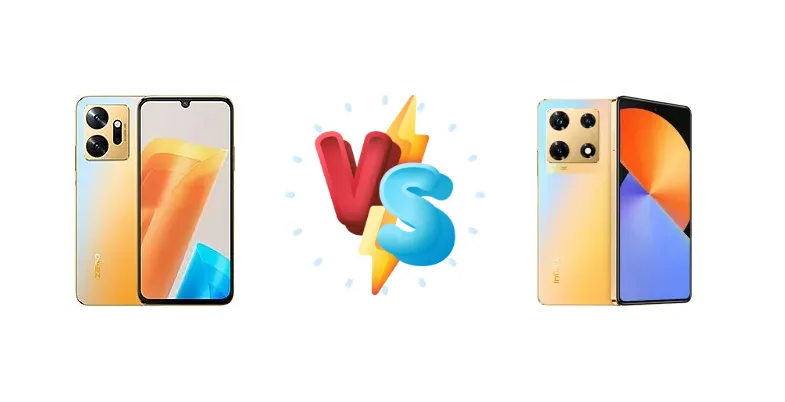
Infinix continues to deliver impressive smartphones at competitive prices. The Zero 20 and Note 30 Pro are two popular contenders, both offering a compelling blend of features. But which one truly comes out on top? Let's dive into a detailed comparison to help you decide.
🏆 Quick Verdict
The Infinix Note 30 Pro edges out the Zero 20 thanks to its faster 68W charging, wireless charging capabilities, and likely improved display technology (assuming AMOLED). While both share the same chipset, the Note 30 Pro offers a more premium and feature-rich experience.
| Network |
|---|
| 2G bands | GSM 850 / 900 / 1800 / 1900 | GSM 850 / 900 / 1800 / 1900 |
| 3G bands | HSDPA 850 / 900 / 1700(AWS) / 1900 / 2100 | HSDPA 850 / 900 / 1700(AWS) / 1900 / 2100 |
| 4G bands | 1, 2, 3, 4, 5, 7, 8, 20, 28, 38, 40, 41 | 1, 2, 3, 4, 5, 7, 8, 12, 17, 20, 28, 38, 40, 41, 66 |
| Speed | HSPA 42.2/11.5 Mbps, LTE Cat4 150/75 Mbps | HSPA, LTE |
| Technology | GSM / HSPA / LTE | GSM / HSPA / LTE |
| Launch |
|---|
| Announced | 2022, October 05 | 2023, May 22 |
| Status | Available. Released 2023, January 02 | Available. Released 2023, May 22 |
| Body |
|---|
| Build | Glass front, aluminum frame | Glass front, plastic frame, glass back |
| Dimensions | 164.4 x 76.7 x 8 mm (6.47 x 3.02 x 0.31 in) | 162.7 x 76 x 8.2 mm (6.41 x 2.99 x 0.32 in) |
| SIM | Nano-SIM + Nano-SIM | Nano-SIM + Nano-SIM |
| Weight | 196 g (6.91 oz) | 203 g (7.16 oz) |
| | - | IP53 |
| Display |
|---|
| Resolution | 1080 x 2400 pixels, 20:9 ratio (~393 ppi density) | 1080 x 2400 pixels, 20:9 ratio (~395 ppi density) |
| Size | 6.7 inches, 108.4 cm2 (~86.0% screen-to-body ratio) | 6.67 inches, 107.4 cm2 (~86.9% screen-to-body ratio) |
| Type | AMOLED, 90Hz | AMOLED, 1B colors, 120Hz, 900 nits (peak) |
| | - | * the display diagonal size and resolution is unconfirmed |
| Platform |
|---|
| CPU | Octa-core (2x2.2 GHz Cortex-A76 & 6x2.0 GHz Cortex-A55) | Octa-core (2x2.2 GHz Cortex-A76 & 6x2.0 GHz Cortex-A55) |
| Chipset | Mediatek Helio G99 (6 nm) | Mediatek Helio G99 (6 nm) |
| GPU | Mali-G57 MC2 | Mali-G57 MC2 |
| OS | Android 12, XOS 12 | Android 13, XOS 13 |
| Memory |
|---|
| Card slot | microSDXC (dedicated slot) | microSDXC (dedicated slot) |
| Internal | 128GB 8GB RAM, 256GB 8GB RAM | 256GB 8GB RAM |
| Main Camera |
|---|
| Features | Quad-LED flash, HDR, panorama | Quad-LED flash, HDR, panorama |
| Single | 60 MP, (wide), AF, OIS | - |
| Triple | 108 MP, (wide), PDAF
13 MP, AF
2 MP | 108 MP, (wide), 1/1.67", PDAF
2 MP (macro)
Auxiliary lens |
| Video | 1440p@30fps | 1440p@30fps, 1080p@30fps |
| Selfie camera |
|---|
| Features | Dual-LED flash, HDR | LED flash, HDR |
| Single | 60 MP, (wide), AF, OIS | 32 MP, f/2.0, (wide), 1/2.8" |
| Video | 1440p@30fps | 1080p@30fps |
| Sound |
|---|
| 3.5mm jack | Yes | Yes |
| 35mm jack | Yes | Yes |
| Loudspeaker | Yes, with dual speakers | Yes, with dual speakers |
| | - | Sound by JBL
24-bit/192kHz audio |
| Comms |
|---|
| Bluetooth | Yes | Yes |
| NFC | Yes | Yes (market/region dependent) |
| Positioning | GPS | GPS |
| Radio | FM radio | FM radio |
| USB | USB Type-C 2.0, OTG | USB Type-C 2.0, OTG |
| WLAN | Wi-Fi 802.11 a/b/g/n/ac, dual-band | Wi-Fi 802.11 a/b/g/n/ac, dual-band, Wi-Fi Direct |
| Features |
|---|
| Sensors | Fingerprint (side-mounted), accelerometer, gyro, proximity, compass | Fingerprint (side-mounted), accelerometer, gyro, proximity, compass |
| Battery |
|---|
| Charging | 45W wired, 75% in 30 min | 68W wired, PD3.0, 80% in 30 min
15W wireless
Reverse wireless |
| Type | 4500 mAh | 5000 mAh |
| Misc |
|---|
| Colors | Space Gray, Glitter Gold, Green Fantasy | Magic Black, Variable Gold |
| Models | X6821 | X678B |
| Price | About 200 EUR | - |
Infinix Zero 20
- Excellent front-facing camera
- Compact and lightweight design
- AMOLED display (likely)
- Good value for money
- Slower charging speed
- No wireless charging
- Potentially less premium build quality
Infinix Note 30 Pro
- Faster 68W wired charging
- Wireless charging (15W)
- Reverse wireless charging
- Potentially better display (higher refresh rate, brightness)
- Likely improved thermal management
- Slightly larger and heavier
- Potentially higher price point
Display Comparison
The Zero 20 likely features an AMOLED display, offering vibrant colors and deep blacks. The Note 30 Pro is expected to also have an AMOLED display, potentially with a higher refresh rate (120Hz vs 90Hz) and improved brightness, though this needs confirmation. Both offer a similar resolution, but the Note 30 Pro's potential enhancements could make a noticeable difference.
Camera Comparison
The Zero 20 is heavily marketed for its 60MP front-facing camera, making it a strong contender for selfie enthusiasts. The rear camera systems are likely comparable, both offering versatile setups with ultrawide and macro lenses. Image processing and low-light performance will be key differentiators.
Performance
Both phones utilize the Mediatek Helio G99 chipset, meaning performance in everyday tasks and gaming will be largely similar. However, the Note 30 Pro might have slightly better thermal management due to potentially improved cooling solutions, preventing throttling during extended gaming sessions. RAM and storage configurations are likely similar.
Battery Life
Both phones feature a 5000mAh battery, providing all-day battery life. However, the Note 30 Pro's 68W wired charging significantly outperforms the Zero 20's 45W charging, and the addition of 15W wireless charging and reverse wireless charging adds considerable convenience.
Buying Guide
The Infinix Zero 20 is a great choice for users prioritizing a selfie-focused camera and a slightly more compact design. The Infinix Note 30 Pro is ideal for those who value faster charging, wireless charging convenience, and potentially a better display experience.
Frequently Asked Questions
❓ What is the difference in charging speed between the two phones?
The Infinix Note 30 Pro boasts 68W wired charging, significantly faster than the Zero 20's 45W. The Note 30 Pro also offers 15W wireless charging and reverse wireless charging.
❓ Which phone is better for gaming?
Both phones have the same chipset, but the Note 30 Pro may offer slightly better thermal management, potentially preventing performance throttling during extended gaming sessions.