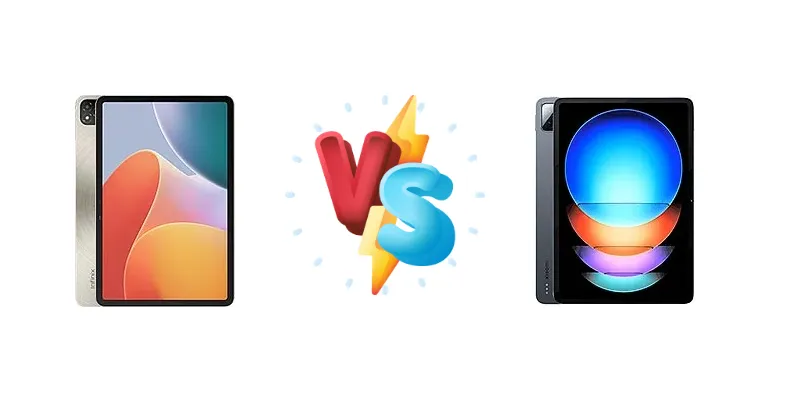
The Android tablet market is heating up, with options ranging from budget-friendly to premium. We pit the Infinix Xpad, a value-focused contender, against the Xiaomi Pad 6S Pro 12.4, a performance-driven device boasting flagship silicon, to determine which tablet delivers the best experience for your money.
🏆 Quick Verdict
For most users, the Xiaomi Pad 6S Pro 12.4 is the superior choice. Its Snapdragon 8 Gen 2 chipset provides significantly faster performance and better long-term support, while the 120W charging is a game-changer. However, the Infinix Xpad remains a compelling option for budget-conscious users prioritizing affordability.
| Network |
|---|
| 2G bands | GSM 850 / 900 / 1800 / 1900 | N/A |
| 3G bands | HSDPA 900 / 2100 | N/A |
| 4G bands | LTE | - |
| EDGE | - | N/A |
| GPRS | - | N/A |
| Speed | HSPA, LTE - cellular model only | - |
| Technology | GSM / HSPA / LTE | No cellular connectivity |
| Launch |
|---|
| Announced | 2024, August 12 | 2024, February 22 |
| Status | Available. Released 2024, August 18 | Available. Released 2024, February 22 |
| Body |
|---|
| Build | Glass front, aluminum frame, aluminum back | Glass front (Gorilla Glass 5), aluminum frame, aluminum back |
| Dimensions | 257 x 168.6 x 7.6 mm (10.12 x 6.64 x 0.30 in) | 278.7 x 191.6 x 6.3 mm (10.97 x 7.54 x 0.25 in) |
| SIM | Nano-SIM (cellular model only) | No |
| Weight | 496 g (1.09 lb) | 590 g (1.30 lb) |
| Display |
|---|
| Protection | - | Corning Gorilla Glass 5 |
| Resolution | 1200 x 1920 pixels, 16:10 ratio (~206 ppi density) | 2032 x 3048 pixels, 3:2 ratio (~295 ppi density) |
| Size | 11.0 inches, 350.9 cm2 (~81.0% screen-to-body ratio) | 12.4 inches, 457.8 cm2 (~85.7% screen-to-body ratio) |
| Type | IPS LCD, 90Hz, 440 nits | IPS LCD, 68B colors, 144Hz, HDR10, Dolby Vision, 900 nits (peak) |
| Platform |
|---|
| CPU | Octa-core (2x2.2 GHz Cortex-A76 & 6x2.0 GHz Cortex-A55) | Octa-core (1x3.2 GHz Cortex-X3 & 2x2.8 GHz Cortex-A715 & 2x2.8 GHz Cortex-A710 & 3x2.0 GHz Cortex-A510) |
| Chipset | Mediatek Helio G99 (6 nm) | Qualcomm SM8550-AB Snapdragon 8 Gen 2 (4 nm) |
| GPU | Mali-G57 MC2 | Adreno 740 |
| OS | Android 14, XOS 14 | Android 14, up to 3 major Android upgrades, HyperOS |
| Memory |
|---|
| Card slot | microSDXC | No |
| Internal | 128GB 4GB RAM, 256GB 4GB RAM, 256GB 8GB RAM | 256GB 8GB RAM, 256GB 12GB RAM, 512GB 12GB RAM, 1TB 16GB RAM |
| Main Camera |
|---|
| Dual | - | 50 MP, f/1.8, (wide), 1/2.76", 0.64µm, PDAF
Auxiliary lens |
| Features | Quad-LED flash | LED flash, HDR, panorama |
| Single | 8 MP | - |
| Video | 1440p@30fps, 1080p@30fps | 4K@30/60fps, 1080p@30/60fps |
| Selfie camera |
|---|
| Features | Dual-LED flash | - |
| Single | 8 MP | 32 MP, f/2.2, (wide), 1/3.6", 0.61µm |
| Video | 1080p@30fps | 1080p@30fps |
| Sound |
|---|
| 35mm jack | Yes | No |
| Loudspeaker | Yes, with stereo speakers (4 speakers) | Yes, with stereo speakers (6 speakers) |
| Comms |
|---|
| Bluetooth | 5.2, A2DP, LE | 5.3, A2DP, LE, LHDC |
| NFC | No | Yes (file transfer only) |
| Positioning | GPS - cellular model only | No |
| Radio | FM radio | No |
| USB | USB Type-C 2.0, OTG | USB Type-C 3.2, accessory connector |
| WLAN | Wi-Fi 802.11 a/b/g/n/ac, dual-band | Wi-Fi 802.11 a/b/g/n/a/6/7, dual-band, Wi-Fi Direct |
| Features |
|---|
| Sensors | Accelerometer, proximity, compass | Fingerprint (side-mounted), accelerometer, gyro, proximity (accessories only), compass |
| Battery |
|---|
| Charging | 18W wired, 50% in 40 min | 120W wired, PD3.0, QC4, 45% in 10 min, 100% in 35 min |
| Type | Li-Po 7000 mAh | 10000 mAh |
| Misc |
|---|
| Colors | Titan Gold, Frost Blue, Stellar Grey | Black, Blue, Green |
| Models | X1101 | 24018RPACG |
| Price | About 140 EUR | About 700 EUR |
| SAR EU | - | 0.99 W/kg (body) |
Infinix Xpad
- Significantly more affordable
- Decent performance for basic tasks
- Lightweight and portable
- Outmatched by Snapdragon 8 Gen 2 in performance
- Slow charging speed (18W)
- Display quality likely inferior
Xiaomi Pad 6S Pro 12.4
- Flagship Snapdragon 8 Gen 2 performance
- Ultra-fast 120W charging
- High-brightness, high-contrast display
- Higher price point
- Larger size may be less portable
- Potentially more expensive repairs
Display Comparison
The Xiaomi Pad 6S Pro 12.4 immediately distinguishes itself with a measured peak brightness of 848 nits, offering a significantly more vibrant and visible experience, especially outdoors, compared to the Infinix Xpad (brightness data unavailable). While the Xpad’s panel specifics are unknown, the 6S Pro’s 1378:1 contrast ratio ensures deep blacks and vivid colors. The larger screen size of the Xiaomi Pad 6S Pro 12.4 also contributes to a more immersive viewing experience. We anticipate the Xiaomi Pad 6S Pro 12.4 to have a higher quality panel overall.
Camera Comparison
Given the tablet form factor, camera quality isn't a primary concern for most users. However, the Xiaomi Pad 6S Pro 12.4 is likely to offer a more refined camera experience due to its superior image signal processor (ISP) integrated within the Snapdragon 8 Gen 2. While specific camera specs for both devices are limited, the Xiaomi’s flagship chipset will enable better image processing, noise reduction, and dynamic range. We expect the Infinix Xpad to have a more basic camera setup focused on casual snapshots.
Performance
The performance gap is substantial. The Xiaomi Pad 6S Pro 12.4’s Qualcomm Snapdragon 8 Gen 2 (4nm) is in a different league than the Infinix Xpad’s MediaTek Helio G99 (6nm). The Snapdragon 8 Gen 2 features a prime Cortex-X3 core clocked at 3.2 GHz, alongside high-performance Cortex-A715 and A710 cores, offering a massive leap in CPU and GPU capabilities. The G99, while capable for everyday tasks, relies on older Cortex-A76 and A55 cores. This translates to significantly faster app loading times, smoother multitasking, and a far superior gaming experience on the Xiaomi Pad 6S Pro 12.4. The 4nm process node of the Snapdragon also contributes to better thermal efficiency, reducing the likelihood of performance throttling during extended use.
Battery Life
The Xiaomi Pad 6S Pro 12.4 boasts an impressive active use battery score of 11:14h, demonstrating excellent endurance. While the Infinix Xpad’s battery capacity is unknown, the Xiaomi’s 120W wired charging is a standout feature, achieving 45% charge in just 10 minutes and a full charge in 35 minutes. This is a massive advantage over the Infinix Xpad’s 18W charging, which takes 40 minutes to reach 50%. The faster charging speed significantly reduces downtime and makes the Xiaomi Pad 6S Pro 12.4 more convenient for on-the-go users.
Buying Guide
Buy the Infinix Xpad if you need a highly affordable tablet for basic tasks like media consumption, web browsing, and light gaming, and aren't concerned with future-proofing or demanding performance. Buy the Xiaomi Pad 6S Pro 12.4 if you prioritize raw power for demanding applications, gaming, and multitasking, and value features like incredibly fast charging and a high-quality display.
Frequently Asked Questions
❓ Will the MediaTek Helio G99 in the Infinix Xpad struggle with demanding games like Genshin Impact?
Yes, the Helio G99 will likely struggle with graphically intensive games like Genshin Impact at higher settings. You'll likely need to lower the graphics settings significantly to achieve playable frame rates. The Snapdragon 8 Gen 2 in the Xiaomi Pad 6S Pro 12.4 will handle these games with ease at maximum settings.
❓ How much faster is the 120W charging on the Xiaomi Pad 6S Pro 12.4 compared to the 18W charging on the Infinix Xpad in a real-world scenario?
The difference is dramatic. The Xiaomi Pad 6S Pro 12.4 can gain 45% charge in 10 minutes, and reach 100% in 35 minutes. The Infinix Xpad takes 40 minutes just to reach 50%. This means you can quickly top up the Xiaomi Pad 6S Pro 12.4 during short breaks, while the Infinix Xpad requires a much longer charging period.
❓ Is the Xiaomi Pad 6S Pro 12.4 likely to overheat during prolonged gaming sessions?
The Snapdragon 8 Gen 2 is a thermally efficient chip, and the larger chassis of the Xiaomi Pad 6S Pro 12.4 provides more space for heat dissipation. While some throttling is possible during extremely demanding tasks, it's unlikely to be a significant issue. The 4nm process node also contributes to lower heat generation compared to the Infinix Xpad's 6nm chip.