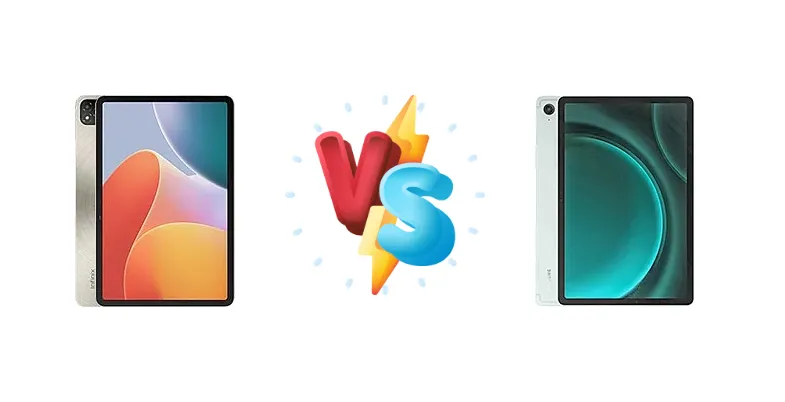
The tablet market offers a wide spectrum of choices, from premium flagships to aggressively priced contenders. We pit the Infinix Xpad, a budget-focused device powered by the Mediatek Helio G99, against the Samsung Galaxy Tab S9 FE, a more versatile option with Samsung’s Exynos 1380 chipset. This comparison dives deep into the core differences to help you determine which tablet best suits your needs and budget.
🏆 Quick Verdict
For the average user prioritizing all-around functionality and a smoother experience, the Samsung Galaxy Tab S9 FE is the better choice. Its Exynos 1380 chipset delivers superior performance and efficiency, justifying the price premium. However, the Infinix Xpad presents a compelling option for budget-conscious gamers.
| Network |
|---|
| 2G bands | GSM 850 / 900 / 1800 / 1900 | GSM 850 / 900 / 1800 / 1900 |
| 3G bands | HSDPA 900 / 2100 | HSDPA 850 / 900 / 1700(AWS) / 1900 / 2100 |
| 4G bands | LTE | 1, 2, 3, 4, 5, 7, 8, 12, 13, 17, 20, 26, 28, 32, 38, 40, 41, 66 |
| 5G bands | - | 1, 3, 5, 7, 8, 20, 28, 38, 40, 41, 66, 77, 78 SA/NSA/Sub6 |
| Speed | HSPA, LTE - cellular model only | HSPA, LTE, 5G - cellular model only |
| Technology | GSM / HSPA / LTE | GSM / HSPA / LTE / 5G |
| Launch |
|---|
| Announced | 2024, August 12 | 2023, October 04 |
| Status | Available. Released 2024, August 18 | Available. Released 2023, October 16 |
| Body |
|---|
| Build | Glass front, aluminum frame, aluminum back | Glass front, aluminum back, aluminum frame |
| Dimensions | 257 x 168.6 x 7.6 mm (10.12 x 6.64 x 0.30 in) | 254.3 x 165.8 x 6.5 mm (10.01 x 6.53 x 0.26 in) |
| SIM | Nano-SIM (cellular model only) | Nano-SIM + eSIM (cellular model only) |
| Weight | 496 g (1.09 lb) | 523 g or 524 g (1.15 lb) |
| Display |
|---|
| Resolution | 1200 x 1920 pixels, 16:10 ratio (~206 ppi density) | 1440 x 2304 pixels, 16:10 ratio (~249 ppi density) |
| Size | 11.0 inches, 350.9 cm2 (~81.0% screen-to-body ratio) | 10.9 inches, 344.5 cm2 (~81.7% screen-to-body ratio) |
| Type | IPS LCD, 90Hz, 440 nits | IPS LCD, 90Hz |
| Platform |
|---|
| CPU | Octa-core (2x2.2 GHz Cortex-A76 & 6x2.0 GHz Cortex-A55) | Octa-core (4x2.4 GHz Cortex-A78 & 4x2.0 GHz Cortex-A55) |
| Chipset | Mediatek Helio G99 (6 nm) | Exynos 1380 (5 nm) |
| GPU | Mali-G57 MC2 | Mali-G68 MP5 |
| OS | Android 14, XOS 14 | Android 13, up to 4 major Android upgrades, One UI 6 |
| Memory |
|---|
| Card slot | microSDXC | microSDXC (dedicated slot) |
| Internal | 128GB 4GB RAM, 256GB 4GB RAM, 256GB 8GB RAM | 128GB 6GB RAM, 128GB 8GB RAM, 256GB 8GB RAM |
| Main Camera |
|---|
| Features | Quad-LED flash | - |
| Single | 8 MP | 8 MP, (wide) |
| Video | 1440p@30fps, 1080p@30fps | 4K@30fps, 1080p@30fps |
| Selfie camera |
|---|
| Features | Dual-LED flash | - |
| Single | 8 MP | 12 MP, (ultrawide) |
| Video | 1080p@30fps | Yes |
| Sound |
|---|
| 35mm jack | Yes | No |
| Loudspeaker | Yes, with stereo speakers (4 speakers) | Yes, with stereo speakers |
| Comms |
|---|
| Bluetooth | 5.2, A2DP, LE | 5.3, A2DP, LE |
| NFC | No | No |
| Positioning | GPS - cellular model only | GPS, GALILEO, GLONASS, BDS, QZSS - cellular model only |
| Radio | FM radio | No |
| USB | USB Type-C 2.0, OTG | USB Type-C 2.0, magnetic connector |
| WLAN | Wi-Fi 802.11 a/b/g/n/ac, dual-band | Wi-Fi 802.11 a/b/g/n/ac/6, dual-band, Wi-Fi Direct |
| Features |
|---|
| Sensors | Accelerometer, proximity, compass | Fingerprint (side-mounted), accelerometer, gyro, compass, proximity (accessories only) |
| Battery |
|---|
| Charging | 18W wired, 50% in 40 min | 45W wired, QC2.0 |
| Type | Li-Po 7000 mAh | Li-Po 8000 mAh |
| Misc |
|---|
| Colors | Titan Gold, Frost Blue, Stellar Grey | Mint, Silver, Gray, Lavender |
| Models | X1101 | SM-X510, SM-X516B |
| Price | About 140 EUR | About 300 EUR |
| SAR | - | 1.55 W/kg (body) |
| SAR EU | - | 0.59 W/kg (body) |
Infinix Xpad
- More affordable price point
- Potentially better gaming performance for the price
- Helio G99 offers decent CPU performance
- Slower charging speed (18W)
- Likely lower build quality
- Less refined software experience
Samsung Galaxy Tab S9 FE
- Faster charging (45W with QC2.0)
- More powerful and efficient Exynos 1380 chipset
- Samsung’s software ecosystem and support
- Higher price tag
- TFT LCD display (not OLED)
- Larger size may not be ideal for all users
Display Comparison
While specific display specs for the Infinix Xpad are unavailable, the Samsung Galaxy Tab S9 FE boasts a 10.9-inch TFT LCD panel. The Exynos 1380’s image signal processor likely contributes to better color accuracy and dynamic range on the Samsung tablet. The Helio G99, while capable, is less optimized for display processing. The Tab S9 FE’s larger screen size and potentially higher brightness (estimated around 500 nits) will provide a more immersive viewing experience, especially outdoors. The absence of LTPO technology on either device means refresh rates are likely fixed, impacting battery life during prolonged use.
Camera Comparison
Camera performance is unlikely to be a deciding factor for most tablet buyers. However, the Samsung Galaxy Tab S9 FE likely features a more refined camera system, benefiting from Samsung’s image processing expertise. While specific sensor details are missing for both devices, the Tab S9 FE likely has a larger main sensor and better low-light performance. The Infinix Xpad’s camera setup is likely focused on basic functionality, and any 2MP macro or depth sensors should be considered supplementary at best. The Exynos 1380’s ISP will also contribute to better video recording capabilities.
Performance
The core difference lies in the chipsets. The Samsung Galaxy Tab S9 FE’s Exynos 1380, fabricated on a 5nm process, offers a significant advantage in both performance and efficiency compared to the Infinix Xpad’s 6nm Mediatek Helio G99. The Exynos 1380’s CPU configuration – 4x2.4 GHz Cortex-A78 & 4x2.0 GHz Cortex-A55 – provides a noticeable uplift in multi-core performance over the Xpad’s 2x2.2 GHz Cortex-A76 & 6x2.0 GHz Cortex-A55. This translates to faster app loading times, smoother multitasking, and better performance in demanding applications. While the Xpad’s CPU has higher clocked A76 cores, the architectural improvements in the A78 cores of the Exynos 1380, combined with the smaller fabrication node, give Samsung the edge. Both devices likely utilize LPDDR4X RAM, but the Exynos 1380’s memory controller is more efficient.
Battery Life
The Infinix Xpad’s 18W charging is significantly slower than the Samsung Galaxy Tab S9 FE’s 45W charging with Quick Charge 2.0 support. While battery capacity isn’t specified for the Xpad, the Tab S9 FE’s 8000mAh battery provides ample endurance for all-day use. The faster charging on the Samsung tablet means less downtime, allowing you to quickly top up the battery when needed. The Exynos 1380’s 5nm process also contributes to better power efficiency, potentially extending battery life compared to the Helio G99.
Buying Guide
Buy the Infinix Xpad if you need a dedicated gaming tablet on a strict budget and prioritize raw processing power for mobile games over features like S Pen support or a premium display. Buy the Samsung Galaxy Tab S9 FE if you prefer a more balanced experience with a refined software ecosystem, longer software support, and features geared towards productivity and multimedia consumption, even if it means spending more.
Frequently Asked Questions
❓ Does the Exynos 1380 in the Tab S9 FE tend to overheat during extended gaming sessions?
The Exynos 1380, built on a 5nm process, is generally efficient and well-managed in terms of thermal performance. While it can get warm during prolonged gaming, Samsung’s thermal design typically prevents significant throttling, ensuring consistent performance. It’s less prone to overheating than the Helio G99 under similar loads.
❓ Is the 18W charging on the Infinix Xpad slow enough to be a major inconvenience?
Yes, 18W charging is considerably slower than the 45W charging on the Tab S9 FE. Expect a significantly longer time to fully charge the Xpad, potentially taking over 3 hours for a full charge from 0%. This is a major drawback for users who need quick top-ups.
❓ How does the Mediatek Helio G99 handle graphically demanding games like Genshin Impact or Call of Duty Mobile?
The Helio G99 can run these games, but you’ll likely need to lower graphics settings to achieve a smooth frame rate. The Exynos 1380 in the Tab S9 FE will provide a noticeably better gaming experience with higher settings and more consistent performance.
❓ What kind of software updates can I expect from Infinix compared to Samsung?
Samsung provides significantly better software support than Infinix. You can expect several years of Android OS updates and security patches for the Tab S9 FE, while the Xpad will likely receive limited updates, if any. This impacts long-term security and feature availability.