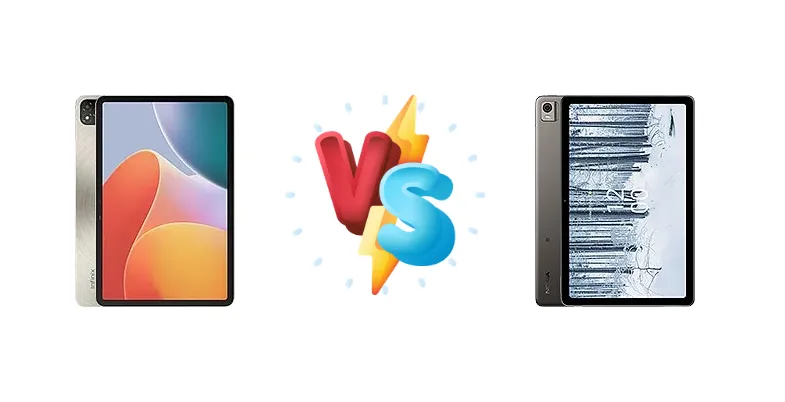
The tablet market is heating up with affordable options, and the Infinix Xpad and Nokia T21 represent compelling choices for budget-conscious consumers. While both aim to deliver a versatile Android experience, they diverge significantly in their core hardware, particularly in their chipsets. This comparison will dissect those differences, revealing which tablet best suits your needs.
🏆 Quick Verdict
For most users, the Infinix Xpad offers a better overall experience. Its Mediatek Helio G99 chipset, built on a 6nm process, provides a noticeable performance advantage over the Nokia T21’s 12nm Unisoc Tiger T612. While both charge at 18W, the Xpad’s more efficient processor translates to better battery life during demanding tasks.
| Network |
|---|
| 2G bands | GSM 850 / 900 / 1800 / 1900 | GSM 850 / 900 / 1800 / 1900 |
| 3G bands | HSDPA 900 / 2100 | HSDPA 850 / 900 / 1700(AWS) / 1900 / 2100 - US, LATAM |
| 4G bands | LTE | 1, 2, 3, 4, 5, 7, 8, 12, 13, 17, 20, 28, 40, 66 - US, LATAM |
| Speed | HSPA, LTE - cellular model only | HSPA, LTE - cellular model only |
| Technology | GSM / HSPA / LTE | GSM / HSPA / LTE |
| | - | 1, 3, 5, 7, 8, 20, 28, 38, 40, 41 - International |
| Launch |
|---|
| Announced | 2024, August 12 | 2022, September 01 |
| Status | Available. Released 2024, August 18 | Available. Released 2022, September 01 |
| Body |
|---|
| Build | Glass front, aluminum frame, aluminum back | Glass front, aluminum back |
| Dimensions | 257 x 168.6 x 7.6 mm (10.12 x 6.64 x 0.30 in) | 247.5 x 157.3 x 7.5 mm (9.74 x 6.19 x 0.30 in) |
| SIM | Nano-SIM (cellular model only) | Nano-SIM (cellular model only) |
| Weight | 496 g (1.09 lb) | 466 g (1.03 lb) |
| | - | Splash resistant
Stylus support |
| Display |
|---|
| Protection | - | Scratch-resistant glass |
| Resolution | 1200 x 1920 pixels, 16:10 ratio (~206 ppi density) | 1200 x 2000 pixels, 5:3 ratio (~224 ppi density) |
| Size | 11.0 inches, 350.9 cm2 (~81.0% screen-to-body ratio) | 10.4 inches, 307.9 cm2 (~79.1% screen-to-body ratio) |
| Type | IPS LCD, 90Hz, 440 nits | IPS LCD, 360 nits (typ) |
| Platform |
|---|
| CPU | Octa-core (2x2.2 GHz Cortex-A76 & 6x2.0 GHz Cortex-A55) | Octa-core (2x1.8 GHz Cortex-A75 & 6x1.8 GHz Cortex-A55) |
| Chipset | Mediatek Helio G99 (6 nm) | Unisoc Tiger T612 (12 nm) |
| GPU | Mali-G57 MC2 | Mali-G57 |
| OS | Android 14, XOS 14 | Android 12, upgradable to Android 13 |
| Memory |
|---|
| Card slot | microSDXC | microSDXC (dedicated slot) |
| Internal | 128GB 4GB RAM, 256GB 4GB RAM, 256GB 8GB RAM | 64GB 4GB RAM, 128GB 4GB RAM |
| | - | eMMC 5.1 |
| Main Camera |
|---|
| Features | Quad-LED flash | LED flash |
| Single | 8 MP | 8 MP, AF |
| Video | 1440p@30fps, 1080p@30fps | 1080p@30fps |
| Selfie camera |
|---|
| Features | Dual-LED flash | - |
| Single | 8 MP | 8 MP |
| Video | 1080p@30fps | Yes |
| Sound |
|---|
| 3.5mm jack | - | Yes |
| 35mm jack | Yes | Yes |
| Loudspeaker | Yes, with stereo speakers (4 speakers) | Yes, with stereo speakers |
| Comms |
|---|
| Bluetooth | 5.2, A2DP, LE | 5.0, A2DP, LE |
| NFC | No | Yes (Wi-Fi/LTE model only / TA-1521) |
| Positioning | GPS - cellular model only | GPS - cellular model only |
| Radio | FM radio | FM radio |
| USB | USB Type-C 2.0, OTG | USB Type-C 2.0, OTG |
| WLAN | Wi-Fi 802.11 a/b/g/n/ac, dual-band | Wi-Fi 802.11 a/b/g/n/ac, dual-band |
| Features |
|---|
| Sensors | Accelerometer, proximity, compass | Accelerometer, proximity |
| Battery |
|---|
| Charging | 18W wired, 50% in 40 min | 18W wired, PD3.0 |
| Type | Li-Po 7000 mAh | Li-Po 8200 mAh |
| Misc |
|---|
| Colors | Titan Gold, Frost Blue, Stellar Grey | Charcoal Grey |
| Models | X1101 | TA-1495, TA-1521, TA-1505, TA-1487 |
| Price | About 140 EUR | About 240 EUR |
| SAR | - | 1.19 W/kg (body) |
| SAR EU | - | 1.56 W/kg (body) |
Infinix Xpad
- More powerful Mediatek Helio G99 chipset
- More efficient 6nm manufacturing process
- Faster CPU clock speeds for improved responsiveness
- Lack of PD3.0 charging compatibility
- Limited information on display quality
Nokia T21
- PD3.0 charging support for wider charger compatibility
- Potentially cleaner software experience (Nokia's reputation)
- May have better carrier compatibility
- Less powerful Unisoc Tiger T612 chipset
- Less efficient 12nm manufacturing process
Display Comparison
Display specifications are not provided, so a direct comparison is limited. However, given the price points, both tablets likely utilize IPS LCD panels. The absence of details like resolution, refresh rate, or peak brightness suggests neither device is aiming for display excellence. Users should expect adequate, but not exceptional, viewing experiences. Bezels are likely to be noticeable on both devices, typical for this segment.
Camera Comparison
Camera details are absent, making a meaningful comparison impossible. Given the target market, it’s safe to assume both tablets feature modest camera setups primarily intended for video calls and casual snapshots. Expect image quality to be acceptable in good lighting conditions, but subpar in low light. The absence of details like sensor size or aperture suggests neither device prioritizes photography.
Performance
The core difference lies in the chipsets. The Infinix Xpad’s Mediatek Helio G99 (6nm) boasts a more modern architecture than the Nokia T21’s Unisoc Tiger T612 (12nm). The G99’s Cortex-A76 cores, clocked at 2.2 GHz, offer a significant performance uplift over the T612’s Cortex-A75 cores at 1.8 GHz. The smaller 6nm node also contributes to improved power efficiency, meaning the Xpad will likely run cooler and consume less battery during intensive tasks. This translates to smoother multitasking, faster app loading times, and a more enjoyable gaming experience for the Xpad. The Unisoc T612 is adequate for basic tasks, but will struggle with demanding games or applications.
Battery Life
Both tablets support 18W wired charging, with the Infinix Xpad claiming a 50% charge in 40 minutes. The Nokia T21 adds PD3.0 support, offering broader charger compatibility and potentially faster charging with a compatible power adapter. However, the Helio G99’s superior power efficiency in the Xpad means it will likely achieve a longer overall battery life despite potentially similar 0-100% charging times. The 6nm process allows for more efficient power management, extending usage between charges.
Buying Guide
Buy the Infinix Xpad if you prioritize performance for gaming or multitasking and want a tablet that feels more responsive. It’s ideal for students, casual gamers, and anyone who frequently uses demanding apps. Buy the Nokia T21 if you value a clean software experience, potentially wider carrier compatibility, and the convenience of PD3.0 charging, even if it means sacrificing some raw processing power. It’s a solid choice for media consumption and basic productivity.
Frequently Asked Questions
❓ Will the Unisoc Tiger T612 in the Nokia T21 struggle with graphically intensive games like Genshin Impact?
Yes, the Unisoc Tiger T612 is likely to struggle with demanding titles like Genshin Impact. While it can handle less intensive games, you'll likely need to lower graphics settings significantly or experience noticeable frame rate drops. The Mediatek Helio G99 in the Infinix Xpad is better equipped to handle such games.
❓ Does the 18W charging on the Infinix Xpad feel slow compared to other tablets with faster charging capabilities?
While 18W isn't the fastest charging available, the Helio G99's efficiency means the Xpad doesn't require extremely rapid charging to achieve a reasonable battery life. The 50% charge in 40 minutes is acceptable, and the overall battery endurance will likely be better than tablets with faster charging but less efficient processors.
❓ Is the PD3.0 support on the Nokia T21 a significant advantage for charging?
PD3.0 offers broader compatibility with USB-C chargers, meaning you're more likely to be able to use an existing charger. However, the actual charging speed will depend on the power adapter's output. If you don't already own a PD3.0 charger, the benefit is minimal.