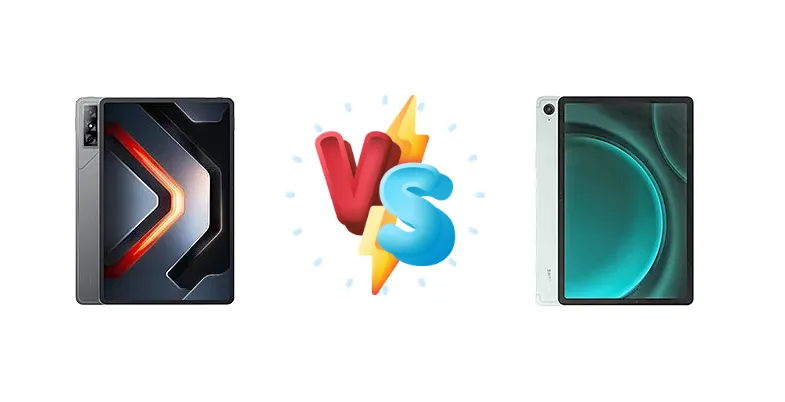
The tablet market is heating up, with options ranging from ultra-premium flagships to aggressively priced contenders. The Infinix Xpad GT aims to disrupt the mid-range with its Snapdragon 888 chipset, while the Samsung Galaxy Tab S9 FE offers a more balanced approach with its Exynos 1380 and focus on the Samsung ecosystem. This comparison dissects both tablets to determine which delivers the best value and performance for your needs.
🏆 Quick Verdict
For users prioritizing raw performance and gaming on a budget, the Infinix Xpad GT is the clear winner. Its Snapdragon 888 provides a significant performance edge. However, the Samsung Galaxy Tab S9 FE excels in overall efficiency, charging speed, and integration with the Samsung ecosystem, making it a better choice for everyday productivity and media consumption.
| Network |
|---|
| 2G bands | N/A | GSM 850 / 900 / 1800 / 1900 |
| 3G bands | N/A | HSDPA 850 / 900 / 1700(AWS) / 1900 / 2100 |
| 4G bands | N/A | 1, 2, 3, 4, 5, 7, 8, 12, 13, 17, 20, 26, 28, 32, 38, 40, 41, 66 |
| 5G bands | - | 1, 3, 5, 7, 8, 20, 28, 38, 40, 41, 66, 77, 78 SA/NSA/Sub6 |
| EDGE | No | - |
| GPRS | No | - |
| Speed | - | HSPA, LTE, 5G - cellular model only |
| Technology | No cellular connectivity | GSM / HSPA / LTE / 5G |
| Launch |
|---|
| Announced | 2025, May 21 | 2023, October 04 |
| Status | Available. Released 2025, June 04 | Available. Released 2023, October 16 |
| Body |
|---|
| Build | Glass front (Gorilla Glass 3), aluminum frame, aluminum back | Glass front, aluminum back, aluminum frame |
| Dimensions | 291.7 x 191.1 x 6.5 mm (11.48 x 7.52 x 0.26 in) | 254.3 x 165.8 x 6.5 mm (10.01 x 6.53 x 0.26 in) |
| SIM | No | Nano-SIM + eSIM (cellular model only) |
| Weight | 655 g (1.44 lb) | 523 g or 524 g (1.15 lb) |
| Display |
|---|
| Protection | Corning Gorilla Glass 3 | - |
| Resolution | 2880 x 1840 pixels (~263 ppi density) | 1440 x 2304 pixels, 16:10 ratio (~249 ppi density) |
| Size | 13.0 inches, 494.7 cm2 (~88.7% screen-to-body ratio) | 10.9 inches, 344.5 cm2 (~81.7% screen-to-body ratio) |
| Type | IPS LCD, 1B colors, 144Hz, HDR10, 700 nits (peak) | IPS LCD, 90Hz |
| Platform |
|---|
| CPU | Octa-core (1x2.84 GHz Cortex-X1 & 3x2.42 GHz Cortex-A78 & 4x1.80 GHz Cortex-A55) | Octa-core (4x2.4 GHz Cortex-A78 & 4x2.0 GHz Cortex-A55) |
| Chipset | Qualcomm SM8350 Snapdragon 888 5G (5 nm) | Exynos 1380 (5 nm) |
| GPU | Adreno 660 | Mali-G68 MP5 |
| OS | Android 14 | Android 13, up to 4 major Android upgrades, One UI 6 |
| Memory |
|---|
| Card slot | No | microSDXC (dedicated slot) |
| Internal | 256GB 8GB RAM | 128GB 6GB RAM, 128GB 8GB RAM, 256GB 8GB RAM |
| Main Camera |
|---|
| Features | LED flash | - |
| Single | 13 MP, f/2.0, AF | 8 MP, (wide) |
| Video | 1080p@30fps | 4K@30fps, 1080p@30fps |
| Selfie camera |
|---|
| Single | 9 MP, f/2.2 | 12 MP, (ultrawide) |
| Video | 1080p@30fps | Yes |
| Sound |
|---|
| 35mm jack | No | No |
| Loudspeaker | Yes, with stereo speakers (8 speakers) | Yes, with stereo speakers |
| Comms |
|---|
| Bluetooth | 5.3, A2DP, LE | 5.3, A2DP, LE |
| NFC | No | No |
| Positioning | Unspecified | GPS, GALILEO, GLONASS, BDS, QZSS - cellular model only |
| Radio | FM radio | No |
| USB | USB Type-C, OTG, accessory connector pins | USB Type-C 2.0, magnetic connector |
| WLAN | Wi-Fi 802.11 a/b/g/n/ac/6, dual-band | Wi-Fi 802.11 a/b/g/n/ac/6, dual-band, Wi-Fi Direct |
| Features |
|---|
| Sensors | Accelerometer | Fingerprint (side-mounted), accelerometer, gyro, compass, proximity (accessories only) |
| Battery |
|---|
| Charging | 33W wired
10W reverse wired | 45W wired, QC2.0 |
| Type | 10000 mAh | Li-Po 8000 mAh |
| Misc |
|---|
| Colors | Stellar Gray | Mint, Silver, Gray, Lavender |
| Models | X1301 | SM-X510, SM-X516B |
| Price | About 350 EUR | About 300 EUR |
| SAR | - | 1.55 W/kg (body) |
| SAR EU | - | 0.59 W/kg (body) |
Infinix Xpad GT
- Superior raw processing power with Snapdragon 888
- Potentially longer active use battery life
- 10W reverse wired charging for accessory top-ups
- Snapdragon 888 prone to thermal throttling
- Slower charging speed (33W)
- Display specs unknown, potentially lower quality
Samsung Galaxy Tab S9 FE
- More efficient Exynos 1380 processor
- Faster 45W charging with QC2.0
- Seamless integration with Samsung ecosystem
- Lower peak performance compared to Snapdragon 888
- Lacks reverse wireless charging
- Potentially higher price point
Display Comparison
While display specifications are missing for the Xpad GT, the Tab S9 FE’s display is likely superior due to Samsung’s display expertise. The Exynos 1380’s ISP is optimized for Samsung’s panels. The Tab S9 FE benefits from Samsung’s color calibration and potentially higher peak brightness. The Xpad GT’s reliance on the Snapdragon 888’s older ISP may result in less accurate color reproduction. Bezels are a key differentiator, and without Xpad GT specs, it's difficult to compare.
Camera Comparison
Camera details are sparse for both devices. Given the price points, neither tablet is expected to excel in photography. The Tab S9 FE likely benefits from Samsung’s image processing algorithms, potentially delivering more pleasing results despite potentially similar sensor sizes. The Xpad GT’s camera performance will heavily rely on software optimization, which is an unknown factor. Without detailed sensor information, it’s difficult to make a definitive judgment, but the Tab S9 FE’s brand reputation suggests a slight edge.
Performance
The Infinix Xpad GT’s Qualcomm Snapdragon 888 5G (5nm) is a significant step up in raw processing power compared to the Samsung Galaxy Tab S9 FE’s Exynos 1380 (5nm). The Snapdragon 888’s Cortex-X1 prime core, clocked at 2.84 GHz, offers a substantial performance advantage over the Tab S9 FE’s Cortex-A78 cores at 2.4 GHz. However, the Exynos 1380’s more modern architecture and 5nm process may offer better sustained performance due to improved thermal efficiency. The Snapdragon 888 is known to throttle under prolonged heavy load, potentially limiting its advantage in extended gaming sessions. The Tab S9 FE’s LPDDR4X RAM (spec assumed based on market segment) is likely slower than the Xpad GT’s (spec missing, but likely LPDDR5), impacting multitasking performance.
Battery Life
The Infinix Xpad GT boasts an impressive 11:23 hours of active use, suggesting a well-optimized battery experience despite a potentially smaller capacity (spec missing). The Samsung Galaxy Tab S9 FE’s battery life is not specified, but its Exynos 1380 chip is more power-efficient. However, the Tab S9 FE’s 45W wired charging with QC2.0 support significantly outperforms the Xpad GT’s 33W charging, allowing for much faster top-ups. The Xpad GT’s 10W reverse wired charging is a useful feature for topping up accessories, but the Tab S9 FE lacks this capability.
Buying Guide
Buy the Infinix Xpad GT if you need a tablet primarily for gaming, demanding applications, or tasks where CPU and GPU power are paramount, and you're willing to trade some battery life and ecosystem features for that performance. Buy the Samsung Galaxy Tab S9 FE if you prefer a tablet for everyday tasks like browsing, streaming, note-taking, and light gaming, and value a streamlined user experience, faster charging, and seamless integration with other Samsung devices.
Frequently Asked Questions
❓ Does the Exynos 1380 in the Tab S9 FE overheat during extended gaming sessions?
The Exynos 1380 is generally known for its efficiency and thermal management. While it won't match the peak performance of the Snapdragon 888, it's less prone to significant throttling, allowing for more consistent performance during longer gaming sessions. Samsung's software optimization also plays a role in mitigating heat buildup.
❓ Is the Snapdragon 888 in the Xpad GT still a viable chipset for demanding games in 2024?
Yes, the Snapdragon 888 remains a capable chipset for most Android games, even in 2024. However, be aware that it can experience thermal throttling under sustained heavy load, potentially leading to frame rate drops in graphically intensive titles. It's still a significant step up from more recent mid-range chips.
❓ How does the charging speed difference impact daily use between the two tablets?
The Tab S9 FE’s 45W charging is a game-changer. You can expect a significantly faster top-up, potentially going from 0% to 50% in around 30 minutes. The Xpad GT’s 33W charging will take considerably longer, making it less convenient for users who need quick power boosts throughout the day.
❓ What kind of gaming performance can I expect on the Infinix Xpad GT?
The Xpad GT should handle most Android games at high settings with smooth frame rates. However, demanding titles like Genshin Impact or Call of Duty: Mobile may require some graphical adjustments to avoid excessive throttling and maintain consistent performance. The Snapdragon 888’s Adreno 660 GPU is still a powerful performer.