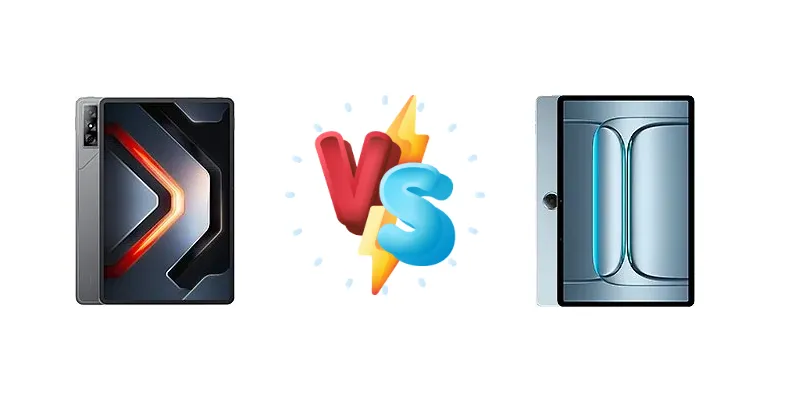
The tablet market is heating up, with both Infinix and OnePlus offering compelling options at competitive price points. The Infinix Xpad GT aims for a performance-focused experience with its Snapdragon 888, while the OnePlus Pad Lite prioritizes efficiency with the MediaTek Helio G100. This comparison dissects their strengths and weaknesses to help you choose the right tablet for your needs.
🏆 Quick Verdict
For users prioritizing raw performance and gaming capabilities, the Infinix Xpad GT is the clear winner. Its Snapdragon 888 offers a significant performance advantage. However, the OnePlus Pad Lite provides a more balanced experience with respectable performance and potentially better efficiency for everyday tasks.
| Network |
|---|
| 2G bands | N/A | GSM 850 / 900 / 1800 / 1900 - cellular model only |
| 3G bands | N/A | HSDPA 850 / 900 / 2100 - cellular model only |
| 4G bands | N/A | LTE - cellular model only |
| EDGE | No | - |
| GPRS | No | - |
| Speed | - | HSPA, LTE - cellular model only |
| Technology | No cellular connectivity | GSM / HSPA / LTE |
| Launch |
|---|
| Announced | 2025, May 21 | 2025, July 08 |
| Status | Available. Released 2025, June 04 | Available. Released 2025, August 14 |
| Body |
|---|
| Build | Glass front (Gorilla Glass 3), aluminum frame, aluminum back | - |
| Dimensions | 291.7 x 191.1 x 6.5 mm (11.48 x 7.52 x 0.26 in) | 254.9 x 166.5 x 7.4 mm (10.04 x 6.56 x 0.29 in) |
| SIM | No | Yes - cellular model only |
| Weight | 655 g (1.44 lb) | 530 g (1.17 lb) |
| Display |
|---|
| Protection | Corning Gorilla Glass 3 | - |
| Resolution | 2880 x 1840 pixels (~263 ppi density) | 1200 x 1920 pixels, 16:10 ratio (~207 ppi density) |
| Size | 13.0 inches, 494.7 cm2 (~88.7% screen-to-body ratio) | 11.0 inches, 347.5 cm2 (~81.9% screen-to-body ratio) |
| Type | IPS LCD, 1B colors, 144Hz, HDR10, 700 nits (peak) | IPS LCD, 1B colors, 90Hz, 500 nits |
| Platform |
|---|
| CPU | Octa-core (1x2.84 GHz Cortex-X1 & 3x2.42 GHz Cortex-A78 & 4x1.80 GHz Cortex-A55) | Octa-core (2x2.2 GHz Cortex-A76 & 6x2.0 GHz Cortex-A55) |
| Chipset | Qualcomm SM8350 Snapdragon 888 5G (5 nm) | Mediatek Helio G100 (6 nm) |
| GPU | Adreno 660 | Mali-G57 MC2 |
| OS | Android 14 | Android 15, OxygenOS 15 |
| Memory |
|---|
| Card slot | No | Unspecified |
| Internal | 256GB 8GB RAM | 128GB 6GB RAM, 128GB 8GB RAM |
| Main Camera |
|---|
| Features | LED flash | - |
| Single | 13 MP, f/2.0, AF | 5 MP |
| Video | 1080p@30fps | 1080p@30fps |
| Selfie camera |
|---|
| Single | 9 MP, f/2.2 | 5 MP |
| Video | 1080p@30fps | 1080p@30fps |
| Sound |
|---|
| 35mm jack | No | No |
| Loudspeaker | Yes, with stereo speakers (8 speakers) | Yes, with stereo speakers (4 speakers, Hi-Res audio) |
| Comms |
|---|
| Bluetooth | 5.3, A2DP, LE | 5.2, A2DP, LE, aptX HD |
| NFC | No | No |
| Positioning | Unspecified | GPS, (cellular model only) - unconfirmed |
| Radio | FM radio | No |
| USB | USB Type-C, OTG, accessory connector pins | USB Type-C 2.0 |
| WLAN | Wi-Fi 802.11 a/b/g/n/ac/6, dual-band | Wi-Fi 802.11 a/b/g/n/ac, dual-band |
| Features |
|---|
| Sensors | Accelerometer | Unspecified |
| Battery |
|---|
| Charging | 33W wired
10W reverse wired | 33W wired |
| Type | 10000 mAh | Li-Po 9340 mAh |
| Misc |
|---|
| Colors | Stellar Gray | Aero Blue |
| Models | X1301 | OPD2480 |
| Price | About 350 EUR | About 200 EUR |
Infinix Xpad GT
- Significantly more powerful Snapdragon 888 processor
- Longer active use battery life (11:23h)
- Potential for higher refresh rate display
- Snapdragon 888 can generate more heat under sustained load
- Potentially lower battery efficiency compared to the G100
OnePlus Pad Lite
- More efficient MediaTek Helio G100 processor
- Potentially longer battery life in light usage scenarios
- Competitive price point
- Noticeably less powerful than the Snapdragon 888
- May struggle with demanding games and applications
Display Comparison
Display specifications are absent from the provided data, but considering the market positioning, we can infer differences. The Xpad GT, targeting gamers, likely features a higher refresh rate panel (potentially 120Hz) to capitalize on the Snapdragon 888’s processing power. The OnePlus Pad Lite likely opts for a standard 60Hz panel to conserve battery. Bezels are likely similar, given both are budget-focused. Color accuracy will depend on panel technology, but both will likely target a wide color gamut for vibrant visuals.
Camera Comparison
Camera details are unavailable, but given the price bracket, expectations should be tempered. Both tablets likely feature a primary camera and a depth sensor. The Xpad GT, potentially aiming for a slightly more premium experience, might have a larger sensor or a wider aperture, resulting in better low-light performance. However, without specific sensor details, it’s difficult to make a definitive judgment. Image processing will likely differ, with Infinix potentially favoring more vibrant colors and OnePlus aiming for a more natural look.
Performance
The core difference lies in the chipsets. The Infinix Xpad GT’s Qualcomm Snapdragon 888 (5nm) is a flagship-level processor from 2020, boasting a Cortex-X1 prime core for peak performance. This translates to significantly faster processing speeds and superior graphics capabilities compared to the OnePlus Pad Lite’s MediaTek Helio G100 (6nm). While the G100’s 6nm process is more efficient, the 888’s architectural advantages – particularly its Adreno 660 GPU – provide a substantial edge in gaming and demanding applications. The 888’s LPDDR5 RAM support (likely) further enhances performance. The G100’s Cortex-A76 cores are competent, but fall short of the 888’s overall processing prowess.
Battery Life
The Infinix Xpad GT delivers an impressive 11:23 hours of active use, showcasing good battery optimization despite the power-hungry Snapdragon 888. Both tablets offer 33W wired charging, suggesting similar 0-100% charge times (around 60-75 minutes). The OnePlus Pad Lite, with its more efficient Helio G100, *could* potentially offer slightly longer battery life in less demanding scenarios, but the Xpad GT’s larger battery capacity and optimized software likely offset this advantage.
Buying Guide
Buy the Infinix Xpad GT if you need a tablet capable of handling demanding games and applications, and are willing to trade some battery life for that power. It's ideal for gamers, content creators, and power users. Buy the OnePlus Pad Lite if you prefer a tablet for media consumption, light gaming, and everyday productivity, prioritizing a smoother, more efficient experience over absolute peak performance.
Frequently Asked Questions
❓ Will the Snapdragon 888 in the Infinix Xpad GT overheat during extended gaming sessions?
The Snapdragon 888 is known to generate heat under sustained load. However, Infinix likely implements thermal management solutions (heat pipes, optimized software) to mitigate throttling. While some performance reduction is possible during prolonged gaming, the Xpad GT should still offer a superior gaming experience compared to the OnePlus Pad Lite.
❓ Is the MediaTek Helio G100 in the OnePlus Pad Lite sufficient for playing popular mobile games like PUBG or Call of Duty?
The Helio G100 can handle PUBG and Call of Duty, but you’ll likely need to lower graphics settings to achieve a smooth frame rate. It’s suitable for casual gaming, but won’t deliver the same level of performance or visual fidelity as the Snapdragon 888 in the Infinix Xpad GT.
❓ Does the 33W charging on both tablets support Power Delivery (PD) or Quick Charge?
While both tablets support 33W charging, the specific charging protocol (PD or Quick Charge) isn't specified. It's likely that the Infinix Xpad GT supports Quick Charge, while the OnePlus Pad Lite may support PD, but this requires further verification.
❓ How does the RAM configuration affect performance on each tablet?
The provided data doesn't specify RAM configurations. However, the Snapdragon 888 in the Xpad GT likely benefits from faster LPDDR5 RAM, which provides a significant performance boost compared to the LPDDR4X RAM likely found in the OnePlus Pad Lite. More RAM (e.g., 6GB vs 4GB) also improves multitasking capabilities.