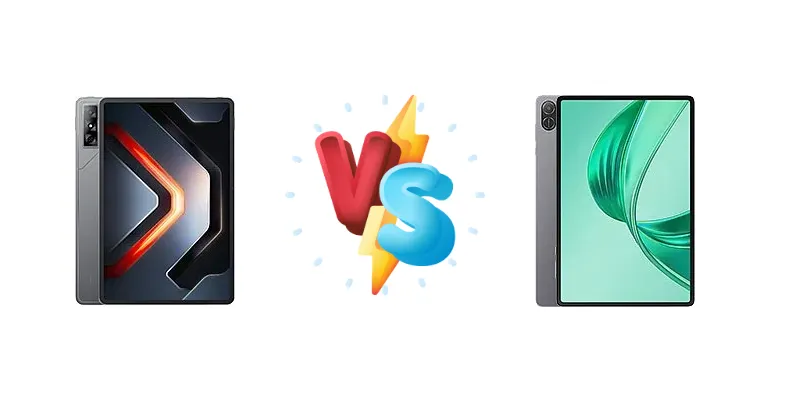
The tablet market offers a diverse range of options, but often forces a compromise between raw performance and extended battery life. The Infinix Xpad GT, powered by the Snapdragon 888, aims to deliver a flagship-level experience at a more accessible price point. Conversely, the Honor Pad X8a prioritizes longevity with its Snapdragon 680 chipset and impressive endurance claims. This comparison dissects these two tablets to determine which best suits your needs.
🏆 Quick Verdict
For users prioritizing gaming and demanding tasks, the Infinix Xpad GT is the clear winner. Its Snapdragon 888 provides significantly more processing power. However, the Honor Pad X8a excels in battery life, offering a staggering 133:17h endurance, making it ideal for users who prioritize media consumption and portability over peak performance.
| Network |
|---|
| 2G bands | N/A | N/A |
| 3G bands | N/A | N/A |
| 4G bands | N/A | N/A |
| EDGE | No | No |
| GPRS | No | No |
| Technology | No cellular connectivity | No cellular connectivity |
| Launch |
|---|
| Announced | 2025, May 21 | 2024, August 08 |
| Status | Available. Released 2025, June 04 | Available. Released 2024, August 15 |
| Body |
|---|
| Build | Glass front (Gorilla Glass 3), aluminum frame, aluminum back | Glass front, aluminum frame, aluminum back |
| Dimensions | 291.7 x 191.1 x 6.5 mm (11.48 x 7.52 x 0.26 in) | 257 x 168.5 x 7.3 mm (10.12 x 6.63 x 0.29 in) |
| SIM | No | No |
| Weight | 655 g (1.44 lb) | 495 g (1.09 lb) |
| Display |
|---|
| Protection | Corning Gorilla Glass 3 | Mohs level 4 |
| Resolution | 2880 x 1840 pixels (~263 ppi density) | 1200 x 1920 pixels, 16:10 ratio (~206 ppi density) |
| Size | 13.0 inches, 494.7 cm2 (~88.7% screen-to-body ratio) | 11.0 inches, 350.9 cm2 (~81.0% screen-to-body ratio) |
| Type | IPS LCD, 1B colors, 144Hz, HDR10, 700 nits (peak) | TFT LCD, 90Hz, 400 nits |
| Platform |
|---|
| CPU | Octa-core (1x2.84 GHz Cortex-X1 & 3x2.42 GHz Cortex-A78 & 4x1.80 GHz Cortex-A55) | Octa-core (4x2.4 GHz Kryo 265 Gold & 4x1.9 GHz Kryo 265 Silver) |
| Chipset | Qualcomm SM8350 Snapdragon 888 5G (5 nm) | Qualcomm SM6225 Snapdragon 680 4G (6 nm) |
| GPU | Adreno 660 | Adreno 610 |
| OS | Android 14 | Android 14, MagicOS 8 |
| Memory |
|---|
| Card slot | No | No |
| Internal | 256GB 8GB RAM | 64GB 4GB RAM, 128GB 4GB RAM |
| Main Camera |
|---|
| Features | LED flash | HDR |
| Single | 13 MP, f/2.0, AF | 5 MP, f/2.2, AF |
| Video | 1080p@30fps | 1080p@30fps |
| Selfie camera |
|---|
| Single | 9 MP, f/2.2 | 5 MP, f/2.2 |
| Video | 1080p@30fps | 1080p@30fps |
| Sound |
|---|
| 35mm jack | No | No |
| Loudspeaker | Yes, with stereo speakers (8 speakers) | Yes, with stereo speakers (4 speakers) |
| Comms |
|---|
| Bluetooth | 5.3, A2DP, LE | 5.1, A2DP, LE |
| NFC | No | No |
| Positioning | Unspecified | No |
| Radio | FM radio | No |
| USB | USB Type-C, OTG, accessory connector pins | USB Type-C, OTG |
| WLAN | Wi-Fi 802.11 a/b/g/n/ac/6, dual-band | Wi-Fi 802.11 a/b/g/n/ac, dual-band |
| Features |
|---|
| Sensors | Accelerometer | Accelerometer |
| Battery |
|---|
| Charging | 33W wired
10W reverse wired | - |
| Type | 10000 mAh | Li-Ion 8300 mAh |
| Misc |
|---|
| Colors | Stellar Gray | Space Gray |
| Models | X1301 | NDL-W09 |
| Price | About 350 EUR | About 150 EUR |
| EU LABEL |
|---|
| Battery | - | 133:17h endurance, 1200 cycles |
| Energy | - | Class D |
| Free fall | - | Class E (7 falls) |
| Repairability | - | Class C |
Infinix Xpad GT
- Significantly more powerful Snapdragon 888 processor
- Faster 33W wired charging
- Potential for higher refresh rate display for smoother gaming
- Shorter battery life compared to the Honor Pad X8a
- Potential for thermal throttling under sustained load
Honor Pad X8a
- Exceptional battery life (133:17h endurance)
- Efficient Snapdragon 680 processor
- Long-lasting battery with 1200 charge cycles
- Lower processing power compared to the Infinix Xpad GT
- Slower performance for demanding games and applications
Display Comparison
Display specifications are absent from the provided data, but considering the target market, we can infer differences. The Xpad GT, positioned as a gaming tablet, likely features a higher refresh rate panel (potentially 90Hz or 120Hz) to enhance visual fluidity. The X8a, focused on endurance, likely utilizes a more power-efficient 60Hz panel. Bezels are likely to be wider on the X8a to maximize screen real estate within a similar form factor. Color accuracy will likely be prioritized on the Xpad GT for a more immersive gaming experience.
Camera Comparison
Camera details are limited. However, given the price points, we can expect both tablets to feature modest camera setups. The absence of specific sensor information suggests neither device will excel in photography. The Xpad GT, potentially targeting a slightly more enthusiast audience, might have a slightly larger main sensor, but image processing will likely be similar on both devices, focusing on basic scene optimization. The inclusion of a 2MP macro camera on either device is likely a marketing feature with limited practical utility.
Performance
The core difference lies in the chipsets. The Infinix Xpad GT’s Qualcomm Snapdragon 888 5G (5nm) is a flagship-level processor, boasting an octa-core configuration with a Cortex-X1 prime core clocked at 2.84 GHz. This architecture delivers substantial performance gains over the Honor Pad X8a’s Snapdragon 680 4G (6nm). The 680, while efficient, utilizes Kryo 265 Gold and Silver cores clocked at 2.4 GHz and 1.9 GHz respectively, geared towards efficiency rather than outright speed. The 5nm process node of the 888 also contributes to better thermal efficiency, though sustained loads may still induce throttling. The Xpad GT will handle graphically intensive games and applications with ease, while the X8a is better suited for everyday tasks and light gaming.
Battery Life
Battery life is where the Honor Pad X8a truly shines. Its claimed 133:17h endurance and 1200 cycles suggest exceptional longevity, far exceeding the Infinix Xpad GT’s active use score of 11:23h. While the Xpad GT offers 33W wired charging and 10W reverse wired charging, the X8a’s efficiency allows it to stretch a single charge for days. The Xpad GT’s faster charging is beneficial for quickly topping up, but the X8a’s extended runtime is more valuable for users on the go.
Buying Guide
Buy the Infinix Xpad GT if you need a tablet capable of handling demanding games, video editing, or multitasking without slowdowns. It's for the power user who values performance above all else. Buy the Honor Pad X8a if you prefer a tablet that can last for days on a single charge, perfect for travel, reading, or casual media consumption where raw power isn't a primary concern.
Frequently Asked Questions
❓ Will the Snapdragon 888 in the Infinix Xpad GT overheat during prolonged gaming sessions?
The Snapdragon 888 is known to generate heat under sustained load. While the 5nm process helps, throttling is possible. The Xpad GT may incorporate cooling solutions, but extended gaming at maximum settings could lead to performance dips to manage temperatures.
❓ How does the Snapdragon 680's 6nm process contribute to the Honor Pad X8a's battery life?
The 6nm process node is more efficient than older manufacturing processes. This means the Snapdragon 680 consumes less power for the same level of performance, directly translating to longer battery life. Combined with the X8a's likely power-efficient display, it achieves exceptional endurance.
❓ Is the 1200 charge cycle claim for the Honor Pad X8a realistic?
While 1200 cycles is a high number, it's achievable with modern battery management and chemistry. It suggests the X8a's battery is designed to retain a significant portion of its capacity even after years of regular use, offering long-term value.
❓ Can the Infinix Xpad GT handle demanding games like Genshin Impact or Call of Duty Mobile?
Yes, the Snapdragon 888 is capable of running demanding games like Genshin Impact and Call of Duty Mobile. However, you may need to adjust graphics settings to maintain a stable frame rate and prevent overheating during extended play sessions.