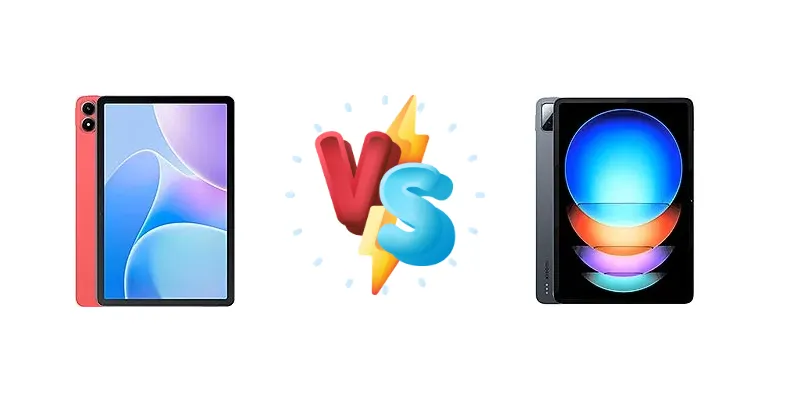
The Android tablet market is heating up, with options ranging from ultra-affordable to premium flagships. We're pitting the Infinix Xpad 20, a budget-focused device, against the Xiaomi Pad 6S Pro 12.4, a powerhouse boasting the Snapdragon 8 Gen 2. This comparison will dissect their key differences to help you determine which tablet best suits your needs and budget.
🏆 Quick Verdict
For the average user prioritizing performance and a premium experience, the Xiaomi Pad 6S Pro 12.4 is the clear winner. Its Snapdragon 8 Gen 2 chipset and vibrant display significantly outperform the Infinix Xpad 20. However, the Xpad 20 remains a viable option for casual users on a tight budget.
| Network |
|---|
| 2G bands | GSM 850 / 900 / 1800 / 1900 | N/A |
| 3G bands | HSDPA 850 / 900 / 1700(AWS) / 1900 / 2100 | N/A |
| 4G bands | 1, 2, 3, 4, 5, 7, 8, 12, 13, 17, 20, 25, 26, 28, 38, 41, 40, 66 | - |
| EDGE | - | N/A |
| GPRS | - | N/A |
| Speed | HSPA, LTE | - |
| Technology | GSM / HSPA / LTE | No cellular connectivity |
| Launch |
|---|
| Announced | 2025, May 30 | 2024, February 22 |
| Status | Available. Released 2025, June | Available. Released 2024, February 22 |
| Body |
|---|
| Build | - | Glass front (Gorilla Glass 5), aluminum frame, aluminum back |
| Dimensions | 257.7 x 169.2 x 7.9 mm (10.15 x 6.66 x 0.31 in) | 278.7 x 191.6 x 6.3 mm (10.97 x 7.54 x 0.25 in) |
| SIM | Nano-SIM | No |
| Weight | 498 g (1.10 lb) | 590 g (1.30 lb) |
| Display |
|---|
| Protection | - | Corning Gorilla Glass 5 |
| Resolution | 1200 x 1920 pixels, 16:10 ratio (~206 ppi density) | 2032 x 3048 pixels, 3:2 ratio (~295 ppi density) |
| Size | 11.0 inches, 350.9 cm2 (~80.5% screen-to-body ratio) | 12.4 inches, 457.8 cm2 (~85.7% screen-to-body ratio) |
| Type | IPS LCD, 90Hz, 440 nits | IPS LCD, 68B colors, 144Hz, HDR10, Dolby Vision, 900 nits (peak) |
| Platform |
|---|
| CPU | Octa-core (2x2.0 GHz Cortex-A75 & 6x1.8 GHz Cortex-A55) | Octa-core (1x3.2 GHz Cortex-X3 & 2x2.8 GHz Cortex-A715 & 2x2.8 GHz Cortex-A710 & 3x2.0 GHz Cortex-A510) |
| Chipset | Mediatek Helio G88 (12 nm) | Qualcomm SM8550-AB Snapdragon 8 Gen 2 (4 nm) |
| GPU | Mali-G52 MC2 | Adreno 740 |
| OS | Android 15 | Android 14, up to 3 major Android upgrades, HyperOS |
| Memory |
|---|
| Card slot | microSDXC (dedicated slot) | No |
| Internal | 128GB 4GB RAM, 128GB 6GB RAM, 128GB 8GB RAM, 256GB 8GB RAM | 256GB 8GB RAM, 256GB 12GB RAM, 512GB 12GB RAM, 1TB 16GB RAM |
| Main Camera |
|---|
| Dual | - | 50 MP, f/1.8, (wide), 1/2.76", 0.64µm, PDAF
Auxiliary lens |
| Features | LED flash, panorama | LED flash, HDR, panorama |
| Single | 8 MP | - |
| Video | 1080p@30fps | 4K@30/60fps, 1080p@30/60fps |
| Selfie camera |
|---|
| Single | 5 MP | 32 MP, f/2.2, (wide), 1/3.6", 0.61µm |
| Video | Yes | 1080p@30fps |
| Sound |
|---|
| 35mm jack | Yes | No |
| Loudspeaker | Yes, with stereo speakers | Yes, with stereo speakers (6 speakers) |
| Comms |
|---|
| Bluetooth | 5.2, A2DP, LE | 5.3, A2DP, LE, LHDC |
| NFC | No | Yes (file transfer only) |
| Positioning | GPS | No |
| Radio | FM radio | No |
| USB | USB Type-C 2.0, OTG | USB Type-C 3.2, accessory connector |
| WLAN | Wi-Fi 802.11 a/b/g/n/ac, dual-band | Wi-Fi 802.11 a/b/g/n/a/6/7, dual-band, Wi-Fi Direct |
| Features |
|---|
| Sensors | Accelerometer | Fingerprint (side-mounted), accelerometer, gyro, proximity (accessories only), compass |
| Battery |
|---|
| Charging | 10W wired
Reverse wired | 120W wired, PD3.0, QC4, 45% in 10 min, 100% in 35 min |
| Type | 7000 mAh | 10000 mAh |
| Misc |
|---|
| Colors | Stellar Grey, Forest Green, Dreamy Purple, Rising Red | Black, Blue, Green |
| Models | - | 24018RPACG |
| Price | - | About 700 EUR |
| SAR EU | - | 0.99 W/kg (body) |
Infinix Xpad 20
- Significantly lower price point
- Reverse wired charging capability
- Suitable for basic tasks
- Weak processor for demanding tasks
- Slow 10W charging
- Likely lower quality display
Xiaomi Pad 6S Pro 12.4
- Flagship Snapdragon 8 Gen 2 performance
- Fast 120W charging
- High-brightness, high-contrast display
- Higher price tag
- May be overkill for basic users
- Larger size may not suit all users
Display Comparison
The Xiaomi Pad 6S Pro 12.4 boasts a significantly more impressive display. While the Xpad 20’s specifications are unavailable, the 6S Pro’s measured 848 nits of peak brightness ensures excellent visibility even in bright environments. Furthermore, the 1378:1 contrast ratio delivers deeper blacks and more vibrant colors. The larger screen size of the 6S Pro (12.4 inches vs. assumed smaller Xpad 20 screen) also contributes to a more immersive experience. The absence of detailed display specs for the Xpad 20 suggests a more basic panel, likely with lower brightness and contrast.
Camera Comparison
Given the context data, a detailed camera comparison is limited. Both tablets likely feature basic camera setups geared towards video calls rather than photography. The absence of specific camera details for the Xpad 20 suggests a focus on cost reduction in this area. The Xiaomi Pad 6S Pro 12.4, while not a photography powerhouse, likely benefits from the superior image signal processor (ISP) within the Snapdragon 8 Gen 2, potentially offering better image quality in favorable conditions.
Performance
The performance gap between these tablets is substantial. The Xiaomi Pad 6S Pro 12.4’s Snapdragon 8 Gen 2 (4nm) is a flagship-level chipset featuring a core configuration of 1x3.2 GHz Cortex-X3, 2x2.8 GHz Cortex-A715, 2x2.8 GHz Cortex-A710, and 3x2.0 GHz Cortex-A510. This architecture provides a massive leap in CPU and GPU performance compared to the Infinix Xpad 20’s MediaTek Helio G88 (12nm) with its 2x2.0 GHz Cortex-A75 and 6x1.8 GHz Cortex-A55 cores. The 4nm process node of the Snapdragon 8 Gen 2 also translates to superior thermal efficiency, minimizing throttling during extended gaming sessions. The Xpad 20 is suitable for basic tasks, but will struggle with demanding games or multitasking.
Battery Life
The Xiaomi Pad 6S Pro 12.4 demonstrates a clear advantage in battery and charging capabilities. Its active use score of 11:14h indicates excellent battery life, allowing for a full day of moderate use. Crucially, the 120W wired charging, supporting PD3.0 and QC4, is a game-changer, delivering a 45% charge in just 10 minutes and a full charge in 35 minutes. The Infinix Xpad 20’s 10W wired charging is significantly slower, requiring considerably more time to reach a full charge. While the Xpad 20’s battery capacity is unknown, the slower charging speed suggests a smaller battery or less efficient charging circuitry.
Buying Guide
Buy the Infinix Xpad 20 if you need a basic tablet for light tasks like web browsing, video streaming, and casual gaming, and your budget is the primary concern. Buy the Xiaomi Pad 6S Pro 12.4 if you prioritize demanding applications, gaming, content creation, and a superior viewing experience, and are willing to invest in a premium device.
Frequently Asked Questions
❓ How much faster is the Snapdragon 8 Gen 2 in the Xiaomi Pad 6S Pro 12.4 compared to the Helio G88 in the Infinix Xpad 20 for gaming?
The Snapdragon 8 Gen 2 is multiple generations ahead of the Helio G88. Expect a substantial difference in frame rates and graphical fidelity in demanding games. The 8 Gen 2 will allow for higher settings and smoother gameplay, while the Helio G88 will likely require reduced settings and may struggle with newer titles.
❓ Does the 120W charging on the Xiaomi Pad 6S Pro 12.4 generate a lot of heat during charging?
While 120W charging is fast, Xiaomi incorporates thermal management technologies to mitigate heat generation. The charging process is optimized to balance speed and temperature, preventing overheating and ensuring battery health. The 4nm process of the Snapdragon 8 Gen 2 also contributes to overall thermal efficiency.
❓ Is the Infinix Xpad 20 suitable for taking notes with a stylus?
The context data doesn't specify stylus support for the Infinix Xpad 20. Given its budget nature, stylus compatibility is unlikely. The Xiaomi Pad 6S Pro 12.4 supports optional stylus accessories, offering a more refined note-taking experience.