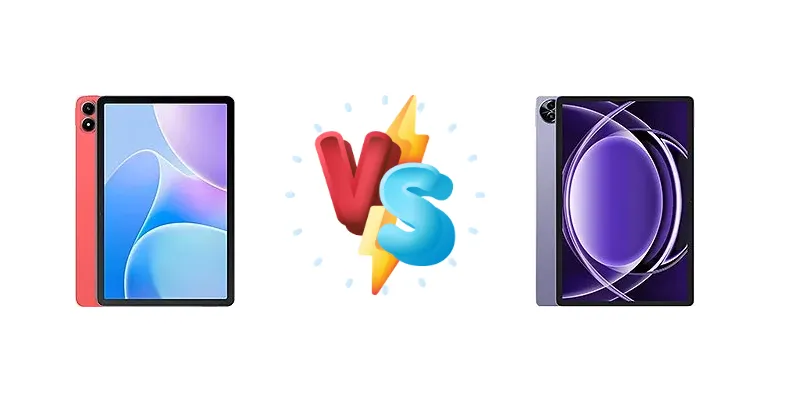
The budget tablet market is heating up, with the Realme Pad 2 Lite and Infinix Xpad 20 vying for dominance. Both aim to deliver an affordable Android experience, but they take different approaches to achieving that goal. This comparison dissects their key specifications to determine which tablet best suits your needs.
🏆 Quick Verdict
For most users, the Realme Pad 2 Lite emerges as the superior choice. Its more efficient Helio G99 chipset, built on a 6nm process, provides a noticeable performance uplift and better thermal management compared to the Infinix Xpad 20’s Helio G88. While the charging speed is slightly faster on the Realme, the overall experience is smoother and more future-proof.
| Network |
|---|
| 2G bands | GSM 850 / 900 / 1800 / 1900 | GSM 850 / 900 / 1800 / 1900 |
| 3G bands | HSDPA 850 / 900 / 1700(AWS) / 1900 / 2100 | HSDPA 850 / 900 / 2100 |
| 4G bands | 1, 2, 3, 4, 5, 7, 8, 12, 13, 17, 20, 25, 26, 28, 38, 41, 40, 66 | 1, 3, 5, 7, 8, 20, 28, 38, 40, 41 |
| Speed | HSPA, LTE | HSPA, LTE |
| Technology | GSM / HSPA / LTE | GSM / HSPA / LTE |
| Launch |
|---|
| Announced | 2025, May 30 | 2024, September 13 |
| Status | Available. Released 2025, June | Available. Released 2024, September 26 |
| Body |
|---|
| Dimensions | 257.7 x 169.2 x 7.9 mm (10.15 x 6.66 x 0.31 in) | 258 x 169.5 x 8.3 mm (10.16 x 6.67 x 0.33 in) |
| SIM | Nano-SIM | No |
| Weight | 498 g (1.10 lb) | 525 g (1.16 lb) |
| Display |
|---|
| Resolution | 1200 x 1920 pixels, 16:10 ratio (~206 ppi density) | 1200 x 1920 pixels, 16:10 ratio (~207 ppi density) |
| Size | 11.0 inches, 350.9 cm2 (~80.5% screen-to-body ratio) | 10.95 inches, 347.7 cm2 (~79.5% screen-to-body ratio) |
| Type | IPS LCD, 90Hz, 440 nits | IPS LCD, 1B colors, 90Hz, 450 nits (peak) |
| Platform |
|---|
| CPU | Octa-core (2x2.0 GHz Cortex-A75 & 6x1.8 GHz Cortex-A55) | Octa-core (2x2.2 GHz Cortex-A76 & 6x2.0 GHz Cortex-A55) |
| Chipset | Mediatek Helio G88 (12 nm) | Mediatek Helio G99 (6 nm) |
| GPU | Mali-G52 MC2 | Mali-G57 MC2 |
| OS | Android 15 | Android 14, Realme UI 5.0 for Pad |
| Memory |
|---|
| Card slot | microSDXC (dedicated slot) | Unspecified |
| Internal | 128GB 4GB RAM, 128GB 6GB RAM, 128GB 8GB RAM, 256GB 8GB RAM | 128GB 4GB RAM, 128GB 8GB RAM |
| Main Camera |
|---|
| Features | LED flash, panorama | Panorama |
| Single | 8 MP | 8 MP, f/2.0 |
| Video | 1080p@30fps | 1080p@30fps |
| Selfie camera |
|---|
| Features | - | Panorama |
| Single | 5 MP | 5 MP, f/2.2 |
| Video | Yes | 1080p@30fps |
| Sound |
|---|
| 35mm jack | Yes | No |
| Loudspeaker | Yes, with stereo speakers | Yes, with stereo speakers (4 speakers) |
| Comms |
|---|
| Bluetooth | 5.2, A2DP, LE | 5.2, A2DP, LE |
| NFC | No | No |
| Positioning | GPS | GPS, GALILEO, GLONASS, BDS |
| Radio | FM radio | No |
| USB | USB Type-C 2.0, OTG | USB Type-C |
| WLAN | Wi-Fi 802.11 a/b/g/n/ac, dual-band | Wi-Fi 802.11 a/b/g/n/ac, dual-band |
| Features |
|---|
| Sensors | Accelerometer | Accelerometer |
| Battery |
|---|
| Charging | 10W wired
Reverse wired | 15W wired |
| Type | 7000 mAh | 8300 mAh |
| Misc |
|---|
| Colors | Stellar Grey, Forest Green, Dreamy Purple, Rising Red | Nebula Purple, Space Grey |
| Models | - | RMP2402 |
| Price | - | About 160 EUR |
Infinix Xpad 20
- Reverse Wired Charging: Can charge other devices.
- Potentially Lower Price: Likely the more affordable option.
- Familiar Android Experience: Runs a standard Android build.
- Less Powerful Chipset: Helio G88 lags behind the G99.
- Less Efficient: 12nm process leads to more heat and lower battery life.
Realme Pad 2 Lite
- More Powerful Chipset: Helio G99 offers better performance.
- More Efficient: 6nm process improves battery life and thermal management.
- Faster Charging: 15W charging reduces charging times.
- Lacks Reverse Charging: Cannot charge other devices.
- Potentially Higher Price: May be slightly more expensive than the Xpad 20.
Display Comparison
Neither device boasts a particularly standout display. Given the provided data focuses on processing, we must infer display characteristics based on market positioning. Both are likely to feature IPS LCD panels, common in this price bracket. The Realme Pad 2 Lite, being a newer release, *may* benefit from slightly improved color calibration. However, without specific brightness nits or color gamut coverage data, it’s difficult to definitively declare a winner. Bezels are expected to be similar on both, prioritizing affordability over premium aesthetics.
Camera Comparison
Camera performance is unlikely to be a deciding factor for buyers in this segment. Without sensor details, we can assume both tablets feature basic camera setups geared towards casual use. The focus should be on video calling and occasional snapshots rather than photography. Any claims of advanced features or image quality should be viewed with skepticism. The absence of OIS or large sensors suggests limited low-light performance on both devices.
Performance
The core difference lies in the chipsets. The Realme Pad 2 Lite’s MediaTek Helio G99 (6nm) is a significant upgrade over the Infinix Xpad 20’s Helio G88 (12nm). The 6nm process inherently offers better power efficiency, translating to less heat generation and potentially sustained performance during demanding tasks. The G99’s CPU configuration – 2x2.2 GHz Cortex-A76 cores – also represents a step up from the Xpad 20’s 2x2.0 GHz Cortex-A75 cores, resulting in faster single-core performance. This will be most noticeable in app loading times and general UI responsiveness. While both utilize octa-core configurations, the architectural improvements in the G99 provide a tangible advantage for users who multitask or enjoy mobile gaming.
Battery Life
The Realme Pad 2 Lite’s 15W wired charging is a modest improvement over the Infinix Xpad 20’s 10W charging. While neither is particularly fast by modern standards, the faster charging will reduce the time spent tethered to a power outlet. The actual battery capacity isn’t specified, but given the similar target market, they are likely comparable. The G99’s superior power efficiency in the Realme Pad 2 Lite, however, means it will likely deliver longer real-world battery life despite potentially having a similar capacity to the Xpad 20.
Buying Guide
Buy the Infinix Xpad 20 if you prioritize reverse wired charging functionality and are on an extremely tight budget, accepting a trade-off in processing power. Buy the Realme Pad 2 Lite if you value a more responsive user experience, improved gaming capabilities, and a more efficient chipset, even if it means sacrificing the reverse charging feature.
Frequently Asked Questions
❓ Will the Helio G99 in the Realme Pad 2 Lite handle demanding games like PUBG Mobile smoothly?
The Helio G99 is a capable chipset for casual gaming. PUBG Mobile should be playable at medium settings with reasonable frame rates. However, don't expect flagship-level performance; demanding titles may require lower graphics settings to maintain a smooth experience. The G99's efficiency will also help prevent excessive throttling during extended gaming sessions.
❓ Is the 10W charging on the Infinix Xpad 20 noticeably slow in everyday use?
Yes, 10W charging is relatively slow by today's standards. Expect a full charge to take several hours. While sufficient for overnight charging, it's less convenient if you need a quick power boost. The Realme Pad 2 Lite's 15W charging offers a noticeable improvement in this regard.
❓ Does either tablet support expandable storage via microSD card?
This information isn't provided in the specifications. However, given the target market and price point, it's *likely* that both tablets offer microSD card support. Check the official product listings for confirmation before purchasing if expandable storage is a priority.
❓ What kind of software updates can I expect on the Infinix Xpad 20 and Realme Pad 2 Lite?
Software update support is often limited on budget tablets. Realme generally provides more consistent updates than Infinix, but don't expect the same level of long-term support as flagship devices. Expect at least one major Android version update, but beyond that, security patches may be infrequent.