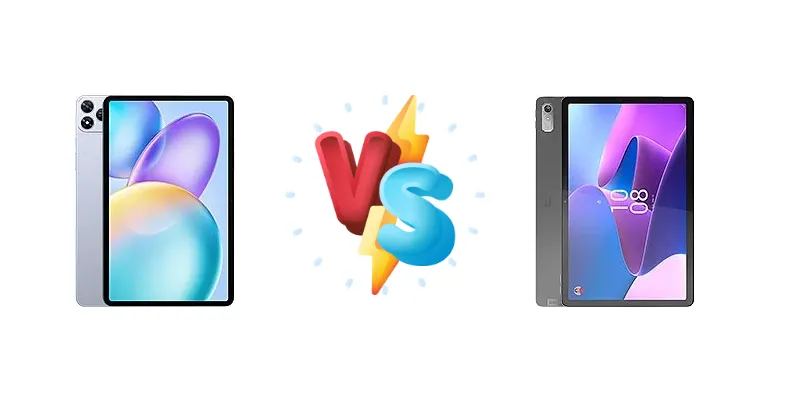
The sub-$200 tablet market is fiercely competitive, and the Infinix Xpad 20 Pro and Lenovo Tab P11 Gen 2 are two strong contenders. Both aim to deliver a solid Android tablet experience without breaking the bank, but they achieve this with slightly different approaches to chipset selection and overall feature sets. This comparison dives deep into the specifics to determine which tablet offers the best value for your money.
🏆 Quick Verdict
For most users, the Lenovo Tab P11 Gen 2 emerges as the slightly better choice. While both tablets utilize Mediatek Helio chipsets, the G99 in the Lenovo offers a marginal performance edge and potentially better sustained performance due to its slightly more efficient architecture. The Xpad 20 Pro's reverse wired charging is a nice bonus, but doesn't outweigh the overall refinement of the Lenovo.
| Network |
|---|
| 2G bands | GSM 850 / 900 / 1800 / 1900 | GSM 850 / 900 / 1800 / 1900 |
| 3G bands | HSDPA 850 / 900 / 1700(AWS) / 1900 / 2100 | HSDPA 800 / 850 / 900 / 1700(AWS) / 1900 / 2100 |
| 4G bands | LTE | 1, 2, 3, 4, 5, 7, 8, 12, 13, 18, 19, 20, 25, 26, 28, 38, 40, 41, 66 |
| Speed | HSPA, LTE | HSPA, LTE - cellular model only |
| Technology | GSM / HSPA / LTE | GSM / HSPA / LTE |
| Launch |
|---|
| Announced | 2025, September 03 | 2022, September 01 |
| Status | Available. Released 2025, September 03 | Available. Released 2023, January |
| Body |
|---|
| Build | Glass front, aluminum frame, aluminum back | - |
| Dimensions | 278.6 x 173.6 x 6.6 mm (10.97 x 6.83 x 0.26 in) | 269.1 x 169.4 x 7.4 mm (10.59 x 6.67 x 0.29 in) |
| SIM | Nano-SIM | Nano-SIM (cellular model only) |
| Weight | 545 g (1.20 lb) | 520 g (1.15 lb) |
| | - | Stylus support |
| Display |
|---|
| Resolution | 1200 x 2000 pixels, 5:3 ratio (~194 ppi density) | 1200 x 2000 pixels, 5:3 ratio (~203 ppi density) |
| Size | 12.0 inches, 409.9 cm2 (~84.7% screen-to-body ratio) | 11.5 inches, 376.4 cm2 (~82.6% screen-to-body ratio) |
| Type | IPS LCD, 90Hz, 450 nits | IPS LCD, 120Hz, 400 nits (typ) |
| Platform |
|---|
| CPU | Octa-core (2x2.2 GHz Cortex-A76 & 6x2.0 GHz Cortex-A55) | Octa-core (2x2.2 GHz Cortex-A76 & 6x2.0 GHz Cortex-A55) |
| Chipset | Mediatek Helio G100 Ultimate (6 nm) | Mediatek Helio G99 (6 nm) |
| GPU | Mali-G57 MC2 | Mali-G57 MC2 |
| OS | Android 15 | Android 12L |
| Memory |
|---|
| Card slot | microSDXC (dedicated slot) | microSDXC (dedicated slot) |
| Internal | 128GB 4GB RAM, 128GB 8GB RAM, 256GB 8GB RAM | 64GB 4GB RAM, 128GB 4GB RAM, 128GB 6GB RAM |
| Main Camera |
|---|
| Features | LED flash, panorama | LED flash |
| Single | 8 MP, f/2.0, AF | 13 MP, f/2.4, (wide), AF |
| Video | 1440p@30fps, 1080p@30fps | 1080p@30fps |
| Selfie camera |
|---|
| Single | 5 MP, f/2.0 | 8 MP, f/2.0 |
| Video | 1440p@30fps, 1080p@30fps | 1080p@30fps |
| Sound |
|---|
| 3.5mm jack | - | Yes |
| 35mm jack | No | Yes |
| Loudspeaker | Yes, with stereo speakers with DTS (4 speakers) | Yes, with stereo speakers (4 speakers) |
| Comms |
|---|
| Bluetooth | 5.2, A2DP, LE | 5.2, A2DP, LE |
| NFC | No | No |
| Positioning | Unspecified | GPS, GLONASS, BDS - cellular model only |
| Radio | FM radio | No |
| USB | USB Type-C 2.0, OTG | USB Type-C 2.0, OTG, magnetic connector |
| WLAN | Wi-Fi 802.11 a/b/g/n/ac, dual-band | Wi-Fi 802.11 a/b/g/n/ac/6e, dual-band, Wi-Fi Direct |
| Features |
|---|
| Sensors | Accelerometer | Accelerometer, gyro, proximity |
| Battery |
|---|
| Charging | 18W wired
Reverse wired | - |
| Type | 8000 mAh | Li-Po 7700 mAh |
| Misc |
|---|
| Colors | Titanium Grey, Mist Blue | Storm Grey, Sage |
| Models | X1201 | TB350FU |
| Price | About 290 EUR | About 350 EUR |
Infinix Xpad 20 Pro
- Reverse wired charging for topping up other devices
- Competitive price point
- Helio G100 Ultimate offers solid performance
- Software support may be less frequent than Lenovo
- Potential for more aggressive power management to maximize battery life
Lenovo Tab P11 Gen 2
- Slightly more refined performance with the Helio G99
- Established brand reputation for software updates
- Potentially better sustained performance during gaming
- Lacks reverse wired charging functionality
- May be slightly more expensive than the Infinix
Display Comparison
Unfortunately, detailed display specifications like brightness and color accuracy are unavailable. However, both tablets likely utilize IPS LCD panels common in this price bracket. The focus here is on the processing power driving the display. The similar CPU core configuration suggests a comparable visual experience in everyday tasks, but the G99's slightly improved GPU could translate to smoother animations and potentially better gaming visuals.
Camera Comparison
Camera performance is unlikely to be a deciding factor for buyers in this segment. Detailed camera specs are unavailable, but both tablets likely feature basic camera setups suitable for casual snapshots and video calls. Focusing on the chipset, the image signal processor (ISP) within the Helio G99 may offer slightly better image processing capabilities, potentially resulting in marginally improved photo quality in good lighting conditions. However, expect similar limitations in low-light scenarios.
Performance
Both the Infinix Xpad 20 Pro and Lenovo Tab P11 Gen 2 are powered by octa-core CPUs featuring the same core configuration: 2x2.2 GHz Cortex-A76 and 6x2.0 GHz Cortex-A55. However, the key difference lies in the chipset: the Infinix uses the Mediatek Helio G100 Ultimate (6nm), while the Lenovo employs the Helio G99 (also 6nm). While both are 6nm chips, the G99 generally offers a slight performance advantage in GPU benchmarks, meaning better graphics performance for gaming and video playback. The G99's architecture is a refinement of the G96, offering incremental improvements in efficiency and sustained performance, potentially mitigating thermal throttling during extended gaming sessions. Both tablets likely feature similar RAM configurations, but the speed (LPDDR4X vs LPDDR5) is unknown, impacting overall system responsiveness.
Battery Life
Battery capacity is not specified for either device. However, the Infinix Xpad 20 Pro boasts 18W wired charging *and* reverse wired charging, a feature absent on the Lenovo Tab P11 Gen 2. This allows the Xpad 20 Pro to act as a power bank for other devices, a useful feature for travelers or those with multiple gadgets. While the Lenovo may have a larger battery capacity, the Infinix's faster charging and reverse charging capability provide a tangible benefit. Without knowing the battery sizes, it's difficult to definitively say which tablet offers better battery life, but the G99's slightly improved efficiency could give the Lenovo an edge in sustained usage.
Buying Guide
Buy the Infinix Xpad 20 Pro if you prioritize the convenience of reverse wired charging to top up other devices, and are comfortable with a potentially less polished software experience. Buy the Lenovo Tab P11 Gen 2 if you value a slightly smoother overall user experience, potentially better sustained performance during gaming, and a more established brand reputation for software updates and support.
Frequently Asked Questions
❓ Does the Mediatek Helio G99 in the Lenovo Tab P11 Gen 2 noticeably outperform the Helio G100 Ultimate in the Infinix Xpad 20 Pro for gaming?
While both chipsets are capable, the Helio G99 generally exhibits a slight edge in GPU performance. This translates to potentially higher frame rates and smoother gameplay in demanding titles, especially at medium to high settings. However, the difference won't be dramatic, and both tablets are best suited for casual gaming rather than pushing graphical boundaries.
❓ How useful is the reverse wired charging feature on the Infinix Xpad 20 Pro in real-world scenarios?
The reverse wired charging is surprisingly practical. It allows you to use the Xpad 20 Pro as a power bank for your smartphone, earbuds, or other USB-C devices when you're away from a power outlet. While it won't fully charge a phone, it can provide a significant boost to get you through the day, making it a valuable feature for travelers or anyone who frequently finds themselves with a low battery.
❓ Which tablet is likely to receive more frequent software updates and security patches?
Lenovo generally has a better track record for providing software updates and security patches compared to Infinix. While Infinix has improved in recent years, Lenovo's established presence in the tablet market suggests a higher likelihood of receiving timely updates, ensuring your device remains secure and performs optimally.