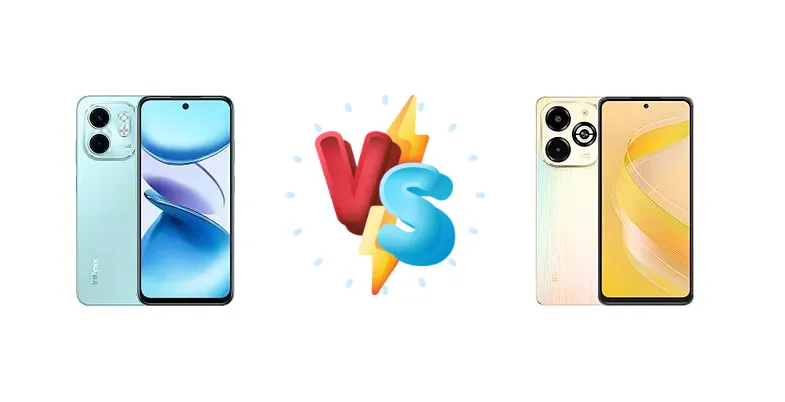
The Infinix Smart series consistently targets the ultra-budget segment, offering a blend of affordability and essential features. The Smart 9 and Smart 8 Plus represent recent iterations, but key differences in their chipsets and charging capabilities create a distinct choice for consumers. This comparison dives deep into these aspects to determine which device offers the best overall experience.
🏆 Quick Verdict
For most users, the Infinix Smart 8 Plus emerges as the better choice. While the Smart 9 boasts the more powerful Helio G81, the Smart 8 Plus’s faster 18W charging significantly improves usability, especially given both phones target users prioritizing battery life and convenience over raw performance.
| Network |
|---|
| 2G bands | GSM 850 / 900 / 1800 / 1900 | GSM 850 / 900 / 1800 / 1900 |
| 3G bands | HSDPA 850 / 900 / 1700(AWS) / 1900 / 2100 | HSDPA 850 / 900 / 1700(AWS) / 1900 / 2100 |
| 4G bands | 1, 2, 3, 4, 5, 7, 8, 12, 13, 17, 20, 25, 26, 28, 38, 41, 40, 66 | 1, 2, 3, 4, 5, 7, 8, 20, 28, 38, 41, 40 |
| Speed | HSPA, LTE | HSPA, LTE |
| Technology | GSM / HSPA / LTE | GSM / HSPA / LTE |
| Launch |
|---|
| Announced | 2024, September 23 | 2024, January 30 |
| Status | Available. Released 2024, October | Available. Released 2024, February |
| Body |
|---|
| Build | Glass front, plastic back, plastic frame | Glass front, plastic back, plastic frame |
| Dimensions | 165.7 x 77.1 x 8.4 mm (6.52 x 3.04 x 0.33 in) | 163.7 x 75.7 x 9 mm (6.44 x 2.98 x 0.35 in) |
| SIM | Nano-SIM + Nano-SIM | Nano-SIM + Nano-SIM |
| Weight | 188 g (6.63 oz) | 204 g (7.20 oz) |
| Display |
|---|
| Resolution | 720 x 1600 pixels, 20:9 ratio (~262 ppi density) | 720 x 1612 pixels, 20:9 ratio (~267 ppi density) |
| Size | 6.7 inches, 108.4 cm2 (~84.8% screen-to-body ratio) | 6.6 inches, 104.6 cm2 (~84.4% screen-to-body ratio) |
| Type | IPS LCD, 120Hz, 500 nits (peak) | IPS LCD, 90Hz, 500 nits (peak) |
| Platform |
|---|
| CPU | Octa-core (2x2.0 GHz Cortex-A75 & 6x1.7 GHz Cortex-A55) | Octa-core (4x2.2 GHz Cortex-A53 & 4x1.6 GHz Cortex-A53) |
| Chipset | Mediatek Helio G81 | Mediatek Helio G36 (12 nm) |
| GPU | Mali-G52 MC2 | PowerVR GE8320 |
| OS | Android 14 (Go edition), XOS 14 | Android 13 (Go edition), XOS 13 |
| Memory |
|---|
| Card slot | microSDXC (dedicated slot) | microSDXC (dedicated slot) |
| Internal | 64GB 3GB RAM, 64GB 4GB RAM, 128GB 3GB RAM, 128GB 4GB RAM, 128GB 6GB RAM | 64GB 4GB RAM, 128GB 4GB RAM |
| Main Camera |
|---|
| Features | LED flash, HDR, panorama | Ring-LED flash, HDR, panorama |
| Single | 13 MP, f/1.9, 27mm (wide), 1/3.07", 1.12µm, AF
Auxiliary lens | 50 MP, f/1.9, (wide), AF
Auxiliary lens |
| Video | 1080p@30fps | 1080p@30fps |
| Selfie camera |
|---|
| Single | 8 MP, f/2.0, 26mm (wide), 1/3.96", 1.12µm | 8 MP, f/2.0, (wide) |
| Video | Yes | Yes |
| Sound |
|---|
| 35mm jack | Yes | Yes |
| Loudspeaker | Yes, with stereo speakers | Yes |
| Comms |
|---|
| Bluetooth | Yes | 5.0, A2DP, LE |
| Infrared port | Yes | - |
| NFC | No | No |
| Positioning | GPS | GPS |
| Radio | FM radio | FM radio |
| USB | USB Type-C 2.0, OTG | USB Type-C 2.0, OTG |
| WLAN | Wi-Fi 802.11 a/b/g/n/ac, dual-band | Wi-Fi 802.11 a/b/g/n/ac, dual-band |
| Features |
|---|
| Sensors | Fingerprint (side-mounted), accelerometer, proximity, compass | Fingerprint (side-mounted), accelerometer, proximity, compass |
| Battery |
|---|
| Charging | 10W wired
Reverse wired | 18W wired
Reverse wired |
| Type | 5000 mAh | 6000 mAh |
| Misc |
|---|
| Colors | Metallic Black, Neo Titanium, Mint Green, Sandstone Gold | Galaxy White, Shiny Gold, Timber Black |
| Models | X6532 | X6526 |
| Price | About 70 EUR | About 100 EUR |
Infinix Smart 9
- More powerful CPU cores (Cortex-A75)
- Potentially better single-core performance
- Reverse wired charging
- Slower 10W charging
- Older chipset architecture
- Potentially less efficient power consumption
Infinix Smart 8 Plus
- Faster 18W charging
- More efficient 12nm process node
- Reverse wired charging
- Less powerful CPU cores (Cortex-A53)
- Potentially lower single-core performance
- May struggle with very demanding games
Display Comparison
Neither Infinix provides detailed display specifications beyond resolution. However, both likely utilize IPS LCD panels common in this price bracket. The focus here isn't on display quality, but rather on the overall user experience. Bezels are expected to be substantial on both, and color accuracy will likely be standard for the segment. The absence of high refresh rates or advanced features like LTPO is typical.
Camera Comparison
Detailed camera specs are unavailable, but both phones likely feature a primary camera alongside auxiliary lenses (often 2MP macro or depth sensors). Given the price point, image quality will be heavily reliant on software processing. The larger sensor (if present) will always be the determining factor. Without specific sensor size information, it’s difficult to declare a clear winner. The focus should be on daylight photography, as low-light performance will be limited on both devices. The 2MP auxiliary cameras are unlikely to provide significant value.
Performance
The core difference lies in the chipsets. The Infinix Smart 9’s Mediatek Helio G81, built on a larger process node, features a CPU configuration of 2x2.0 GHz Cortex-A75 cores and 6x1.7 GHz Cortex-A55 cores. This contrasts with the Smart 8 Plus’s Helio G36, utilizing 4x2.2 GHz Cortex-A53 cores and 4x1.6 GHz Cortex-A53 cores. While the G81’s A75 cores offer higher single-core performance, the G36’s higher clock speeds on its A53 cores provide a competitive multi-core experience. The G81’s architecture is older, but its core design is more efficient. The Smart 8 Plus’s 12nm process node is more efficient than the G81’s, potentially leading to better thermal management under sustained load. The impact will be noticeable in demanding games or multitasking.
Battery Life
Both devices support reverse wired charging, a useful feature for topping up accessories. However, the key differentiator is charging speed. The Infinix Smart 9 is limited to 10W wired charging, while the Smart 8 Plus supports 18W wired charging. This translates to a significantly faster 0-100% charge time for the Smart 8 Plus. While battery capacity isn’t specified, the faster charging speed is more impactful for users who frequently need to quickly replenish their battery. The 18W charging is a substantial advantage, especially considering the target audience likely prioritizes battery life.
Buying Guide
Buy the Infinix Smart 9 if you prioritize occasional gaming or demanding app usage and are willing to accept slower charging speeds. Its Helio G81 offers a performance edge. Buy the Infinix Smart 8 Plus if you value consistent, all-day battery life and faster charging, making it ideal for everyday tasks like social media, calls, and light web browsing. The 18W charging is a significant advantage for this use case.
Frequently Asked Questions
❓ Will the Infinix Smart 8 Plus handle popular games like PUBG Mobile?
The Helio G36 in the Smart 8 Plus can run PUBG Mobile, but likely at lower graphics settings to maintain a stable frame rate. The G81 in the Smart 9 will offer a smoother experience at higher settings, but the difference won't be dramatic. Prioritize battery life and consistent performance over maximum graphical fidelity.
❓ How long does it realistically take to fully charge the Infinix Smart 9 with the 10W charger?
With a 10W charger, a full charge from 0% on the Infinix Smart 9 will likely take around 3-4 hours, depending on usage during charging. This is a significant drawback compared to the Smart 8 Plus’s 18W charging.
❓ Is the reverse wired charging feature useful on either of these phones?
Yes, reverse wired charging is a convenient feature for topping up accessories like wireless earbuds or smartwatches. However, the charging speed will be limited, and it will drain the phone's battery relatively quickly.
❓ Which phone is better for someone who primarily uses their phone for social media and calls?
The Infinix Smart 8 Plus is the better choice for this use case. Its faster charging and efficient chipset will provide all-day battery life, and the performance is more than sufficient for social media and calls.