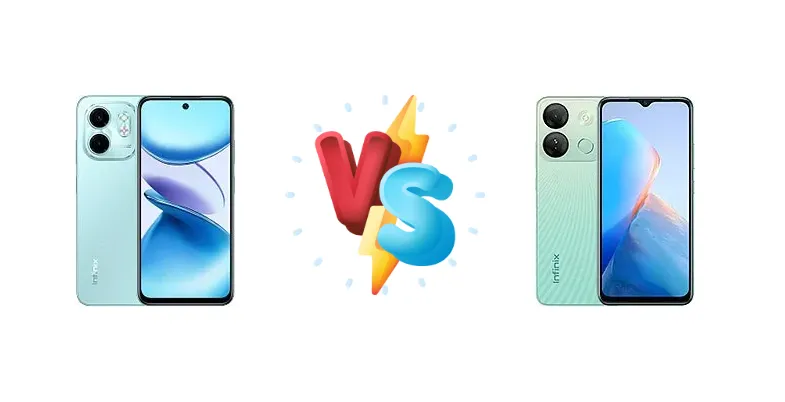
Infinix’s Smart series consistently targets the ultra-budget segment, offering a balance of features and affordability. The Smart 9 represents a recent iteration, boasting a more powerful chipset. But does the upgrade to the MediaTek Helio G81 justify the potential price difference over the older, but still relevant, Smart 7 HD? We dissect both phones to reveal which delivers the best value for your money.
🏆 Quick Verdict
For users prioritizing performance and smoother multitasking, the Infinix Smart 9 is the clear winner thanks to its Helio G81 chipset. However, if absolute affordability is the primary concern and basic smartphone functionality is sufficient, the Smart 7 HD remains a viable option, especially if found at a significantly lower price point.
| Network |
|---|
| 2G bands | GSM 850 / 900 / 1800 / 1900 | GSM 850 / 900 / 1800 / 1900 |
| 3G bands | HSDPA 850 / 900 / 1700(AWS) / 1900 / 2100 | HSDPA 850 / 900 / 2100 |
| 4G bands | 1, 2, 3, 4, 5, 7, 8, 12, 13, 17, 20, 25, 26, 28, 38, 41, 40, 66 | 1, 3, 5, 8, 38, 40, 41 |
| Speed | HSPA, LTE | HSPA, LTE |
| Technology | GSM / HSPA / LTE | GSM / HSPA / LTE |
| | - | 1, 2, 3, 4, 5, 7, 8, 20, 28, 38, 40, 41 |
| Launch |
|---|
| Announced | 2024, September 23 | 2023, April 14 |
| Status | Available. Released 2024, October | Available. Released 2023, April 14 |
| Body |
|---|
| Build | Glass front, plastic back, plastic frame | Glass front, plastic back, plastic frame |
| Dimensions | 165.7 x 77.1 x 8.4 mm (6.52 x 3.04 x 0.33 in) | 163.9 x 75.5 x 8.7 mm (6.45 x 2.97 x 0.34 in) |
| SIM | Nano-SIM + Nano-SIM | Nano-SIM + Nano-SIM |
| Weight | 188 g (6.63 oz) | 196.5 g (6.95 oz) |
| Display |
|---|
| Resolution | 720 x 1600 pixels, 20:9 ratio (~262 ppi density) | 720 x 1612 pixels, 20:9 ratio (~267 ppi density) |
| Size | 6.7 inches, 108.4 cm2 (~84.8% screen-to-body ratio) | 6.6 inches, 104.6 cm2 (~84.6% screen-to-body ratio) |
| Type | IPS LCD, 120Hz, 500 nits (peak) | IPS LCD, 500 nits |
| Platform |
|---|
| CPU | Octa-core (2x2.0 GHz Cortex-A75 & 6x1.7 GHz Cortex-A55) | Octa-core 1.6 GHz |
| Chipset | Mediatek Helio G81 | - |
| GPU | Mali-G52 MC2 | - |
| OS | Android 14 (Go edition), XOS 14 | Android 12 (Go edition) |
| Memory |
|---|
| Card slot | microSDXC (dedicated slot) | microSDXC (dedicated slot) |
| Internal | 64GB 3GB RAM, 64GB 4GB RAM, 128GB 3GB RAM, 128GB 4GB RAM, 128GB 6GB RAM | 64GB 2GB RAM |
| | - | UFS 2.1 |
| Main Camera |
|---|
| Dual | - | 8 MP, f/2.0
0.08 MP, (depth) |
| Features | LED flash, HDR, panorama | Dual-LED flash, HDR, panorama |
| Single | 13 MP, f/1.9, 27mm (wide), 1/3.07", 1.12µm, AF
Auxiliary lens | 8 MP, f/2.0
Auxiliary lens |
| Video | 1080p@30fps | 1080p@30fps |
| Selfie camera |
|---|
| Features | - | LED flash |
| Single | 8 MP, f/2.0, 26mm (wide), 1/3.96", 1.12µm | 5 MP, f/2.0 |
| Video | Yes | 720p@30fps |
| Sound |
|---|
| 3.5mm jack | - | Yes |
| 35mm jack | Yes | Yes |
| Loudspeaker | Yes, with stereo speakers | Yes |
| Comms |
|---|
| Bluetooth | Yes | 5.0, A2DP, LE |
| Infrared port | Yes | - |
| NFC | No | No |
| Positioning | GPS | GPS |
| Radio | FM radio | FM radio |
| USB | USB Type-C 2.0, OTG | microUSB 2.0, OTG |
| WLAN | Wi-Fi 802.11 a/b/g/n/ac, dual-band | Wi-Fi 802.11 b/g/n |
| Features |
|---|
| Sensors | Fingerprint (side-mounted), accelerometer, proximity, compass | Fingerprint (rear-mounted), accelerometer, proximity |
| Battery |
|---|
| Charging | 10W wired
Reverse wired | 10W wired |
| Type | 5000 mAh | 5000 mAh |
| Misc |
|---|
| Colors | Metallic Black, Neo Titanium, Mint Green, Sandstone Gold | Ink Black, Silk Blue, Jade White, Green Apple |
| Models | X6532 | X6516 |
| Price | About 70 EUR | About 110 EUR |
Infinix Smart 9
- Significantly faster processor with the Helio G81
- Improved multitasking capabilities
- Reverse wired charging for added convenience
- May be more expensive than the Smart 7 HD
- 10W charging remains slow
Infinix Smart 7 HD
- More affordable price point
- Sufficient for basic smartphone tasks
- Reliable for calls and texts
- Slower processor limits performance
- Struggles with demanding apps and multitasking
Display Comparison
Both devices lack detailed display specifications in the provided data. However, given their price point, it’s safe to assume both utilize LCD panels. The absence of information regarding resolution, refresh rate, or brightness suggests neither phone will excel in outdoor visibility or color accuracy. Bezels are likely to be substantial on both models, typical for this segment. The Smart 9 may benefit from slightly improved color calibration due to the more powerful image signal processor (ISP) within the Helio G81, but this is speculative.
Camera Comparison
Camera details are sparse for both devices. Without sensor size or aperture information, a direct comparison is difficult. However, the Helio G81 in the Smart 9 includes a more capable ISP, potentially leading to better image processing, improved dynamic range, and faster image capture. The Smart 7 HD’s camera will likely suffice for casual snapshots in good lighting conditions, but will struggle in low-light scenarios. The presence of a 2MP macro camera on either device is largely a marketing gimmick and should not be a deciding factor.
Performance
The core difference lies in the chipset. The Infinix Smart 9’s MediaTek Helio G81, with its octa-core configuration (2x2.0 GHz Cortex-A75 & 6x1.7 GHz Cortex-A55), represents a significant leap over the Smart 7 HD’s unspecified octa-core CPU clocked at 1.6 GHz. The Cortex-A75 cores in the G81 provide substantially more processing power for demanding tasks. This translates to faster app loading times, smoother multitasking, and a more responsive user experience. While both phones likely feature similar RAM configurations (unspecified), the G81’s superior CPU architecture will minimize bottlenecks. The Smart 7 HD will be adequate for basic tasks, but will struggle with resource-intensive applications.
Battery Life
Both the Infinix Smart 9 and Smart 7 HD support 10W wired charging. While the charging speed is identical, the Smart 9’s more efficient Helio G81 chipset *may* result in slightly better battery life under heavy usage. However, without knowing the battery capacity of each device, it’s impossible to definitively state which will last longer. The 10W charging speed on both phones is relatively slow, requiring several hours for a full charge. The Smart 9’s reverse wired charging capability is a unique feature, allowing it to act as a power bank for other devices, a feature absent in the Smart 7 HD.
Buying Guide
Buy the Infinix Smart 9 if you frequently use demanding apps, enjoy mobile gaming (even at moderate settings), or need a phone that can handle multitasking without significant slowdown. Buy the Infinix Smart 7 HD if you primarily use your phone for calls, texts, light social media browsing, and require a reliable device at the lowest possible cost. It’s ideal for first-time smartphone users or as a dependable backup device.
Frequently Asked Questions
❓ Will the Infinix Smart 9 handle popular games like PUBG Mobile or Call of Duty?
The Helio G81 in the Smart 9 is capable of running PUBG Mobile and Call of Duty, but likely at lower graphics settings and frame rates to maintain a playable experience. Expect some frame drops during intense action. The Smart 7 HD would struggle significantly with these titles.
❓ Does the Infinix Smart 9’s reverse charging feature work with all devices?
The reverse wired charging feature on the Smart 9 is compatible with most devices that charge via a standard Micro-USB cable. However, charging speeds will be limited to 5W, and it’s not recommended for fast-charging devices as it may not deliver sufficient power.
❓ Is the difference in CPU speed between the Smart 9 and Smart 7 HD noticeable in everyday use?
Yes, the difference is noticeable. While the Smart 7 HD is adequate for basic tasks, the Smart 9’s Helio G81 provides a smoother and more responsive experience when opening apps, browsing the web, and switching between tasks. The Smart 9 will feel significantly less sluggish.