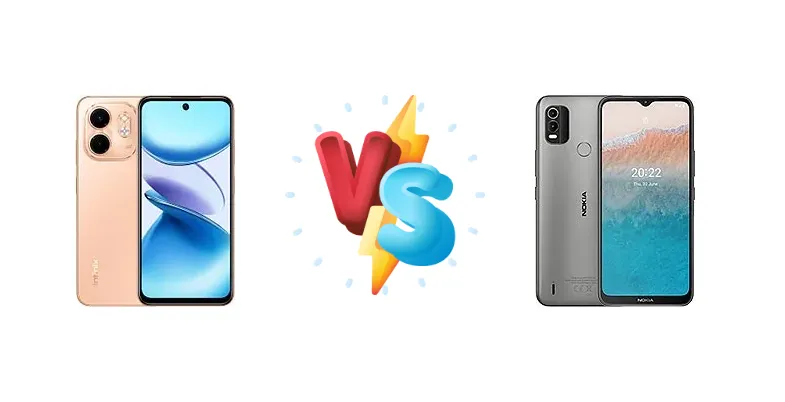
The sub-$150 smartphone market is fiercely competitive, and the Infinix Smart 9 HD and Nokia C21 Plus represent two compelling options for users prioritizing affordability. This comparison dissects their core specifications, focusing on how the chipset choices impact real-world performance and user experience, ultimately determining which device delivers the most value.
🏆 Quick Verdict
For the average user seeking a responsive experience, the Infinix Smart 9 HD is the better choice. Its Mediatek Helio chipset, with its faster 2.2 GHz Cortex-A53 cores, provides a noticeable performance advantage over the Nokia C21 Plus’s Unisoc SC9863A, despite both offering similar battery life and charging speeds.
| Network |
|---|
| 2G bands | GSM 850 / 900 / 1800 / 1900 | GSM 850 / 900 / 1800 / 1900 |
| 3G bands | HSDPA 850 / 900 / 1700(AWS) / 1900 / 2100 | HSDPA 850 / 900 / 2100 |
| 4G bands | 1, 2, 3, 4, 5, 7, 8, 12, 13, 17, 20, 25, 26, 28, 38, 41, 40, 66 | LTE |
| Speed | HSPA, LTE | HSPA 42.2/5.76 Mbps, LTE Cat4 150/50 Mbps |
| Technology | GSM / HSPA / LTE | GSM / HSPA / LTE |
| | - | HSDPA 850 / 900 / 1700(AWS) / 1900 / 2100 |
| Launch |
|---|
| Announced | 2024, November | 2022, February 28 |
| Status | Available. Released 2024, December | Available. Released 2022, April 29 |
| Body |
|---|
| Build | Glass front, plastic back, plastic frame | Glass front, aluminum frame, plastic back |
| Dimensions | 165.7 x 77.1 x 8.4 mm (6.52 x 3.04 x 0.33 in) | 164.8 x 75.9 x 8.6 mm (6.49 x 2.99 x 0.34 in) |
| SIM | Nano-SIM + Nano-SIM | · Nano-SIM· Nano-SIM + Nano-SIM |
| Weight | 188 g (6.63 oz) | 178 g or 191 g (6.28 oz) |
| | - | Splash protection |
| Display |
|---|
| Protection | - | Scratch-resistant glass |
| Resolution | 720 x 1600 pixels, 20:9 ratio (~262 ppi density) | 720 x 1600 pixels, 20:9 ratio (~269 ppi density) |
| Size | 6.7 inches, 108.4 cm2 (~84.8% screen-to-body ratio) | 6.52 inches, 102.6 cm2 (~82.1% screen-to-body ratio) |
| Type | IPS LCD, 90Hz, 500 nits (peak) | IPS LCD |
| Platform |
|---|
| CPU | Octa-core 8x2.2 GHz Cortex-A53 | Octa-core (4x1.6 GHz Cortex-A55 & 4x1.2 GHz Cortex-A55) |
| Chipset | Mediatek Helio | Unisoc SC9863A (28 nm) |
| GPU | Mali-G57 MC1 | IMG8322 |
| OS | Android 14 (Go edition), XOS 14 | Android 11 (Go edition) |
| Memory |
|---|
| Card slot | microSDXC (dedicated slot) | microSDXC (dedicated slot) |
| Internal | 64GB 3GB RAM, 64GB 4GB RAM | 32GB 2GB RAM, 32GB 3GB RAM, 64GB 2GB RAM, 64GB 3GB RAM, 64GB 4GB RAM |
| | - | eMMC 5.1 |
| Main Camera |
|---|
| Dual | - | 13 MP, (wide), AF
Auxiliary lens |
| Features | Dual-LED flash, HDR, panorama | LED flash, HDR, panorama |
| Single | 13 MP, f/1.9, 27mm (wide), AF
Auxiliary lens | 5 MP |
| Video | 1080p@30fps | 1080p@30fps |
| Selfie camera |
|---|
| Features | LED flash | LED flash |
| Single | 8 MP, f/2.0, (wide) | 5 MP |
| Video | Yes | 720p |
| Sound |
|---|
| 3.5mm jack | - | Yes |
| 35mm jack | Yes | Yes |
| Loudspeaker | Yes, with stereo speakers | Yes |
| Comms |
|---|
| Bluetooth | Yes | 4.2, A2DP |
| Infrared port | Yes | - |
| NFC | No | No |
| Positioning | GPS | GPS |
| Radio | FM radio | FM radio |
| USB | USB Type-C 2.0, OTG | microUSB 2.0 |
| WLAN | Wi-Fi 802.11 a/b/g/n/ac, dual-band | Wi-Fi 802.11 b/g/n |
| Features |
|---|
| Sensors | Fingerprint (side-mounted), accelerometer, proximity, compass | Fingerprint (rear-mounted), accelerometer, proximity |
| Battery |
|---|
| Charging | 10W wired
Reverse wired | 10W wired |
| Type | 5000 mAh | Li-Ion 4000/5050 mAh |
| Misc |
|---|
| Colors | Metallic Black, Neo Titanium, Mint Green, Coral Gold | Dark Cyan, Warm Gray |
| Models | X6532C | TA-1433, TA-1431, TA-1426, TA-1424 |
| Price | - | About 120 EUR |
| SAR | - | 0.57 W/kg (head) 0.65 W/kg (body) |
| SAR EU | - | 0.40 W/kg (head) 0.99 W/kg (body) |
Infinix Smart 9 HD
- Faster CPU for smoother performance
- Potentially more responsive user interface
- Reverse wired charging offers added convenience
- Infinix’s software can be bloated
- Camera image processing may be overly saturated
Nokia C21 Plus
- Nokia’s reputation for software reliability
- Potentially cleaner Android experience
- May offer better standby battery life
- Significantly slower CPU performance
- Struggles with multitasking and demanding apps
- Unisoc chipset may have limited software support
Display Comparison
Neither device boasts a standout display. Both likely feature basic IPS LCD panels, and detailed specs like resolution and brightness are missing. However, the focus here isn't display quality, but rather the impact of the chipsets on UI smoothness. A faster processor will translate to quicker app loading and scrolling, regardless of the panel's inherent limitations.
Camera Comparison
Both phones are likely to feature basic camera setups. Without detailed sensor information, it’s difficult to make a definitive judgment. However, given the price point, expect similar image quality – adequate for casual snapshots in good lighting conditions. The focus should be on software processing, and Nokia historically offers more natural image processing, while Infinix tends towards more saturated colors. The absence of OIS on either device means low-light performance will be limited.
Performance
The core difference lies in the chipsets. The Infinix Smart 9 HD’s Mediatek Helio, featuring an octa-core CPU clocked at 2.2 GHz, significantly outperforms the Nokia C21 Plus’s Unisoc SC9863A. The Unisoc chip utilizes a big.LITTLE architecture with a split of 4x1.6 GHz Cortex-A55 cores and 4x1.2 GHz Cortex-A55 cores. While efficient, the lower clock speeds and the older Cortex-A55 architecture mean the Nokia C21 Plus will struggle with multitasking and more demanding applications. The Helio’s Cortex-A53 cores, despite being an older generation, operate at a higher frequency, providing a tangible boost in responsiveness. The 28nm process node of the Unisoc chip also suggests it will be less power efficient under load compared to the Helio.
Battery Life
Both devices feature 10W wired charging, indicating similar charging speeds – expect around 2-3 hours for a full charge. While battery capacity isn’t specified, both likely house batteries in the 4000-5000 mAh range. The Unisoc SC9863A’s 28nm process node, while less efficient under load, may offer slightly better standby power consumption. However, the difference will be minimal, and real-world battery life will largely depend on usage patterns.
Buying Guide
Buy the Infinix Smart 9 HD if you need a phone capable of handling everyday tasks with a bit more fluidity, and appreciate a slightly more responsive user interface. Buy the Nokia C21 Plus if you prioritize brand reliability and a potentially cleaner software experience, and are willing to trade some performance for that peace of mind. Both are excellent choices for first-time smartphone users or those needing a reliable secondary device.
Frequently Asked Questions
❓ Will the Nokia C21 Plus struggle with popular social media apps like Facebook and Instagram?
The Nokia C21 Plus’s Unisoc SC9863A chipset, while capable of running these apps, may exhibit noticeable lag and slowdowns when multitasking or scrolling through image-heavy feeds. The Infinix Smart 9 HD will provide a smoother experience in these scenarios due to its faster processor.
❓ Does the Infinix Smart 9 HD support software updates and security patches?
Infinix’s software update track record is inconsistent. While they have improved in recent years, updates may be less frequent and slower to arrive compared to Nokia, which generally offers more reliable software support, particularly security patches. However, both phones are likely to receive limited long-term support.
❓ Is the 10W charging speed on either phone sufficient for daily use?
10W charging is relatively slow by modern standards. Both phones will take approximately 2-3 hours to fully charge. This is acceptable for overnight charging, but may be inconvenient if you need a quick top-up during the day. Neither phone supports fast charging technologies.