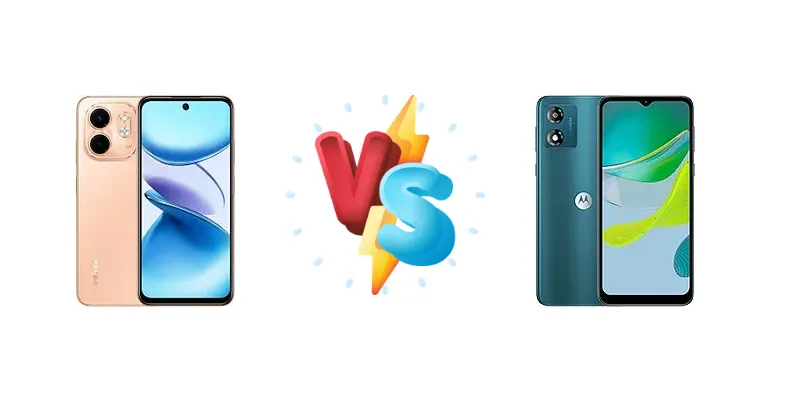
The sub-$150 smartphone market is fiercely competitive, and the Infinix Smart 9 HD and Motorola Moto E13 are two contenders vying for dominance. Both aim to deliver essential smartphone functionality at an accessible price, but they take different approaches to achieving this. This comparison dissects their key specifications to determine which device offers the best overall experience for budget-conscious consumers.
🏆 Quick Verdict
For the average user prioritizing consistent performance in everyday tasks, the Motorola Moto E13 emerges as the slightly better choice. Its Unisoc T606 chipset, with its Cortex-A75 cores, provides a noticeable edge in responsiveness compared to the Infinix Smart 9 HD’s Helio chipset, despite both featuring 10W charging.
| Network |
|---|
| 2G bands | GSM 850 / 900 / 1800 / 1900 | GSM 850 / 900 / 1800 / 1900 |
| 3G bands | HSDPA 850 / 900 / 1700(AWS) / 1900 / 2100 | HSDPA 850 / 900 / 2100 |
| 4G bands | 1, 2, 3, 4, 5, 7, 8, 12, 13, 17, 20, 25, 26, 28, 38, 41, 40, 66 | 1, 3, 5, 7, 8, 28, 38, 40, 41 |
| Speed | HSPA, LTE | HSPA, LTE |
| Technology | GSM / HSPA / LTE | GSM / HSPA / LTE |
| | - | 1, 3, 5, 7, 8, 20, 28, 38, 40, 41 |
| Launch |
|---|
| Announced | 2024, November | 2023, January 24 |
| Status | Available. Released 2024, December | Available. Released 2023, February 13 |
| Body |
|---|
| Build | Glass front, plastic back, plastic frame | Glass front, plastic frame, plastic back |
| Dimensions | 165.7 x 77.1 x 8.4 mm (6.52 x 3.04 x 0.33 in) | 164.2 x 75 x 8.5 mm (6.46 x 2.95 x 0.33 in) |
| SIM | Nano-SIM + Nano-SIM | Nano-SIM + Nano-SIM |
| Weight | 188 g (6.63 oz) | 179.5 g (6.35 oz) |
| | - | Water-resistant design |
| Display |
|---|
| Resolution | 720 x 1600 pixels, 20:9 ratio (~262 ppi density) | 720 x 1600 pixels, 20:9 ratio (~270 ppi density) |
| Size | 6.7 inches, 108.4 cm2 (~84.8% screen-to-body ratio) | 6.5 inches, 102.0 cm2 (~82.8% screen-to-body ratio) |
| Type | IPS LCD, 90Hz, 500 nits (peak) | IPS LCD |
| Platform |
|---|
| CPU | Octa-core 8x2.2 GHz Cortex-A53 | Octa-core (2x1.6 GHz Cortex-A75 & 6x1.6 GHz Cortex-A55) |
| Chipset | Mediatek Helio | Unisoc T606 (12 nm) |
| GPU | Mali-G57 MC1 | Mali-G57 MP1 |
| OS | Android 14 (Go edition), XOS 14 | Android 13 (Go edition) |
| Memory |
|---|
| Card slot | microSDXC (dedicated slot) | microSDXC (dedicated slot) |
| Internal | 64GB 3GB RAM, 64GB 4GB RAM | 32GB 2GB RAM, 64GB 2GB RAM, 64GB 4GB RAM, 128GB 8GB RAM |
| | - | eMMC 5.1 |
| Main Camera |
|---|
| Features | Dual-LED flash, HDR, panorama | LED flash, HDR, panorama |
| Single | 13 MP, f/1.9, 27mm (wide), AF
Auxiliary lens | 13 MP, f/2.2, (wide), 1.12µm, PDAF |
| Video | 1080p@30fps | 1080p@30fps |
| Selfie camera |
|---|
| Features | LED flash | - |
| Single | 8 MP, f/2.0, (wide) | 5 MP, f/2.4, (wide), 1/5.0", 1.12µm |
| Video | Yes | 1080p@30fps |
| Sound |
|---|
| 3.5mm jack | - | Yes |
| 35mm jack | Yes | Yes |
| Loudspeaker | Yes, with stereo speakers | Yes |
| Comms |
|---|
| Bluetooth | Yes | 5.0, A2DP, LE |
| Infrared port | Yes | - |
| NFC | No | No |
| Positioning | GPS | GPS, GLONASS, GALILEO |
| Radio | FM radio | FM radio, recording |
| USB | USB Type-C 2.0, OTG | USB Type-C 2.0, OTG |
| WLAN | Wi-Fi 802.11 a/b/g/n/ac, dual-band | Wi-Fi 802.11 a/b/g/n/ac, dual-band |
| Features |
|---|
| Sensors | Fingerprint (side-mounted), accelerometer, proximity, compass | Accelerometer, proximity |
| Battery |
|---|
| Charging | 10W wired
Reverse wired | 10W wired |
| Type | 5000 mAh | Li-Po 5000 mAh |
| Misc |
|---|
| Colors | Metallic Black, Neo Titanium, Mint Green, Coral Gold | Cosmic Black, Creamy White, Aurora Green |
| Models | X6532C | - |
| Price | - | $ 119.99 / € 104.99 |
Infinix Smart 9 HD
- Reverse wired charging offers added versatility.
- Potentially lower price point depending on region.
- Octa-core processor for multitasking.
- Older CPU architecture (Cortex-A53) results in lower performance.
- Likely less optimized software experience.
Motorola Moto E13
- More modern CPU architecture (Cortex-A75) for smoother performance.
- Improved power efficiency with the Unisoc T606.
- Generally cleaner software experience from Motorola.
- Lacks reverse wired charging functionality.
- 10W charging is slow.
Display Comparison
Neither device boasts a standout display. Both are likely to feature LCD panels, typical for this price bracket. Detailed display specs (resolution, brightness) are missing, but the focus here is on performance, not visual fidelity. Expect basic viewing experiences suitable for essential tasks. Bezels are likely to be substantial on both, maximizing screen real estate within a compact form factor.
Camera Comparison
Camera performance is expected to be basic on both devices. Details regarding sensor size and aperture are unavailable, but both will likely feature a primary camera accompanied by lower-resolution auxiliary lenses (often 2MP macro or depth sensors). Image processing will be crucial, and Motorola generally offers more refined software algorithms. The absence of OIS on either device means low-light photography will be challenging. Focusing on the primary sensor's megapixel count is misleading without knowing sensor size; image quality will depend more on software optimization than raw resolution.
Performance
The core difference lies in the chipsets. The Motorola Moto E13’s Unisoc T606 (12nm) utilizes a heterogeneous core configuration with 2x 1.6 GHz Cortex-A75 cores and 6x 1.6 GHz Cortex-A55 cores. This architecture provides a performance boost over the Infinix Smart 9 HD’s Mediatek Helio chipset, which features an older, homogenous octa-core Cortex-A53 setup clocked at 2.2 GHz. While the Helio has a higher clock speed, the A75 cores in the Unisoc T606 offer significantly better single-core performance, translating to snappier app launches and smoother multitasking. The 12nm process node of the Unisoc T606 also contributes to improved power efficiency compared to the likely larger node process of the Helio.
Battery Life
Both the Infinix Smart 9 HD and Motorola Moto E13 are equipped with 10W wired charging. This is a slow charging standard, meaning a full charge will take several hours. Battery capacity is not specified, but both are likely to house batteries in the 4000-5000 mAh range. The Unisoc T606’s improved power efficiency may give the Moto E13 a slight edge in battery life, offsetting any potential capacity differences. The Infinix Smart 9 HD’s inclusion of reverse wired charging is a unique feature, allowing it to act as a power bank for other devices, a benefit for users who frequently travel or rely on accessories.
Buying Guide
Buy the Infinix Smart 9 HD if you prioritize reverse wired charging for topping up accessories or other devices, and are comfortable with a potentially less fluid user experience. Buy the Motorola Moto E13 if you prefer a more responsive interface for daily tasks like browsing, social media, and light app usage, and value the slightly more modern CPU architecture.
Frequently Asked Questions
❓ Will the Motorola Moto E13 struggle with popular apps like WhatsApp and Facebook?
The Unisoc T606 chipset in the Moto E13 is capable of running these apps smoothly for most users. While it won't offer a high-end experience, the Cortex-A75 cores provide a performance boost over older chipsets, ensuring a responsive experience for everyday social media usage.
❓ Is the 10W charging on either phone fast enough for overnight charging?
Yes, 10W charging is sufficient for overnight charging. However, expect a full charge to take several hours (typically 3-5 hours). It's best to plug the phone in before going to bed to ensure it's fully charged by morning.
❓ Does the Infinix Smart 9 HD's reverse charging work with all devices?
The Infinix Smart 9 HD's reverse wired charging is compatible with most devices that charge via USB-C or Micro-USB, but the charging speed will be limited to 10W. It's ideal for topping up accessories like wireless earbuds or smartwatches, but won't rapidly charge larger devices like tablets.
❓ Which phone is better for playing casual games like Candy Crush or Subway Surfers?
The Motorola Moto E13 will likely provide a smoother gaming experience for casual games due to its more efficient processor. While neither phone is designed for demanding gaming, the Unisoc T606 will handle simpler titles with less lag and stuttering.