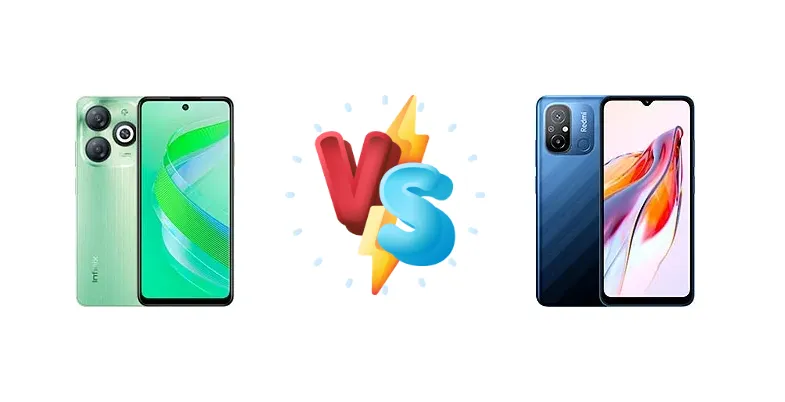
The sub-$150 smartphone market is fiercely competitive, and the Infinix Smart 8 and Xiaomi Redmi 12C are two contenders vying for dominance. Both aim to deliver essential smartphone functionality at an accessible price, but they achieve this with different approaches to chipset selection and core specifications. This comparison dissects their strengths and weaknesses to help you choose the right device for your needs.
🏆 Quick Verdict
For the average user prioritizing consistent performance and slightly better CPU capabilities, the Xiaomi Redmi 12C emerges as the stronger choice. Its Helio G85 chipset, with higher clocked Cortex-A75 cores, provides a noticeable edge in responsiveness and app loading times, despite both phones sharing the same 10W charging.
| Network |
|---|
| 2G bands | GSM 850 / 900 / 1800 / 1900 | GSM 850 / 900 / 1800 / 1900 |
| 3G bands | HSDPA 850 / 900 / 2100 | HSDPA 850 / 900 / 2100 |
| 4G bands | 1, 3, 5, 8, 38, 40, 41 | 1, 3, 5, 7, 8, 20, 28, 38, 40, 41 - International |
| Speed | HSPA, LTE | HSPA, LTE |
| Technology | GSM / HSPA / LTE | GSM / CDMA / HSPA / EVDO / LTE |
| | - | CDMA2000 1xEV-DO |
| Launch |
|---|
| Announced | 2023, November 09 | 2022, December 31 |
| Status | Available. Released 2023, November 09 | Available. Released 2023, January 01 |
| Body |
|---|
| Build | Glass front, plastic back, plastic frame | - |
| Dimensions | 163.6 x 75.6 x 8.5 mm (6.44 x 2.98 x 0.33 in) | 168.8 x 76.4 x 8.8 mm (6.65 x 3.01 x 0.35 in) |
| SIM | Nano-SIM + Nano-SIM | Nano-SIM + Nano-SIM |
| Weight | 184 g (6.49 oz) | 192 g (6.77 oz) |
| Display |
|---|
| Resolution | 720 x 1612 pixels, 20:9 ratio (~267 ppi density) | 720 x 1650 pixels (~268 ppi density) |
| Size | 6.6 inches, 104.6 cm2 (~84.6% screen-to-body ratio) | 6.71 inches, 106.5 cm2 (~82.6% screen-to-body ratio) |
| Type | IPS LCD, 90Hz, 500 nits (peak) | IPS LCD, 500 nits (typ) |
| Platform |
|---|
| CPU | Octa-core (2x1.6 GHz Cortex-A75 & 6x1.6 GHz Cortex-A55) | Octa-core (2x2.0 GHz Cortex-A75 & 6x1.8 GHz Cortex-A55) |
| Chipset | Unisoc T606 (12 nm) | Mediatek MT6769Z Helio G85 (12 nm) |
| GPU | Mali-G57 MP1 | Mali-G52 MC2 |
| OS | Android 13 | Android 12, MIUI 13 |
| Memory |
|---|
| Card slot | microSDXC (dedicated slot) | microSDXC (dedicated slot) |
| Internal | 64GB 2GB RAM, 64GB 3GB RAM, 64GB 4GB RAM, 128GB 4GB RAM | 32GB 2GB RAM, 32GB 3GB RAM, 32GB 4GB RAM, 64GB 3GB RAM, 64GB 4GB RAM, 128GB 3GB RAM, 128GB 4GB RAM, 128GB 6GB RAM |
| | - | eMMC 5.1 |
| Main Camera |
|---|
| Dual | - | 50 MP, (wide), PDAF
0.08 MP (depth) |
| Features | Ring-LED flash, HDR, panorama | LED flash, HDR |
| Single | 13 MP, f/1.9, 27mm (wide), 1/3.05", 1.12µm, AF
Auxiliary lens | 50 MP, f/1.8, (wide), 1/2.76", PDAF
Auxiliary lens |
| Video | 1080p@30fps | 1080p@30fps |
| Selfie camera |
|---|
| Single | 8 MP, f/2.0, 26mm (wide), 1/3.94", 1.12µm | 5 MP, f/2.2, (wide) |
| Video | Yes | 1080p@30fps |
| Sound |
|---|
| 3.5mm jack | - | Yes |
| 35mm jack | Yes | Yes |
| Loudspeaker | Yes | Yes |
| Comms |
|---|
| Bluetooth | 5.0, A2DP, LE | 5.1, A2DP, LE |
| NFC | No | Yes (market/region dependent) |
| Positioning | GPS | GPS, GLONASS, BDS, GALILEO |
| Radio | FM radio | FM radio |
| USB | USB Type-C 2.0, OTG | microUSB 2.0 |
| WLAN | Wi-Fi 802.11 a/b/g/n/ac, dual-band | Wi-Fi 802.11 a/b/g/n/ac, dual-band, Wi-Fi Direct |
| Features |
|---|
| Sensors | Fingerprint (side-mounted), accelerometer, proximity, compass | Fingerprint (rear-mounted), accelerometer |
| | - | Virtual proximity sensing |
| Battery |
|---|
| Charging | 10W wired
Reverse wired | 10W wired |
| Type | 5000 mAh | Li-Po 5000 mAh |
| Misc |
|---|
| Colors | Timber Black, Shiny Gold, Crystal Green, Galaxy White | Graphite Gray, Ocean Blue, Mint Green, Lavender Purple |
| Models | X6525, X6525D | 22120RN86G, 22120RN86I, 22126RN91Y, 2212ARNC4L |
| Price | About 100 EUR | £ 132.99 / € 107.41 |
| SAR | - | 1.08 W/kg (head) 0.64 W/kg (body) |
| SAR EU | - | 0.98 W/kg (head) 0.99 W/kg (body) |
Infinix Smart 8
- Potentially lower price point
- Unisoc T606 offers decent efficiency for basic tasks
- Reverse wired charging capability
- Slower CPU performance compared to the Redmi 12C
- Likely less capable GPU for gaming
- May have a lower-resolution main camera
Xiaomi Redmi 12C
- Faster CPU performance with the Helio G85
- Better GPU performance for light gaming
- Often features a 50MP main camera
- May be slightly more expensive
- 10W charging is slow
- Software experience can be heavily customized
Display Comparison
Neither device boasts a standout display. Both are likely utilizing LCD panels, common in this price bracket. Without specific brightness or resolution data, it's difficult to declare a clear winner. However, the Redmi 12C's slightly larger screen size (typically 6.71 inches vs. the Smart 8's 6.6 inches) may offer a more immersive viewing experience. Color accuracy and viewing angles are expected to be similar, leaning towards the basic side.
Camera Comparison
Both phones are expected to feature a primary camera alongside auxiliary lenses, likely including a depth sensor and potentially a macro lens. However, without specific sensor size or aperture information, a detailed comparison is challenging. The Redmi 12C often features a 50MP main sensor, which, while not exceptional, generally outperforms the lower-resolution sensors found in similarly priced Infinix devices. Image processing will likely be more aggressive on the Redmi 12C, aiming for vibrant colors, while the Smart 8 may prioritize a more natural look. The 2MP macro cameras on both devices are largely present for marketing purposes and offer limited practical utility.
Performance
The core difference lies in the chipsets. The Xiaomi Redmi 12C’s MediaTek Helio G85 features two Cortex-A75 cores clocked at 2.0 GHz, while the Infinix Smart 8 utilizes the Unisoc T606 with Cortex-A75 cores clocked at 1.6 GHz. This 0.4 GHz difference, coupled with the slightly higher clock speed of the A55 cores (1.8 GHz vs 1.6 GHz), translates to a tangible performance advantage for the Redmi 12C in CPU-intensive tasks. While both are 12nm chips, the Helio G85 generally demonstrates better GPU performance, making it more suitable for light gaming. The Smart 8's Unisoc T606 is still capable, but will exhibit more noticeable slowdowns with demanding applications.
Battery Life
Both devices are equipped with 10W wired charging, indicating similar charging speeds – expect around 2.5 to 3 hours for a full charge. Battery capacity is a critical factor, but without specific mAh ratings, we can only speculate. Typically, phones in this segment feature batteries between 5000mAh and 5200mAh. The slightly more efficient Helio G85 in the Redmi 12C *may* translate to marginally better battery life, but real-world usage will heavily depend on individual usage patterns. The shared 10W charging means neither phone offers particularly fast replenishment.
Buying Guide
Buy the Infinix Smart 8 if you prioritize a potentially lower price point and are primarily focused on basic tasks like calling, texting, and light social media use. Buy the Xiaomi Redmi 12C if you prefer a more responsive user experience, occasional gaming, and a chipset known for slightly better sustained performance under load. The Redmi 12C is the better all-rounder.
Frequently Asked Questions
❓ Will the Redmi 12C handle popular games like PUBG Mobile or Call of Duty?
The Helio G85 in the Redmi 12C can run PUBG Mobile and Call of Duty, but you'll need to lower the graphics settings to medium or low to achieve playable frame rates. Expect some occasional stuttering, especially in intense firefights. The Infinix Smart 8 will struggle more with these titles.
❓ Does the Unisoc T606 in the Infinix Smart 8 get hot during prolonged use?
The Unisoc T606 is a relatively efficient chip, so overheating isn't a major concern. However, it may experience thermal throttling during extended gaming sessions or when running multiple demanding apps simultaneously, leading to reduced performance.
❓ Is the 10W charging on either phone a significant drawback?
Yes, 10W charging is quite slow by modern standards. Expect a full charge to take over 2.5 hours. This is a compromise made to keep the price down, and it's a significant inconvenience if you frequently need to top up your battery quickly.
❓ Which phone is better for watching videos and browsing the web?
The Xiaomi Redmi 12C offers a slightly smoother experience for video playback and web browsing due to its faster processor. While both phones are adequate for these tasks, the Redmi 12C will feel more responsive when switching between apps and loading web pages.