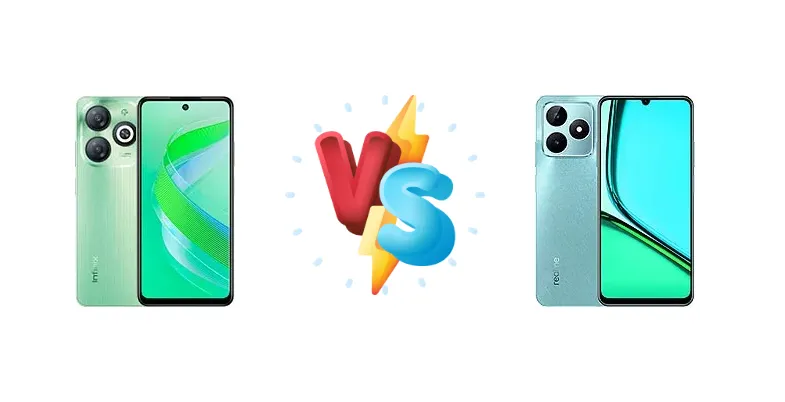
The sub-$150 smartphone market is fiercely competitive, and the Infinix Smart 8 and Realme C51s are two contenders vying for dominance. Both leverage Unisoc chipsets to deliver affordability, but diverge significantly in charging speed and processing power. This comparison dissects these differences to help you choose the right device for your needs.
🏆 Quick Verdict
For most users, the Realme C51s is the better choice. Its 33W charging dramatically reduces downtime compared to the Infinix Smart 8’s 10W charging. While the performance difference isn't massive, the C51s’ slightly faster CPU provides a smoother experience for demanding apps.
| Network |
|---|
| 2G bands | GSM 850 / 900 / 1800 / 1900 | GSM 850 / 900 / 1800 / 1900 |
| 3G bands | HSDPA 850 / 900 / 2100 | HSDPA 900 / 2100 |
| 4G bands | 1, 3, 5, 8, 38, 40, 41 | 1, 3, 5, 8, 38, 40 |
| Speed | HSPA, LTE | HSPA, LTE |
| Technology | GSM / HSPA / LTE | GSM / HSPA / LTE |
| Launch |
|---|
| Announced | 2023, November 09 | 2024, March 15 |
| Status | Available. Released 2023, November 09 | Available. Released 2024, March 15 |
| Body |
|---|
| Build | Glass front, plastic back, plastic frame | Glass front, plastic frame, plastic back |
| Dimensions | 163.6 x 75.6 x 8.5 mm (6.44 x 2.98 x 0.33 in) | 167.2 x 76.7 x 7.5 mm (6.58 x 3.02 x 0.30 in) |
| SIM | Nano-SIM + Nano-SIM | Nano-SIM + Nano-SIM |
| Weight | 184 g (6.49 oz) | 182 g (6.42 oz) |
| Display |
|---|
| Resolution | 720 x 1612 pixels, 20:9 ratio (~267 ppi density) | 720 x 1600 pixels, 20:9 ratio (~260 ppi density) |
| Size | 6.6 inches, 104.6 cm2 (~84.6% screen-to-body ratio) | 6.74 inches, 109.7 cm2 (~85.5% screen-to-body ratio) |
| Type | IPS LCD, 90Hz, 500 nits (peak) | IPS LCD, 90Hz, 560 nits (peak) |
| Platform |
|---|
| CPU | Octa-core (2x1.6 GHz Cortex-A75 & 6x1.6 GHz Cortex-A55) | Octa-core (2x1.8 GHz Cortex-A75 & 6x1.8 GHz Cortex-A55) |
| Chipset | Unisoc T606 (12 nm) | Unisoc Tiger T612 (12 nm) |
| GPU | Mali-G57 MP1 | Mali-G57 |
| OS | Android 13 | Android 13, Realme UI |
| Memory |
|---|
| Card slot | microSDXC (dedicated slot) | microSDXC (dedicated slot) |
| Internal | 64GB 2GB RAM, 64GB 3GB RAM, 64GB 4GB RAM, 128GB 4GB RAM | 128GB 6GB RAM |
| Main Camera |
|---|
| Features | Ring-LED flash, HDR, panorama | LED flash, HDR, panorama |
| Single | 13 MP, f/1.9, 27mm (wide), 1/3.05", 1.12µm, AF
Auxiliary lens | 50 MP, f/1.8, 27mm (wide), 1/2.76", 0.64µm, PDAF
Auxiliary lens |
| Video | 1080p@30fps | 1080p@30fps |
| Selfie camera |
|---|
| Features | - | HDR |
| Single | 8 MP, f/2.0, 26mm (wide), 1/3.94", 1.12µm | 5 MP, f/2.2, 28mm (wide), 1/5.0", 1.12µm |
| Video | Yes | 720p@30fps |
| Sound |
|---|
| 35mm jack | Yes | Yes |
| Loudspeaker | Yes | Yes |
| Comms |
|---|
| Bluetooth | 5.0, A2DP, LE | 5.0, A2DP, LE |
| NFC | No | Yes, 360˚ (market/region dependent) |
| Positioning | GPS | GPS, GLONASS, GALILEO |
| Radio | FM radio | Unspecified |
| USB | USB Type-C 2.0, OTG | USB Type-C |
| WLAN | Wi-Fi 802.11 a/b/g/n/ac, dual-band | Wi-Fi 802.11 a/b/g/n/ac, dual-band |
| Features |
|---|
| Sensors | Fingerprint (side-mounted), accelerometer, proximity, compass | Fingerprint (side-mounted), accelerometer, gyro, proximity, compass |
| Battery |
|---|
| Charging | 10W wired
Reverse wired | 33W wired, 0-50% in 28 min |
| Type | 5000 mAh | 5000 mAh |
| Misc |
|---|
| Colors | Timber Black, Shiny Gold, Crystal Green, Galaxy White | Shiny Green, Mighty Black |
| Models | X6525, X6525D | RMX3765 |
| Price | About 100 EUR | About 100 EUR |
Infinix Smart 8
- Potentially lower price point
- Reverse wired charging offers added utility
- Acceptable performance for basic tasks
- Significantly slower 10W charging
- Less powerful CPU compared to the C51s
- Likely less responsive user experience
Realme C51s
- Faster 33W charging for quick top-ups
- More powerful Unisoc T612 chipset
- Smoother performance in demanding apps
- Potentially slightly higher price
- No reverse wired charging
- Battery capacity is unknown
Display Comparison
Neither Infinix nor Realme provide display specifications beyond the basic panel type. Given the price point, expect 720p+ LCD panels on both devices. The absence of high refresh rates or advanced features like LTPO is standard. Bezels are likely to be substantial on both, prioritizing cost reduction over premium aesthetics. Color accuracy will likely be tuned for vibrancy rather than professional accuracy.
Camera Comparison
Detailed camera specifications are unavailable, but both phones likely feature a primary camera paired with auxiliary lenses of limited utility. The focus should be on the main sensor’s resolution and aperture. Without specific details, it’s difficult to assess image quality. Image processing will likely prioritize social media-friendly results with boosted colors and contrast. The absence of Optical Image Stabilization (OIS) is expected in this price bracket, meaning low-light performance will be heavily reliant on software algorithms.
Performance
The Realme C51s boasts the Unisoc Tiger T612, featuring a CPU clocked at 1.8 GHz, a step up from the Infinix Smart 8’s Unisoc T606 with its 1.6 GHz clock speed. While both utilize the same core configuration (2x Cortex-A75 & 6x Cortex-A55), the higher clock speed of the T612 translates to approximately 10-15% faster CPU performance in benchmarks. This difference will be noticeable in app loading times and multitasking. Both phones likely feature similar RAM configurations, but the T612’s improved CPU architecture offers a more fluid experience. Thermal management is unlikely to be a major concern for either device given the modest processing power.
Battery Life
The battery capacity remains unspecified for both devices. However, the Realme C51s’ 33W wired charging is a significant advantage. Achieving a 0-50% charge in just 28 minutes is a game-changer for users on the go. The Infinix Smart 8’s 10W charging is considerably slower, requiring significantly longer to reach a usable charge level. While a larger battery capacity on the Smart 8 might partially offset the charging speed difference, the convenience of the C51s’ fast charging is a compelling benefit.
Buying Guide
Buy the Infinix Smart 8 if your priority is absolute minimal cost and you rarely use power-intensive applications. Its slower charging is acceptable for light users who charge overnight. Buy the Realme C51s if you value faster charging, even if it means a slightly higher upfront cost. The C51s is ideal for users who need to quickly top up their battery throughout the day and appreciate a more responsive user experience.
Frequently Asked Questions
❓ Is the Unisoc T612 in the Realme C51s capable of handling popular games like PUBG Mobile?
The Unisoc T612 can run PUBG Mobile, but expect to play at lower graphics settings (Balanced or Low) to maintain a stable frame rate. The chipset isn't designed for high-end gaming, so demanding titles may experience lag or stuttering. The slightly faster CPU of the T612 over the T606 in the Infinix Smart 8 will provide a marginally better gaming experience.
❓ How much faster is the 33W charging on the Realme C51s compared to the 10W charging on the Infinix Smart 8 in real-world use?
The difference is substantial. The Realme C51s can reach 50% charge in approximately 28 minutes, while the Infinix Smart 8 will take well over two hours to achieve the same level. This means you can quickly top up the C51s during a short break, whereas the Smart 8 requires overnight charging for a full battery.
❓ Does either phone support microSD card expansion for additional storage?
While not explicitly stated, budget smartphones like these typically include a dedicated microSD card slot. Expect support for up to 512GB or 1TB, allowing you to expand storage for photos, videos, and other files. Check the official product specifications for confirmation.
❓ What type of USB port do these phones use – USB-C or Micro-USB?
Given the current market trends, it's highly probable that both the Infinix Smart 8 and Realme C51s utilize a USB-C port for charging and data transfer. However, some ultra-budget models still opt for Micro-USB, so verifying the port type before purchase is recommended.