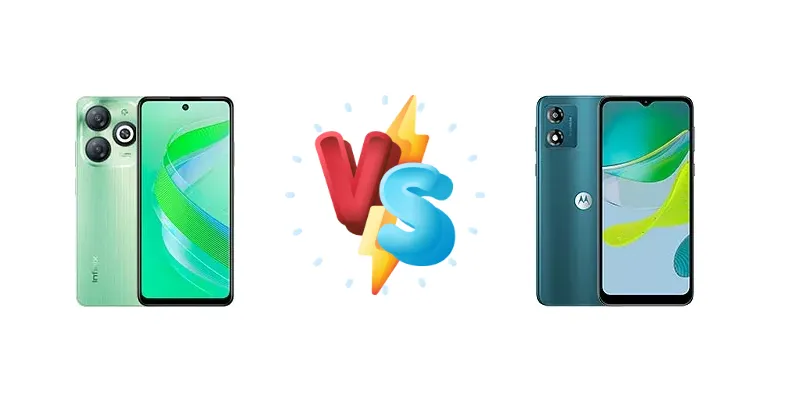
The sub-$150 smartphone market is fiercely competitive, and the Infinix Smart 8 and Motorola Moto E13 are two contenders vying for dominance. Both devices center around the Unisoc T606 chipset, making a direct hardware comparison less impactful. This review focuses on the nuances – software, potential optimizations, and subtle feature differences – to determine which phone delivers the best value for budget-conscious consumers.
🏆 Quick Verdict
For the average user prioritizing a potentially cleaner software experience and Motorola’s established brand reputation, the Moto E13 edges out the Infinix Smart 8. However, the Smart 8’s inclusion of reverse wired charging offers a unique utility not found on the Moto E13, making it a viable alternative for those needing emergency power sharing.
| Network |
|---|
| 2G bands | GSM 850 / 900 / 1800 / 1900 | GSM 850 / 900 / 1800 / 1900 |
| 3G bands | HSDPA 850 / 900 / 2100 | HSDPA 850 / 900 / 2100 |
| 4G bands | 1, 3, 5, 8, 38, 40, 41 | 1, 3, 5, 7, 8, 28, 38, 40, 41 |
| Speed | HSPA, LTE | HSPA, LTE |
| Technology | GSM / HSPA / LTE | GSM / HSPA / LTE |
| | - | 1, 3, 5, 7, 8, 20, 28, 38, 40, 41 |
| Launch |
|---|
| Announced | 2023, November 09 | 2023, January 24 |
| Status | Available. Released 2023, November 09 | Available. Released 2023, February 13 |
| Body |
|---|
| Build | Glass front, plastic back, plastic frame | Glass front, plastic frame, plastic back |
| Dimensions | 163.6 x 75.6 x 8.5 mm (6.44 x 2.98 x 0.33 in) | 164.2 x 75 x 8.5 mm (6.46 x 2.95 x 0.33 in) |
| SIM | Nano-SIM + Nano-SIM | Nano-SIM + Nano-SIM |
| Weight | 184 g (6.49 oz) | 179.5 g (6.35 oz) |
| | - | Water-resistant design |
| Display |
|---|
| Resolution | 720 x 1612 pixels, 20:9 ratio (~267 ppi density) | 720 x 1600 pixels, 20:9 ratio (~270 ppi density) |
| Size | 6.6 inches, 104.6 cm2 (~84.6% screen-to-body ratio) | 6.5 inches, 102.0 cm2 (~82.8% screen-to-body ratio) |
| Type | IPS LCD, 90Hz, 500 nits (peak) | IPS LCD |
| Platform |
|---|
| CPU | Octa-core (2x1.6 GHz Cortex-A75 & 6x1.6 GHz Cortex-A55) | Octa-core (2x1.6 GHz Cortex-A75 & 6x1.6 GHz Cortex-A55) |
| Chipset | Unisoc T606 (12 nm) | Unisoc T606 (12 nm) |
| GPU | Mali-G57 MP1 | Mali-G57 MP1 |
| OS | Android 13 | Android 13 (Go edition) |
| Memory |
|---|
| Card slot | microSDXC (dedicated slot) | microSDXC (dedicated slot) |
| Internal | 64GB 2GB RAM, 64GB 3GB RAM, 64GB 4GB RAM, 128GB 4GB RAM | 32GB 2GB RAM, 64GB 2GB RAM, 64GB 4GB RAM, 128GB 8GB RAM |
| | - | eMMC 5.1 |
| Main Camera |
|---|
| Features | Ring-LED flash, HDR, panorama | LED flash, HDR, panorama |
| Single | 13 MP, f/1.9, 27mm (wide), 1/3.05", 1.12µm, AF
Auxiliary lens | 13 MP, f/2.2, (wide), 1.12µm, PDAF |
| Video | 1080p@30fps | 1080p@30fps |
| Selfie camera |
|---|
| Single | 8 MP, f/2.0, 26mm (wide), 1/3.94", 1.12µm | 5 MP, f/2.4, (wide), 1/5.0", 1.12µm |
| Video | Yes | 1080p@30fps |
| Sound |
|---|
| 3.5mm jack | - | Yes |
| 35mm jack | Yes | Yes |
| Loudspeaker | Yes | Yes |
| Comms |
|---|
| Bluetooth | 5.0, A2DP, LE | 5.0, A2DP, LE |
| NFC | No | No |
| Positioning | GPS | GPS, GLONASS, GALILEO |
| Radio | FM radio | FM radio, recording |
| USB | USB Type-C 2.0, OTG | USB Type-C 2.0, OTG |
| WLAN | Wi-Fi 802.11 a/b/g/n/ac, dual-band | Wi-Fi 802.11 a/b/g/n/ac, dual-band |
| Features |
|---|
| Sensors | Fingerprint (side-mounted), accelerometer, proximity, compass | Accelerometer, proximity |
| Battery |
|---|
| Charging | 10W wired
Reverse wired | 10W wired |
| Type | 5000 mAh | Li-Po 5000 mAh |
| Misc |
|---|
| Colors | Timber Black, Shiny Gold, Crystal Green, Galaxy White | Cosmic Black, Creamy White, Aurora Green |
| Models | X6525, X6525D | - |
| Price | About 100 EUR | $ 119.99 / € 104.99 |
Infinix Smart 8
- Reverse wired charging for emergency power sharing.
- Potentially more vibrant image processing.
- Competitive pricing within the budget segment.
- Likely more pre-installed software (bloatware).
- Potentially less frequent software updates.
Motorola Moto E13
- Cleaner Android experience with less bloatware.
- Motorola’s reputation for timely software updates (even on budget phones).
- Generally reliable build quality.
- Lacks reverse wired charging functionality.
- Image processing may appear less vibrant to some users.
Display Comparison
Both the Infinix Smart 8 and Motorola Moto E13 likely feature similar LCD panels, given their price point. Without specific display specs like resolution or peak brightness, it’s difficult to declare a clear winner. However, Motorola generally calibrates its displays for reasonable color accuracy, which may give it a slight edge. The absence of high refresh rates (90Hz or 120Hz) is expected in this segment, focusing instead on power efficiency. Bezels are likely to be substantial on both devices, maximizing screen real estate within a budget.
Camera Comparison
Camera performance is a likely differentiator, though specifics are limited. Both phones will likely feature a primary camera and potentially a secondary depth or macro sensor. Without knowing the megapixel count or sensor size of the main cameras, it’s difficult to assess image quality. Motorola’s image processing algorithms often prioritize natural-looking photos, while Infinix tends towards more vibrant, saturated images. The inclusion of a 2MP macro camera on either device is largely a marketing tactic, offering limited practical benefit due to the low resolution and lack of optical image stabilization (OIS).
Performance
The core of both phones is the Unisoc T606 (12 nm) chipset, featuring an octa-core CPU configuration with 2x1.6 GHz Cortex-A75 and 6x1.6 GHz Cortex-A55 cores. This means performance will be nearly identical for everyday tasks like browsing, social media, and light gaming. The 12nm process node suggests moderate thermal efficiency; sustained heavy workloads may lead to throttling, but neither phone is positioned as a gaming powerhouse. RAM configurations, which are not specified, will significantly impact multitasking capabilities. The absence of LPDDR5x RAM is expected, with LPDDR4X being the more likely standard.
Battery Life
Both devices are equipped with 10W wired charging, indicating a similar charging experience. Actual 0-100% charge times will likely be around 2.5 to 3.5 hours. Battery capacity is not specified, but both phones likely house batteries in the 5000mAh range, offering all-day battery life for moderate usage. The Infinix Smart 8’s inclusion of reverse wired charging is a significant advantage, allowing it to function as a power bank for other devices, a feature absent on the Moto E13.
Buying Guide
Buy the Infinix Smart 8 if you frequently need to charge other devices on the go thanks to its reverse wired charging capability, and are comfortable with potentially more pre-installed software. Buy the Motorola Moto E13 if you prioritize a streamlined Android experience, a trusted brand known for software updates (even on budget devices), and a generally cleaner user interface out of the box.
Frequently Asked Questions
❓ Does the Unisoc T606 chipset struggle with multitasking on either the Infinix Smart 8 or Motorola Moto E13?
The Unisoc T606 is a capable chipset for basic tasks, but multitasking with numerous apps open simultaneously can lead to slowdowns, especially if the devices are equipped with limited RAM (likely 3GB or 4GB). Closing unused apps will improve performance.
❓ Is the 10W charging speed on both phones significantly slow compared to other smartphones?
Yes, 10W charging is relatively slow compared to the fast charging technologies found on higher-end smartphones. Expect a full charge to take around 2.5 to 3.5 hours. However, for overnight charging or topping up during the day, it's generally sufficient.
❓ How does the software experience differ between the Infinix Smart 8 and Motorola Moto E13?
Motorola is known for providing a near-stock Android experience with minimal bloatware, offering a cleaner and more responsive user interface. Infinix typically includes more pre-installed apps and customizations, which some users may find intrusive. Motorola also generally provides more consistent software updates, even for budget devices.
❓ Will either phone be able to run popular games like PUBG Mobile or Call of Duty Mobile smoothly?
While the Unisoc T606 can technically run these games, expect to play them at the lowest graphics settings and potentially with reduced frame rates to avoid significant lag or stuttering. These phones are not designed for demanding gaming experiences.