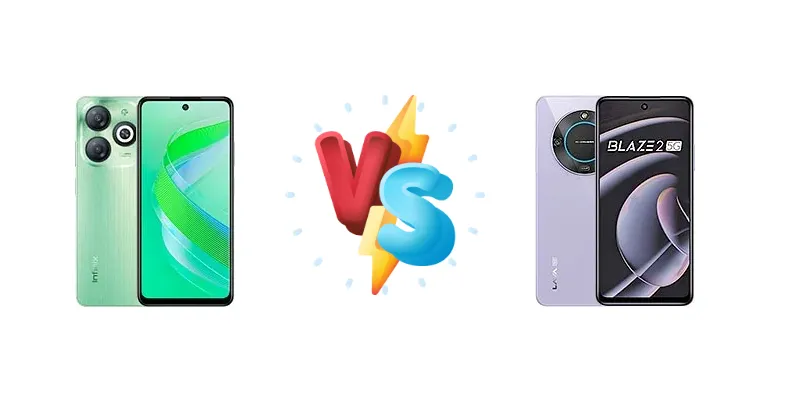
The sub-$150 5G smartphone market is heating up, with the Infinix Smart 8 and Lava Blaze 2 5G vying for dominance. Both aim to deliver 5G connectivity without breaking the bank, but they take different approaches to achieving this. The Infinix relies on a power-efficient Unisoc chipset, while the Lava opts for a more potent MediaTek Dimensity processor. This comparison will dissect their strengths and weaknesses to determine which phone offers the best value.
🏆 Quick Verdict
For most users, the Lava Blaze 2 5G emerges as the better choice. Its Mediatek Dimensity 6020, fabricated on a 7nm process, provides a noticeable performance advantage over the Infinix Smart 8’s Unisoc T606. The faster 18W charging also significantly improves the user experience, offsetting the slightly higher price.
| Network |
|---|
| 2G bands | GSM 850 / 900 / 1800 / 1900 | GSM 850 / 900 / 1800 / 1900 |
| 3G bands | HSDPA 850 / 900 / 2100 | HSDPA 900 / 2100 |
| 4G bands | 1, 3, 5, 8, 38, 40, 41 | 1, 3, 5, 8, 40, 41 |
| 5G bands | - | 1, 3, 5, 8, 28, 41, 77, 88 SA/NSA |
| Speed | HSPA, LTE | HSPA, LTE, 5G |
| Technology | GSM / HSPA / LTE | GSM / HSPA / LTE / 5G |
| Launch |
|---|
| Announced | 2023, November 09 | 2023, November 02 |
| Status | Available. Released 2023, November 09 | Available. Released 2023, November 09 |
| Body |
|---|
| Build | Glass front, plastic back, plastic frame | - |
| Dimensions | 163.6 x 75.6 x 8.5 mm (6.44 x 2.98 x 0.33 in) | 164.2 x 76 x 8.5 mm (6.46 x 2.99 x 0.33 in) |
| SIM | Nano-SIM + Nano-SIM | Nano-SIM + Nano-SIM |
| Weight | 184 g (6.49 oz) | 203 g (7.16 oz) |
| Display |
|---|
| Resolution | 720 x 1612 pixels, 20:9 ratio (~267 ppi density) | 720 x 1600 pixels, 20:9 ratio (~267 ppi density) |
| Size | 6.6 inches, 104.6 cm2 (~84.6% screen-to-body ratio) | 6.56 inches, 103.9 cm2 (~83.3% screen-to-body ratio) |
| Type | IPS LCD, 90Hz, 500 nits (peak) | IPS LCD, 90Hz |
| Platform |
|---|
| CPU | Octa-core (2x1.6 GHz Cortex-A75 & 6x1.6 GHz Cortex-A55) | Octa-core (2x2.2 GHz Cortex-A76 & 6x2.0 GHz Cortex-A55) |
| Chipset | Unisoc T606 (12 nm) | Mediatek Dimensity 6020 (7 nm) |
| GPU | Mali-G57 MP1 | Mali-G57 MC2 |
| OS | Android 13 | Android 13 |
| Memory |
|---|
| Card slot | microSDXC (dedicated slot) | microSDXC (dedicated slot) |
| Internal | 64GB 2GB RAM, 64GB 3GB RAM, 64GB 4GB RAM, 128GB 4GB RAM | 64GB 4GB RAM, 128GB 6GB RAM |
| Main Camera |
|---|
| Features | Ring-LED flash, HDR, panorama | LED flash, HDR, panorama |
| Single | 13 MP, f/1.9, 27mm (wide), 1/3.05", 1.12µm, AF
Auxiliary lens | 50 MP, (wide), AF
Auxiliary lens |
| Video | 1080p@30fps | 1440p@30fps, 1080p@30fps |
| Selfie camera |
|---|
| Single | 8 MP, f/2.0, 26mm (wide), 1/3.94", 1.12µm | 8 MP, (wide) |
| Video | Yes | Yes |
| Sound |
|---|
| 35mm jack | Yes | Yes |
| Loudspeaker | Yes | Yes |
| Comms |
|---|
| Bluetooth | 5.0, A2DP, LE | 5.0, A2DP, LE |
| NFC | No | No |
| Positioning | GPS | GPS, GLONASS |
| Radio | FM radio | FM radio |
| USB | USB Type-C 2.0, OTG | USB Type-C 2.0, OTG |
| WLAN | Wi-Fi 802.11 a/b/g/n/ac, dual-band | Wi-Fi 802.11 b/g/n/ac |
| Features |
|---|
| Sensors | Fingerprint (side-mounted), accelerometer, proximity, compass | Fingerprint (side-mounted), accelerometer, proximity, compass |
| Battery |
|---|
| Charging | 10W wired
Reverse wired | 18W wired |
| Type | 5000 mAh | Li-Po 5000 mAh |
| Misc |
|---|
| Colors | Timber Black, Shiny Gold, Crystal Green, Galaxy White | Glass Blue, Glass Black, Glass Lavender |
| Models | X6525, X6525D | - |
| Price | About 100 EUR | About 110 EUR |
Infinix Smart 8
- Potentially longer battery life due to power-efficient chipset.
- Reverse wired charging for accessory top-ups.
- Lower price point (likely).
- Slower processor performance.
- Slower charging speed.
- Less efficient chipset fabrication process (12nm).
Lava Blaze 2 5G
- Faster processor performance (Dimensity 6020).
- Faster charging speed (18W).
- More efficient chipset fabrication process (7nm).
- Potentially shorter battery life compared to Infinix.
- Slightly higher price point (likely).
- May run warmer under sustained load.
Display Comparison
Neither device boasts a standout display. Both are likely to feature LCD panels, common in this price bracket. However, details like resolution and peak brightness are missing. The focus here is on the underlying processors, as display quality is often a secondary concern for budget buyers. Bezels are expected to be relatively thick on both, and color accuracy will likely be standard for the segment.
Camera Comparison
Without detailed camera specifications, it’s difficult to make a definitive judgment. However, given the price point, both phones likely feature a primary sensor paired with auxiliary lenses of limited utility. The absence of OIS on either device suggests image stabilization will rely heavily on software processing. Image quality will likely be acceptable in good lighting conditions, but performance will degrade significantly in low light. The focus should be on the primary sensor resolution, which is currently unknown for both devices.
Performance
The core difference lies in the chipsets. The Lava Blaze 2 5G’s MediaTek Dimensity 6020 (7nm) is a clear upgrade over the Infinix Smart 8’s Unisoc T606 (12nm). The 7nm process allows for greater transistor density and improved power efficiency, translating to better sustained performance and less heat generation. The Dimensity 6020’s CPU configuration – 2x2.2 GHz Cortex-A76 & 6x2.0 GHz Cortex-A55 – also offers a performance edge over the Smart 8’s 2x1.6 GHz Cortex-A75 & 6x1.6 GHz Cortex-A55. This means faster app loading times, smoother multitasking, and a more enjoyable gaming experience on the Lava.
Battery Life
While battery capacity is not specified, the charging speeds offer a clear differentiator. The Lava Blaze 2 5G’s 18W wired charging is significantly faster than the Infinix Smart 8’s 10W charging. This translates to a much quicker top-up time, reducing downtime and improving overall usability. Even with a similar battery capacity, the faster charging speed gives the Lava a practical advantage. The Infinix’s reverse wired charging is a niche feature, useful for topping up accessories but unlikely to be a primary selling point.
Buying Guide
Buy the Infinix Smart 8 if you prioritize absolute affordability and long battery life over raw performance. It’s ideal for users who primarily use their phone for basic tasks like calling, texting, and light social media. Buy the Lava Blaze 2 5G if you want a smoother, more responsive experience, especially when multitasking or playing mobile games. The faster charging and more powerful processor make it a better choice for power users and those who demand more from their smartphone.
Frequently Asked Questions
❓ Will the Dimensity 6020 in the Lava Blaze 2 5G overheat during extended gaming sessions?
While the Dimensity 6020 is a capable processor, sustained gaming will inevitably generate heat. However, the 7nm fabrication process is more efficient than the 12nm process used in the Infinix Smart 8, meaning the Lava Blaze 2 5G is likely to manage thermal throttling more effectively, providing a more consistent gaming experience.
❓ Is the 10W charging on the Infinix Smart 8 painfully slow in real-world use?
Yes, 10W charging is relatively slow by today's standards. Expect a full charge to take well over two hours. This is a significant drawback compared to the Lava Blaze 2 5G’s 18W charging, which will significantly reduce downtime.
❓ How will the Unisoc T606 handle multitasking compared to the Dimensity 6020?
The MediaTek Dimensity 6020 is expected to handle multitasking more smoothly. Its more powerful CPU cores and improved architecture will allow for quicker switching between apps and a more responsive user experience when running multiple applications simultaneously.
❓ Are either of these phones likely to receive significant software update support?
Software update support is typically limited on phones in this price segment. While both Infinix and Lava may provide occasional security patches, major Android version updates are unlikely. Users should not expect long-term software support from either device.