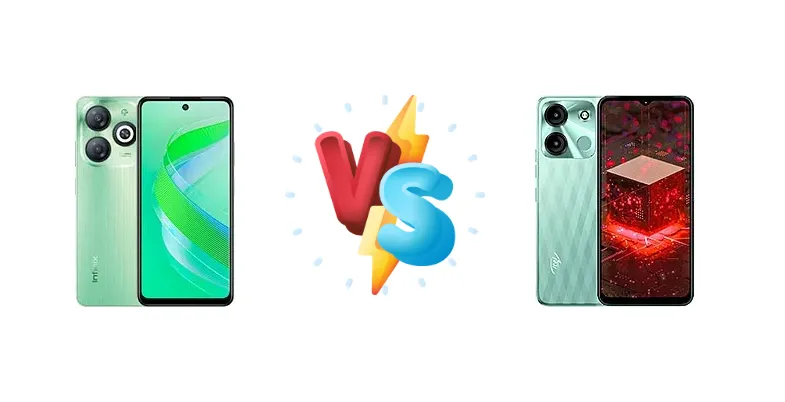
The sub-$100 smartphone market is fiercely competitive, and the Infinix Smart 8 and itel A60s are two contenders vying for dominance. Both aim to deliver essential smartphone functionality at an incredibly accessible price point, but they achieve this with different hardware choices. This comparison dissects those choices, focusing on how they impact real-world performance and user experience.
🏆 Quick Verdict
For the average user prioritizing responsiveness and future-proofing, the Infinix Smart 8 emerges as the better choice. Its Unisoc T606 chipset, built on a more efficient 12nm process, offers a noticeable performance advantage over the itel A60s’ 22nm Unisoc SC9863A1, making it smoother for everyday tasks and light multitasking.
| Network |
|---|
| 2G bands | GSM 850 / 900 / 1800 / 1900 | GSM 850 / 900 / 1800 / 1900 |
| 3G bands | HSDPA 850 / 900 / 2100 | HSDPA 850 / 900 / 2100 |
| 4G bands | 1, 3, 5, 8, 38, 40, 41 | 1, 3, 5, 8, 38, 40, 41 |
| Speed | HSPA, LTE | HSPA, LTE |
| Technology | GSM / HSPA / LTE | GSM / HSPA / LTE |
| Launch |
|---|
| Announced | 2023, November 09 | 2023 |
| Status | Available. Released 2023, November 09 | Available. Released 2023 |
| Body |
|---|
| Build | Glass front, plastic back, plastic frame | - |
| Dimensions | 163.6 x 75.6 x 8.5 mm (6.44 x 2.98 x 0.33 in) | - |
| SIM | Nano-SIM + Nano-SIM | Dual SIM |
| Weight | 184 g (6.49 oz) | - |
| Display |
|---|
| Resolution | 720 x 1612 pixels, 20:9 ratio (~267 ppi density) | 720 x 1612 pixels, 20:9 ratio (~267 ppi density) |
| Size | 6.6 inches, 104.6 cm2 (~84.6% screen-to-body ratio) | 6.6 inches, 104.6 cm2 |
| Type | IPS LCD, 90Hz, 500 nits (peak) | IPS LCD |
| Platform |
|---|
| CPU | Octa-core (2x1.6 GHz Cortex-A75 & 6x1.6 GHz Cortex-A55) | Octa-core (4x1.6 GHz Cortex-A55 & 4x1.2 GHz Cortex-A55) |
| Chipset | Unisoc T606 (12 nm) | Unisoc SC9863A1 (22 nm) |
| GPU | Mali-G57 MP1 | IMG8322 |
| OS | Android 13 | Android 12 |
| Memory |
|---|
| Card slot | microSDXC (dedicated slot) | microSDXC |
| Internal | 64GB 2GB RAM, 64GB 3GB RAM, 64GB 4GB RAM, 128GB 4GB RAM | 64GB 4GB RAM, 128GB 4GB RAM |
| Main Camera |
|---|
| Features | Ring-LED flash, HDR, panorama | LED flash |
| Single | 13 MP, f/1.9, 27mm (wide), 1/3.05", 1.12µm, AF
Auxiliary lens | 8 MP (wide)
Auxiliary lens |
| Video | 1080p@30fps | Yes |
| Selfie camera |
|---|
| Single | 8 MP, f/2.0, 26mm (wide), 1/3.94", 1.12µm | 5 MP |
| Video | Yes | Yes |
| Sound |
|---|
| 35mm jack | Yes | Yes |
| Loudspeaker | Yes | Yes |
| Comms |
|---|
| Bluetooth | 5.0, A2DP, LE | Yes |
| NFC | No | No |
| Positioning | GPS | GPS |
| Radio | FM radio | Unspecified |
| USB | USB Type-C 2.0, OTG | microUSB, OTG |
| WLAN | Wi-Fi 802.11 a/b/g/n/ac, dual-band | Yes |
| Features |
|---|
| Sensors | Fingerprint (side-mounted), accelerometer, proximity, compass | Fingerprint (rear-mounted), accelerometer, compass |
| Battery |
|---|
| Charging | 10W wired
Reverse wired | 10W wired |
| Type | 5000 mAh | 5000 mAh |
| Misc |
|---|
| Colors | Timber Black, Shiny Gold, Crystal Green, Galaxy White | Shadow Black, Glacier Green, Moonlit Violet |
| Models | X6525, X6525D | - |
| Price | About 100 EUR | About 70 EUR |
Infinix Smart 8
- More powerful Unisoc T606 chipset
- More efficient 12nm process node
- Potentially better camera image processing
- May be slightly more expensive than the itel A60s
- 10W charging is slow
itel A60s
- Extremely affordable price point
- Acceptable for basic communication tasks
- 10W charging is standard for the segment
- Less powerful Unisoc SC9863A1 chipset
- Less efficient 22nm process node
- Struggles with multitasking and demanding apps
Display Comparison
Neither Infinix nor itel provide display specifications beyond resolution. Given the price point, both likely utilize LCD panels. However, the chipset difference suggests the Smart 8 *may* be capable of driving a slightly higher refresh rate display, though this is speculative. The larger impact will be on UI responsiveness; the T606’s GPU will handle display rendering more efficiently. Bezels are expected to be substantial on both devices, reflecting their budget nature.
Camera Comparison
Both phones are likely to feature basic camera setups. Without detailed sensor information, it’s safe to assume both rely on low-resolution primary sensors. Focusing on the chipset, the T606 in the Smart 8 has a more powerful ISP (Image Signal Processor) which will result in better image processing, even with similar sensors. This translates to potentially sharper images, better dynamic range, and faster image capture. The larger processing power of the T606 will also be beneficial for any camera features like HDR or portrait mode.
Performance
The core difference lies in the chipsets. The Infinix Smart 8’s Unisoc T606 (12nm) features an octa-core configuration with 2x Cortex-A75 cores clocked at 1.6GHz and 6x Cortex-A55 cores, also at 1.6GHz. This is a significantly more capable CPU arrangement than the itel A60s’ Unisoc SC9863A1 (22nm), which uses 4x Cortex-A55 cores at 1.6GHz and 4x Cortex-A55 cores at 1.2GHz. The 12nm process node of the T606 is more efficient, leading to better thermal management and sustained performance. The A75 cores in the Smart 8 provide a substantial boost in single-core performance, crucial for app launch times and general responsiveness. The A60s’ slower, less efficient chipset will struggle with even moderate multitasking.
Battery Life
Both devices offer 10W wired charging. While the charging speed is identical, the T606’s greater power efficiency in the Infinix Smart 8 means it will likely consume less power during typical usage. This could translate to slightly longer battery life, even if the battery capacities are similar (which is unconfirmed). The 12nm process node contributes to lower power draw, extending the time between charges for the Smart 8.
Buying Guide
Buy the Infinix Smart 8 if you need a phone that feels relatively snappy for basic tasks like social media, messaging, and web browsing, and if you value a slightly more modern chipset architecture. Buy the itel A60s if your primary concern is absolute affordability and you only need a phone for the most essential functions – calls, texts, and very light app usage – and are willing to accept slower performance.
Frequently Asked Questions
❓ Will the Infinix Smart 8 handle popular social media apps like Facebook and Instagram smoothly?
Yes, the Unisoc T606 chipset in the Infinix Smart 8 is sufficiently powerful to run Facebook, Instagram, and similar apps without significant lag. The Cortex-A75 cores provide a performance boost that the itel A60s’ chipset lacks, resulting in a smoother user experience.
❓ Is the Unisoc SC9863A1 in the itel A60s capable of playing any mobile games?
The itel A60s can handle very basic 2D games, but it will struggle with most modern 3D titles. Even less demanding games may require significant compromises in graphics settings to achieve playable frame rates. The chipset’s limited processing power and GPU performance are significant bottlenecks.
❓ Does either phone support VoWiFi (WiFi Calling)?
Neither manufacturer explicitly states VoWiFi support. However, given the target market and chipset capabilities, it's unlikely either phone reliably supports VoWiFi. Carrier compatibility will be a significant factor.
❓ What version of Android do these phones run?
Both phones likely ship with Android Go Edition, a lightweight version of Android designed for devices with limited RAM and processing power. This ensures a smoother experience on these entry-level devices, but also means some features are stripped down.