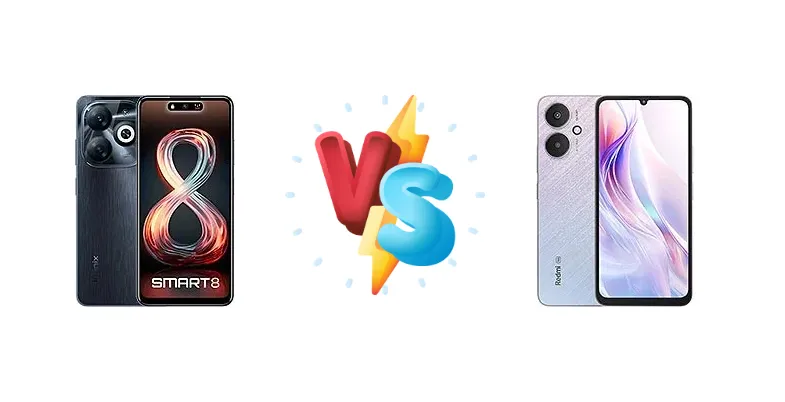
The sub-$150 (USD equivalent) 5G smartphone market is heating up, with the Infinix Smart 8 (India) and Xiaomi Redmi 13C 5G vying for dominance. Both aim to deliver 5G connectivity at an accessible price point, but they take drastically different approaches to achieving this, particularly in their core processing power and charging capabilities. This comparison dissects these differences to help you choose the right device.
🏆 Quick Verdict
For the average user prioritizing a smoother overall experience and future-proofing, the Xiaomi Redmi 13C 5G is the better choice. Its Dimensity 6100+ chipset offers a significant performance leap over the Helio G36 in the Infinix Smart 8, justifying the slight price premium and providing a more responsive user interface and better app loading times.
| Network |
|---|
| 2G bands | GSM 850 / 900 / 1800 / 1900 | GSM 850 / 900 / 1800 / 1900 |
| 3G bands | HSDPA 850 / 900 / 2100 | HSDPA 800 / 850 / 900 / 1700(AWS) / 1900 / 2100 - International |
| 4G bands | 1, 3, 5, 8, 38, 40, 41 | 1, 2, 3, 4, 5, 7, 8, 12, 13, 17, 18, 19, 20, 26, 28, 32, 38, 40, 41, 66 - International |
| 5G bands | - | 1, 3, 5, 7, 8, 20, 28, 38, 40, 41, 66, 77, 78 SA/NSA - International |
| Speed | HSPA, LTE | HSPA, LTE, 5G |
| Technology | GSM / HSPA / LTE | GSM / HSPA / LTE / 5G |
| Launch |
|---|
| Announced | 2024, January 13 | 2023, December 06 |
| Status | Available. Released 2024, January 17 | Available. Released 2023, December 16 |
| Body |
|---|
| Build | Glass front, plastic back, plastic frame | Glass front (Gorilla Glass 3), plastic frame, plastic back |
| Dimensions | 163.6 x 75.6 x 8.5 mm (6.44 x 2.98 x 0.33 in) | 168.1 x 77.9 x 8.2 mm (6.62 x 3.07 x 0.32 in) |
| SIM | Nano-SIM + Nano-SIM | Nano-SIM + Nano-SIM |
| Weight | 189 g (6.67 oz) | 192 g or 195 g (6.77 oz) |
| Display |
|---|
| Protection | - | Corning Gorilla Glass 3 |
| Resolution | 720 x 1612 pixels, 20:9 ratio (~267 ppi density) | 720 x 1600 pixels, 20:9 ratio (~260 ppi density) |
| Size | 6.6 inches, 104.6 cm2 (~84.6% screen-to-body ratio) | 6.74 inches, 109.7 cm2 (~83.8% screen-to-body ratio) |
| Type | IPS LCD, 90Hz, 500 nits (peak) | IPS LCD, 90Hz, 450 nits (typ), 600 nits (HBM) |
| Platform |
|---|
| CPU | Octa-core (4x2.2 GHz Cortex-A53 & 4x1.6 GHz Cortex-A53) | Octa-core (2x2.2 GHz Cortex-A76 & 6x2.0 GHz Cortex-A55) |
| Chipset | Mediatek Helio G36 (12 nm) | Mediatek Dimensity 6100+ (6 nm) |
| GPU | PowerVR GE8320 | Mali-G57 MC2 |
| OS | Android 13 (Go edition), XOS 13 | Android 13, MIUI 14 |
| Memory |
|---|
| Card slot | microSDXC (dedicated slot) | microSDXC (dedicated slot) |
| Internal | 64GB 4GB RAM | 64GB 4GB RAM, 128GB 4GB RAM, 128GB 6GB RAM, 256GB 8GB RAM |
| Main Camera |
|---|
| Features | Ring-LED flash, HDR, panorama | LED flash, HDR |
| Single | 50 MP, (wide), AF
Auxiliary lens | 50 MP, f/1.8, 28mm (wide), 1/2.76", 1.12µm, PDAF
Auxiliary lens |
| Video | 1080p@30fps | 1080p@30fps |
| Selfie camera |
|---|
| Features | - | HDR |
| Single | 8 MP, (wide) | 5 MP, f/2.2, (wide) |
| Video | Yes | 1080p@30fps |
| Sound |
|---|
| 35mm jack | Yes | Yes |
| Loudspeaker | Yes | Yes |
| Comms |
|---|
| Bluetooth | 5.0, A2DP, LE | 5.3, A2DP, LE |
| NFC | No | Yes (market/region dependent) |
| Positioning | GPS | GPS, GLONASS, GALILEO, BDS |
| Radio | FM radio | FM radio |
| USB | USB Type-C 2.0, OTG | USB Type-C 2.0, OTG |
| WLAN | Wi-Fi 802.11 b/g/n/ac, dual-band | Wi-Fi 802.11 a/b/g/n/ac, dual-band |
| Features |
|---|
| Sensors | Fingerprint (side-mounted), accelerometer, proximity, compass | Fingerprint (side-mounted), accelerometer, compass |
| Battery |
|---|
| Charging | 10W wired
Reverse wired | 18W wired, PD |
| Type | 5000 mAh | 5000 mAh |
| Misc |
|---|
| Colors | Rainbow Blue, Galaxy White, Shiny Gold, Timber Black | Starry Black, Twilight Blue, Starry Silver, Starlight Black, Startrail Green, Startrail Silver |
| Models | X6525B | 23124RN87G, 23124RN87I, 23124RN87C |
| Price | About 80 EUR | $ 198.99 / £ 119.00 / € 116.99 / ₹ 10,895 |
| SAR | - | 1.09 W/kg (head) 1.09 W/kg (body) |
| SAR EU | - | 0.98 W/kg (head) 0.98 W/kg (body) |
Infinix Smart 8 (India)
- Potentially lower price point
- Reverse wired charging capability
- Functional for basic smartphone tasks
- Significantly weaker processor
- Slower charging speed
- Likely to struggle with multitasking
Xiaomi Redmi 13C 5G
- More powerful and efficient processor
- Faster 18W charging with PD
- Better overall performance and responsiveness
- Potentially slightly higher price
- May not include reverse wired charging
- Camera performance likely similar to Infinix
Display Comparison
Neither device boasts a standout display. Both are likely to feature LCD panels, typical for this price bracket. However, details like peak brightness and color gamut coverage are missing. The focus here isn't on visual fidelity, but on functionality. Bezels are expected to be noticeable on both, and we anticipate 60Hz refresh rates. The lack of detailed display specs means the choice comes down to subjective preference and in-hand feel.
Camera Comparison
Camera performance is likely to be similar, leaning towards basic functionality. Both phones will likely feature a primary camera accompanied by auxiliary sensors (potentially a 2MP macro on both). Without detailed sensor size or aperture information, it’s difficult to make a definitive judgment. Image processing will likely be geared towards social media sharing, prioritizing vibrant colors over accuracy. The Redmi 13C 5G’s more powerful ISP (Image Signal Processor) within the Dimensity 6100+ may offer slightly better image quality in challenging lighting conditions, but don't expect flagship-level results from either.
Performance
The performance gap is the most significant differentiator. The Xiaomi Redmi 13C 5G’s Mediatek Dimensity 6100+ (6nm) is a substantial upgrade over the Infinix Smart 8’s Helio G36 (12nm). The Dimensity 6100+ utilizes more efficient Cortex-A76 cores alongside Cortex-A55s, resulting in a noticeable improvement in CPU performance and GPU capabilities. The 6nm process node also contributes to better thermal efficiency, meaning sustained performance will be higher on the Redmi 13C 5G. The Helio G36, while capable for basic tasks, will struggle with demanding applications and multitasking. The Redmi 13C 5G will offer a smoother experience for gaming and app switching.
Battery Life
Battery life will depend heavily on usage patterns. While the exact battery capacity isn't specified, both phones will likely feature around 5000mAh batteries. However, the Redmi 13C 5G’s 18W wired charging with PD support is a clear advantage over the Infinix Smart 8’s slower 10W charging. This translates to significantly faster charging times, reducing downtime. The more efficient Dimensity 6100+ may also contribute to slightly better battery life during moderate use.
Buying Guide
Buy the Infinix Smart 8 (India) if you need a basic, functional smartphone primarily for calls, messaging, and light social media use, and are extremely budget-constrained. Buy the Xiaomi Redmi 13C 5G if you prefer a more responsive device capable of handling multitasking, moderate gaming, and benefit from faster charging speeds and a more modern chipset architecture.
Frequently Asked Questions
❓ Will the Dimensity 6100+ in the Redmi 13C 5G overheat during prolonged gaming sessions?
The Dimensity 6100+ is built on a 6nm process, which offers improved thermal efficiency compared to the 12nm Helio G36. While it may get warm during extended gaming, it's less likely to experience significant throttling than the Infinix Smart 8, allowing for more consistent performance over longer periods.
❓ Is the 10W charging on the Infinix Smart 8 slow enough to be a major inconvenience?
Yes, 10W charging is considerably slower than the 18W charging on the Redmi 13C 5G. Expect a significantly longer time to fully charge the Infinix Smart 8, potentially taking over 3 hours for a full charge from 0%. This can be a major drawback for users who rely on quick top-ups throughout the day.
❓ Can the Redmi 13C 5G handle popular games like PUBG Mobile or Call of Duty Mobile?
The Redmi 13C 5G, with its Dimensity 6100+ chipset, should be able to run PUBG Mobile and Call of Duty Mobile at medium settings with reasonable frame rates. While it won't deliver a flagship gaming experience, it will provide a playable experience, unlike the Infinix Smart 8 which will struggle with these titles.
❓ Does the Infinix Smart 8 support VoLTE and VoWiFi for improved call quality?
Given its positioning in the Indian market, the Infinix Smart 8 is highly likely to support VoLTE (Voice over LTE) for improved call quality on 4G networks. VoWiFi (Voice over Wi-Fi) support is less certain, but increasingly common even on budget devices. Check with Infinix's official specifications for confirmation.