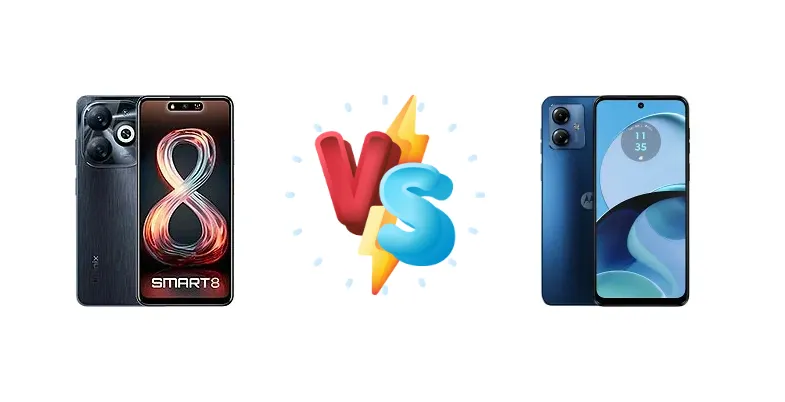
The sub-$100 smartphone market is fiercely competitive, and the Infinix Smart 8 (India) and Motorola Moto G14 are two contenders vying for dominance. Both aim to deliver essential smartphone functionality at an incredibly accessible price point, but they take different approaches to achieving this. This comparison dissects their core components to determine which offers the best overall experience.
🏆 Quick Verdict
For the average user prioritizing slightly faster charging and a more modern CPU architecture, the Motorola Moto G14 emerges as the better choice. While the Infinix Smart 8 offers reverse wired charging, the Moto G14’s Unisoc Tiger T616 provides a performance edge in everyday tasks and potentially smoother multitasking.
| Network |
|---|
| 2G bands | GSM 850 / 900 / 1800 / 1900 | GSM 850 / 900 / 1800 / 1900 |
| 3G bands | HSDPA 850 / 900 / 2100 | HSDPA 850 / 900 / 1900 / 2100 |
| 4G bands | 1, 3, 5, 8, 38, 40, 41 | 1, 2, 3, 5, 7, 8, 20, 28, 38, 40, 41 |
| Speed | HSPA, LTE | HSPA, LTE |
| Technology | GSM / HSPA / LTE | GSM / HSPA / LTE |
| Launch |
|---|
| Announced | 2024, January 13 | 2023, August 01 |
| Status | Available. Released 2024, January 17 | Available. Released 2023, August 08 |
| Body |
|---|
| Build | Glass front, plastic back, plastic frame | Glass front (Panda glass), plastic frame, plastic back |
| Dimensions | 163.6 x 75.6 x 8.5 mm (6.44 x 2.98 x 0.33 in) | 161.5 x 73.8 x 8 mm (6.36 x 2.91 x 0.31 in) |
| SIM | Nano-SIM + Nano-SIM | Nano-SIM + Nano-SIM |
| Weight | 189 g (6.67 oz) | 177 g (6.24 oz) |
| Display |
|---|
| Protection | - | Panda glass |
| Resolution | 720 x 1612 pixels, 20:9 ratio (~267 ppi density) | 1080 x 2400 pixels, 20:9 ratio (~405 ppi density) |
| Size | 6.6 inches, 104.6 cm2 (~84.6% screen-to-body ratio) | 6.5 inches, 102.0 cm2 (~85.6% screen-to-body ratio) |
| Type | IPS LCD, 90Hz, 500 nits (peak) | IPS LCD |
| Platform |
|---|
| CPU | Octa-core (4x2.2 GHz Cortex-A53 & 4x1.6 GHz Cortex-A53) | Octa-core (2x2.0 GHz Cortex-A75 & 6x1.8 GHz Cortex-A55) |
| Chipset | Mediatek Helio G36 (12 nm) | Unisoc Tiger T616 (12 nm) |
| GPU | PowerVR GE8320 | Mali-G57 MP1 |
| OS | Android 13 (Go edition), XOS 13 | Android 13, planned upgrade to Android 14 |
| Memory |
|---|
| Card slot | microSDXC (dedicated slot) | microSDXC (dedicated slot) |
| Internal | 64GB 4GB RAM | 128GB 4GB RAM, 256GB 8GB RAM |
| Main Camera |
|---|
| Dual | - | 50 MP, f/1.8, (wide), 0.64µm, PDAF
2 MP (macro) |
| Features | Ring-LED flash, HDR, panorama | LED flash, HDR, panorama |
| Single | 50 MP, (wide), AF
Auxiliary lens | - |
| Video | 1080p@30fps | 1080p@30fps |
| Selfie camera |
|---|
| Single | 8 MP, (wide) | 8 MP, f/2.0, (wide), 1/4.0", 1.12µm |
| Video | Yes | 1080p@30fps |
| Sound |
|---|
| 35mm jack | Yes | Yes |
| Loudspeaker | Yes | Yes, with stereo speakers |
| Comms |
|---|
| Bluetooth | 5.0, A2DP, LE | 5.0, A2DP, LE |
| NFC | No | Yes (market/region dependent) |
| Positioning | GPS | GPS, GLONASS, GALILEO |
| Radio | FM radio | FM radio |
| USB | USB Type-C 2.0, OTG | USB Type-C 2.0 |
| WLAN | Wi-Fi 802.11 b/g/n/ac, dual-band | Wi-Fi 802.11 a/b/g/n/ac, dual-band |
| Features |
|---|
| Sensors | Fingerprint (side-mounted), accelerometer, proximity, compass | Fingerprint (side-mounted), accelerometer, gyro, proximity, compass (market/region dependent) |
| Battery |
|---|
| Charging | 10W wired
Reverse wired | 15W wired
20W wired (India) |
| Type | 5000 mAh | Li-Po 5000 mAh |
| Misc |
|---|
| Colors | Rainbow Blue, Galaxy White, Shiny Gold, Timber Black | Steel Gray, Sky Blue, Butter Cream, Pale Lilac |
| Models | X6525B | PAYF0010IN |
| Price | About 80 EUR | $ 190.00 / £ 89.99 / € 149.90 |
Infinix Smart 8 (India)
- Reverse wired charging offers unique utility.
- Potentially lower price point.
- All-day battery life with conservative usage.
- Older CPU architecture limits performance.
- Slower 10W charging.
- Less efficient chipset.
Motorola Moto G14
- More modern and efficient Unisoc Tiger T616 chipset.
- Faster 15W/20W charging.
- Improved CPU architecture for smoother multitasking.
- Lacks reverse wired charging.
- May be slightly more expensive.
- Camera performance likely similar to the Infinix.
Display Comparison
Neither device boasts a standout display. Both likely utilize LCD panels, typical for this segment. Detailed display specs (resolution, brightness) are missing, but the focus here is on processing power. Bezels are expected to be substantial on both, maximizing screen real estate within a budget. Color accuracy will likely be standard for the price, prioritizing power efficiency over color fidelity.
Camera Comparison
Camera performance is likely to be similar, with both phones relying on budget sensors. Without specific sensor details, it’s safe to assume image quality will be adequate for social media sharing in good lighting conditions. The presence of a 2MP macro camera on both is largely a marketing tactic, offering limited practical benefit due to the low resolution and lack of optical image stabilization. Image processing will likely be the differentiating factor, with Motorola’s software potentially offering slightly more refined results.
Performance
The core difference lies in the chipsets. The Motorola Moto G14’s Unisoc Tiger T616 utilizes two Cortex-A75 cores clocked at 2.0 GHz, paired with six Cortex-A55 cores at 1.8 GHz. This architecture is demonstrably more efficient and powerful than the Infinix Smart 8’s MediaTek Helio G36, which relies on four older Cortex-A53 cores at 2.2 GHz and another four at 1.6 GHz. While the G36’s higher clock speed *sounds* better, the A75 cores in the T616 offer significantly improved single-core performance, translating to snappier app launches and smoother scrolling. The T616’s newer architecture also suggests better power efficiency. Both devices likely feature similar RAM configurations, but the chipset difference will be the primary determinant of performance.
Battery Life
Both phones are expected to offer all-day battery life with moderate usage. The Infinix Smart 8 features 10W wired charging, while the Moto G14 supports 15W (and 20W in India). This charging speed difference is significant; the Moto G14 will substantially reduce charging times, a crucial benefit for users who frequently need to top up their battery. The inclusion of reverse wired charging on the Infinix Smart 8 is a unique feature, allowing it to act as a power bank for other devices, but this comes at the cost of slower overall charging speeds.
Buying Guide
Buy the Infinix Smart 8 (India) if you frequently share power with other devices and value the convenience of reverse wired charging. This is a niche feature rarely found in this price bracket. Buy the Motorola Moto G14 if you prioritize a more responsive user experience, benefit from a newer CPU architecture, and appreciate the faster 15W (or 20W in India) charging capabilities for quicker top-ups.
Frequently Asked Questions
❓ Will the Unisoc Tiger T616 in the Moto G14 handle popular games like PUBG Mobile?
The Unisoc Tiger T616 is capable of running PUBG Mobile, but expect to play at lower graphics settings (Balanced or Low) to maintain a stable frame rate. The Helio G36 in the Infinix Smart 8 will likely struggle more with consistent performance in demanding games.
❓ How much faster is the charging on the Motorola Moto G14 compared to the Infinix Smart 8?
The Moto G14’s 15W/20W charging will significantly reduce charging times. While exact figures depend on the charger and battery level, expect the Moto G14 to charge from 0-100% roughly 30-45 minutes faster than the Infinix Smart 8’s 10W charging.
❓ Is the reverse wired charging on the Infinix Smart 8 useful in real-world scenarios?
Reverse wired charging is a niche feature, but can be incredibly convenient for charging accessories like Bluetooth headphones or a smartwatch when you don't have access to a wall outlet. However, it will drain the Infinix Smart 8’s battery considerably.
❓ Which phone is better for everyday tasks like browsing, social media, and messaging?
The Motorola Moto G14 is better suited for everyday tasks due to its more modern and efficient Unisoc Tiger T616 chipset. The improved CPU architecture will result in snappier app launches and smoother multitasking.