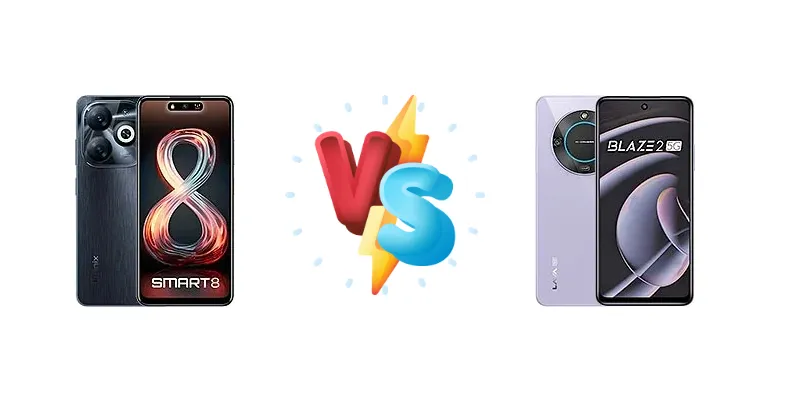
The sub-$10,000 (INR) 5G smartphone segment is heating up, and the Infinix Smart 8 and Lava Blaze 2 5G are two key players. While both aim to deliver 5G connectivity at an accessible price, they take distinctly different approaches to achieving this, primarily through their chipset choices. This comparison dissects those differences and determines which phone offers the best overall experience.
🏆 Quick Verdict
For the average user prioritizing smoother performance and future-proofing, the Lava Blaze 2 5G is the clear winner. Its Mediatek Dimensity 6020, built on a more efficient 7nm process, provides a noticeable performance uplift over the Infinix Smart 8’s Helio G36, justifying the slight price difference.
| Network |
|---|
| 2G bands | GSM 850 / 900 / 1800 / 1900 | GSM 850 / 900 / 1800 / 1900 |
| 3G bands | HSDPA 850 / 900 / 2100 | HSDPA 900 / 2100 |
| 4G bands | 1, 3, 5, 8, 38, 40, 41 | 1, 3, 5, 8, 40, 41 |
| 5G bands | - | 1, 3, 5, 8, 28, 41, 77, 88 SA/NSA |
| Speed | HSPA, LTE | HSPA, LTE, 5G |
| Technology | GSM / HSPA / LTE | GSM / HSPA / LTE / 5G |
| Launch |
|---|
| Announced | 2024, January 13 | 2023, November 02 |
| Status | Available. Released 2024, January 17 | Available. Released 2023, November 09 |
| Body |
|---|
| Build | Glass front, plastic back, plastic frame | - |
| Dimensions | 163.6 x 75.6 x 8.5 mm (6.44 x 2.98 x 0.33 in) | 164.2 x 76 x 8.5 mm (6.46 x 2.99 x 0.33 in) |
| SIM | Nano-SIM + Nano-SIM | Nano-SIM + Nano-SIM |
| Weight | 189 g (6.67 oz) | 203 g (7.16 oz) |
| Display |
|---|
| Resolution | 720 x 1612 pixels, 20:9 ratio (~267 ppi density) | 720 x 1600 pixels, 20:9 ratio (~267 ppi density) |
| Size | 6.6 inches, 104.6 cm2 (~84.6% screen-to-body ratio) | 6.56 inches, 103.9 cm2 (~83.3% screen-to-body ratio) |
| Type | IPS LCD, 90Hz, 500 nits (peak) | IPS LCD, 90Hz |
| Platform |
|---|
| CPU | Octa-core (4x2.2 GHz Cortex-A53 & 4x1.6 GHz Cortex-A53) | Octa-core (2x2.2 GHz Cortex-A76 & 6x2.0 GHz Cortex-A55) |
| Chipset | Mediatek Helio G36 (12 nm) | Mediatek Dimensity 6020 (7 nm) |
| GPU | PowerVR GE8320 | Mali-G57 MC2 |
| OS | Android 13 (Go edition), XOS 13 | Android 13 |
| Memory |
|---|
| Card slot | microSDXC (dedicated slot) | microSDXC (dedicated slot) |
| Internal | 64GB 4GB RAM | 64GB 4GB RAM, 128GB 6GB RAM |
| Main Camera |
|---|
| Features | Ring-LED flash, HDR, panorama | LED flash, HDR, panorama |
| Single | 50 MP, (wide), AF
Auxiliary lens | 50 MP, (wide), AF
Auxiliary lens |
| Video | 1080p@30fps | 1440p@30fps, 1080p@30fps |
| Selfie camera |
|---|
| Single | 8 MP, (wide) | 8 MP, (wide) |
| Video | Yes | Yes |
| Sound |
|---|
| 35mm jack | Yes | Yes |
| Loudspeaker | Yes | Yes |
| Comms |
|---|
| Bluetooth | 5.0, A2DP, LE | 5.0, A2DP, LE |
| NFC | No | No |
| Positioning | GPS | GPS, GLONASS |
| Radio | FM radio | FM radio |
| USB | USB Type-C 2.0, OTG | USB Type-C 2.0, OTG |
| WLAN | Wi-Fi 802.11 b/g/n/ac, dual-band | Wi-Fi 802.11 b/g/n/ac |
| Features |
|---|
| Sensors | Fingerprint (side-mounted), accelerometer, proximity, compass | Fingerprint (side-mounted), accelerometer, proximity, compass |
| Battery |
|---|
| Charging | 10W wired
Reverse wired | 18W wired |
| Type | 5000 mAh | Li-Po 5000 mAh |
| Misc |
|---|
| Colors | Rainbow Blue, Galaxy White, Shiny Gold, Timber Black | Glass Blue, Glass Black, Glass Lavender |
| Models | X6525B | - |
| Price | About 80 EUR | About 110 EUR |
Infinix Smart 8 (India)
- Reverse wired charging for accessory top-ups
- Potentially lower price point
- Functional for basic smartphone tasks
- Older, less efficient Helio G36 chipset
- Slower 10W charging
- Likely struggles with demanding applications
Lava Blaze 2 5G
- More powerful and efficient Dimensity 6020 chipset
- Faster 18W charging
- Improved multitasking and gaming performance
- May be slightly more expensive
- Lacks reverse wired charging
- Camera performance dependent on sensor size (unspecified)
Display Comparison
Neither Infinix nor Lava provide display specifications beyond resolution. However, given the price point, both likely utilize LCD panels. The key differentiator will be color accuracy and peak brightness, areas where neither brand historically excels. Expect similar viewing experiences in typical conditions, but neither will shine in direct sunlight. The absence of high refresh rates is standard for this segment.
Camera Comparison
Without detailed camera specs, a direct comparison is difficult. Both phones likely feature a primary camera and depth sensor, with the Infinix potentially including a macro lens. However, the image processing capabilities of the Dimensity 6020 in the Lava Blaze 2 5G may offer slightly better dynamic range and noise reduction. The sensor size is the critical factor, and without that information, it's difficult to declare a clear winner. Expect similar results in good lighting conditions, but the Lava phone may perform better in low-light scenarios due to its more powerful ISP.
Performance
The performance gap is the most significant distinction. The Lava Blaze 2 5G’s Mediatek Dimensity 6020 (7nm) boasts a more modern architecture with 2x Cortex-A76 cores clocked at 2.2 GHz, alongside 6x Cortex-A55 cores at 2.0 GHz. This contrasts with the Infinix Smart 8’s Helio G36 (12nm) which uses 4x older Cortex-A53 cores at 2.2 GHz and 4x Cortex-A53 cores at 1.6 GHz. The 7nm process of the Dimensity 6020 translates to better power efficiency and thermal management, meaning sustained performance is higher. The A76 cores in the Lava phone provide a substantial boost in single-core performance, impacting app launch times and overall responsiveness. The Helio G36 will suffice for basic tasks, but will struggle with demanding games or heavy multitasking.
Battery Life
The battery capacity is not specified for either device. However, the Lava Blaze 2 5G’s 18W charging is a significant advantage over the Infinix Smart 8’s 10W charging. While battery life will depend on usage patterns, the faster charging will reduce downtime considerably. A full charge on the Lava Blaze 2 5G will likely take around 90-120 minutes, while the Infinix Smart 8 could take upwards of 2 hours. The Infinix does offer reverse wired charging, a niche feature useful for charging accessories, but this is offset by the slower overall charging speed.
Buying Guide
Buy the Infinix Smart 8 (India) if you need a basic, functional smartphone with 5G connectivity and prioritize reverse wired charging for topping up accessories. Buy the Lava Blaze 2 5G if you prefer a more responsive user experience, better multitasking capabilities, and a chipset designed for sustained performance during gaming and demanding applications.
Frequently Asked Questions
❓ Will the Mediatek Dimensity 6020 in the Lava Blaze 2 5G overheat during prolonged gaming sessions?
The Dimensity 6020 is built on a 7nm process, which is more efficient than the 12nm Helio G36 in the Infinix Smart 8. This improved efficiency translates to better thermal management, reducing the likelihood of significant overheating during gaming. While some throttling is possible, it should be less pronounced than on the Infinix.
❓ Is the performance difference between the Helio G36 and Dimensity 6020 noticeable in everyday tasks like browsing and social media?
Yes, the difference is noticeable. The Lava Blaze 2 5G’s Dimensity 6020 has more powerful cores and a more efficient architecture, resulting in snappier app launches, smoother scrolling, and faster overall responsiveness. While the Infinix Smart 8 will handle basic tasks, the Lava phone provides a more fluid and enjoyable user experience.
❓ Does the Lava Blaze 2 5G support carrier aggregation for faster 5G speeds?
While not explicitly stated, the Dimensity 6020 typically supports carrier aggregation, which can significantly improve 5G download and upload speeds in areas with good network coverage. This is a potential advantage over the Infinix Smart 8, which may have limited 5G capabilities.
❓ How important is reverse wired charging, and is it a significant advantage of the Infinix Smart 8?
Reverse wired charging is a niche feature that allows you to use the phone as a power bank for other devices. While convenient for topping up accessories like earbuds or smartwatches, it's not a critical feature for most users. The slower 10W charging speed of the Infinix Smart 8 diminishes the usefulness of this feature.