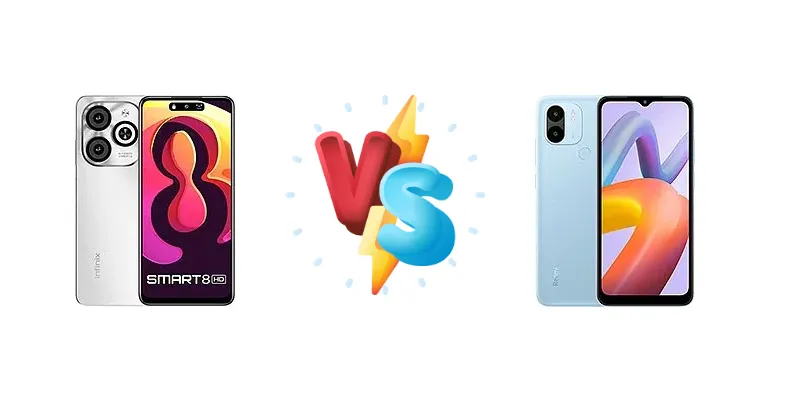
The sub-$150 smartphone market is fiercely competitive, and the Infinix Smart 8 HD and Xiaomi Redmi A2+ are two contenders vying for dominance. Both aim to deliver essential smartphone functionality at an incredibly accessible price point, but they achieve this with different approaches to chipset architecture and feature sets. This comparison dives deep into the specifics to determine which device offers the best value for your money.
🏆 Quick Verdict
For the average user prioritizing consistent performance in everyday tasks, the Infinix Smart 8 HD edges out the Redmi A2+. Its Unisoc T606 chipset, with its Cortex-A75 cores, provides a noticeable boost in responsiveness compared to the Redmi A2+'s older Cortex-A53 cores, making it a smoother experience for multitasking and app loading.
| Network |
|---|
| 2G bands | GSM 850 / 900 / 1800 / 1900 | GSM 850 / 900 / 1800 / 1900 |
| 3G bands | HSDPA 850 / 900 / 2100 | HSDPA 850 / 900 / 2100 |
| 4G bands | 1, 3, 5, 8, 38, 40, 41 | 1, 3, 5, 7, 8, 20, 28, 38, 40, 41 - International |
| Speed | HSPA, LTE | HSPA, LTE |
| Technology | GSM / HSPA / LTE | GSM / HSPA / LTE |
| | - | 1, 3, 5, 8, 40, 41 - India |
| Launch |
|---|
| Announced | 2023, December 08 | 2023, March 24 |
| Status | Available. Released 2023, December 13 | Available. Released 2023, March 24 |
| Body |
|---|
| Build | Glass front, plastic back, plastic frame | - |
| Dimensions | 163.6 x 75.6 x 8.5 mm (6.44 x 2.98 x 0.33 in) | 164.9 x 76.8 x 9.1 mm (6.49 x 3.02 x 0.36 in) |
| SIM | Nano-SIM + Nano-SIM | Nano-SIM + Nano-SIM |
| Weight | 184 g (6.49 oz) | 192 g (6.77 oz) |
| Display |
|---|
| Resolution | 720 x 1612 pixels, 20:9 ratio (~267 ppi density) | 720 x 1600 pixels, 20:9 ratio (~269 ppi density) |
| Size | 6.6 inches, 104.6 cm2 (~84.6% screen-to-body ratio) | 6.52 inches, 102.6 cm2 (~81.0% screen-to-body ratio) |
| Type | IPS LCD, 90Hz, 500 nits (peak) | IPS LCD, 400 nits (typ) |
| Platform |
|---|
| CPU | Octa-core (2x1.6 GHz Cortex-A75 & 6x1.6 GHz Cortex-A55) | Octa-core (4x2.2 GHz Cortex-A53 & 4x1.7 GHz Cortex-A53) |
| Chipset | Unisoc T606 (12 nm) | Mediatek Helio G36 (12 nm) |
| GPU | Mali-G57 MP1 | PowerVR GE8320 |
| OS | Android 13, XOS 13 | Android 12 or 13 (Go edition), MIUI |
| Memory |
|---|
| Card slot | microSDXC (dedicated slot) | microSDXC (dedicated slot) |
| Internal | 64GB 3GB RAM, 64GB 4GB RAM | 32GB 2GB RAM, 32GB 3GB RAM, 64GB 3GB RAM, 64GB 4GB RAM, 128GB 4GB RAM |
| | - | eMMC 5.1 |
| Main Camera |
|---|
| Dual | - | 8 MP, f/2.0, (wide)
0.08 MP (depth) |
| Features | Ring-LED flash, HDR, panorama | Dual-LED flash, HDR |
| Single | 13 MP, f/1.8, 27mm (wide), AF
Auxiliary lens | 8 MP, f/2.0, (wide)
Auxiliary lens |
| Video | 1080p@30fps | 1080p@30fps |
| Selfie camera |
|---|
| Single | 8 MP, f/2.0, (wide) | 5 MP, f/2.2 |
| Video | Yes | 1080p@30fps |
| Sound |
|---|
| 3.5mm jack | - | Yes |
| 35mm jack | Yes | Yes |
| Loudspeaker | Yes | Yes |
| Comms |
|---|
| Bluetooth | 5.0, A2DP, LE | 5.0, A2DP, LE |
| NFC | No | No |
| Positioning | GPS | GPS, GLONASS, GALILEO, BDS |
| Radio | FM radio | FM radio |
| USB | USB Type-C 2.0, OTG | microUSB 2.0 |
| WLAN | Wi-Fi 802.11 a/b/g/n/ac, dual-band | Wi-Fi 802.11 a/b/g/n |
| Features |
|---|
| Sensors | Fingerprint (side-mounted), accelerometer, proximity, compass | Fingerprint (rear-mounted), accelerometer |
| Battery |
|---|
| Charging | 10W wired
Reverse wired | 10W wired |
| Type | 5000 mAh | Li-Po 5000 mAh |
| Misc |
|---|
| Colors | Timber Black, Shiny Gold, Crystal Green, Galaxy White | Aqua Blue, Classic Black, Sea Green |
| Models | X6525 | 23028RNCAG, 23028RN4DI, 23028RNCAI, 23028RN4DH |
| Price | About 70 EUR | About 100 EUR |
| SAR | - | 1.10 W/kg (head) 1.01 W/kg (body) |
| SAR EU | - | 0.71 W/kg (head) 1.00 W/kg (body) |
Infinix Smart 8 HD
- More responsive processor with Cortex-A75 cores
- Reverse wired charging capability
- Potentially slightly better battery life due to processor efficiency
- Brand recognition is lower than Xiaomi
- May lack a fingerprint sensor
Xiaomi Redmi A2+
- Established brand reputation with Xiaomi
- Potentially wider software support and updates
- May include a fingerprint sensor
- Less powerful processor with older Cortex-A53 cores
- Slower app loading and multitasking
Display Comparison
Neither device boasts a standout display. Both are likely utilizing LCD panels, typical for this price bracket. Detailed specs like resolution and peak brightness are missing, but we can assume they are similar – around 720p+ and modest brightness levels. The focus here isn't on visual fidelity, but on basic usability. Bezels are likely to be substantial on both, maximizing screen real estate within a compact form factor.
Camera Comparison
Camera performance on both devices will be basic. Details on sensor size and aperture are unavailable, but given the price point, expect 8MP or 13MP main sensors. Image processing will be heavily reliant on software algorithms to compensate for the limitations of the hardware. The Redmi A2+ often includes a fingerprint sensor, which the Smart 8 HD may lack. Any claims of advanced features like night mode should be viewed with skepticism. The 2MP macro cameras often found on these devices are largely marketing fluff and offer minimal practical benefit.
Performance
This is where the key difference lies. The Infinix Smart 8 HD’s Unisoc T606 features two Cortex-A75 cores clocked at 1.6 GHz alongside six Cortex-A55 cores. This architecture provides a significant advantage over the Redmi A2+'s MediaTek Helio G36, which utilizes four Cortex-A53 cores clocked at 2.2 GHz and another four at 1.7 GHz. While the Helio G36's higher clock speed *appears* better, the A75 cores in the T606 offer superior single-core performance, translating to snappier app launches and smoother multitasking. The T606’s 12nm process node is comparable to the Helio G36’s, meaning thermal efficiency will be similar. Both phones will struggle with demanding games, but the Infinix will likely handle them slightly better.
Battery Life
Both phones feature 10W wired charging, indicating similar charging speeds – expect around 2-3 hours for a full charge. Battery capacity is not specified, but both likely house around 5000mAh batteries, sufficient for a full day of light to moderate use. The efficiency of the Unisoc T606 might give the Infinix Smart 8 HD a slight edge in battery life, but the difference will likely be marginal. The inclusion of reverse wired charging on the Infinix Smart 8 HD is a niche feature that could be useful for topping up accessories.
Buying Guide
Buy the Infinix Smart 8 HD if you need a phone that feels more responsive for daily use, even with multiple apps open. Its processor architecture is better suited for handling common tasks. Buy the Xiaomi Redmi A2+ if you prioritize a slightly more established brand reputation and potentially wider software support, and your usage is primarily limited to basic communication and light web browsing.
Frequently Asked Questions
❓ Will the Infinix Smart 8 HD struggle with popular social media apps like Facebook and Instagram?
While the Unisoc T606 is a budget chipset, it's generally capable of running social media apps smoothly. However, expect some loading times and occasional stuttering if you have many apps open simultaneously. The Cortex-A75 cores provide a performance boost over older chipsets, making the experience more tolerable than on the Redmi A2+.
❓ Is the MediaTek Helio G36 in the Redmi A2+ sufficient for playing basic mobile games like Candy Crush or Subway Surfers?
Yes, the Helio G36 can handle less demanding games like Candy Crush and Subway Surfers without significant issues. However, don't expect a high frame rate or detailed graphics. More graphically intensive games will likely be unplayable or suffer from severe lag. The Infinix Smart 8 HD might offer a slightly better gaming experience due to its more powerful processor.
❓ Does either phone support fast charging, and how long does it take to fully charge?
Neither phone supports fast charging. Both are limited to 10W wired charging, which means a full charge will take approximately 2-3 hours. This is typical for phones in this price range.
❓ What version of Android do these phones run, and will they receive software updates?
Both phones likely ship with Android Go Edition, a lightweight version of Android designed for devices with limited resources. Software update support is often limited on budget phones. Xiaomi generally provides slightly better software support than Infinix, but don't expect major Android version upgrades.